Artificial Intelligence Weekly: Key News and How to Follow
The inference cost for a system performing at roughly GPT-3.5 level fell more than 280-fold between November 2022 and October 2024, according to Stanford's AI Index 2025. No launch post sounds as loud as a new model name, yet that single number explains more about your working week than most of them do. Capability that was expensive became cheap, and cheap capability spreads into tools people already own.
So treat a weekly artificial intelligence digest as a stack of claims rather than a list of gifts. Some claims are about capability, some about price, some about what the law allows, and each one can be checked against a baseline, a cost, and a primary source. Read them that way and the loudest item in the feed stops being the one you act on.
The method here is deliberately ordinary. Name the kind of story you're reading, compare it with how organizations use AI, test the claim against evidence, and keep the handful of changes that touch your own work. You don't need to understand transformers to do any of it.
The Five Kinds of AI News Worth Tracking
A weekly feed mixes five kinds of story, and they arrive in identical packaging: a headline, a screenshot, a link. Treating them as one stream is how a reader ends up excited about a demo they can't access and indifferent to a rule that changes what they can sell.
| Category | What it covers | Why it matters | Typical source |
|---|---|---|---|
| Model and product releases | New models, features and tool updates | Changes what you can make this week | Company blogs and release notes |
| Research and benchmarks | Papers and test results | Shows whether capability claims hold | Research papers and evaluation reports |
| Funding and deals | Investment rounds, acquisitions, partnerships | Signals where the market and tools are heading | Financial press and company announcements |
| Policy and regulation | Government reports, rules and standards | Defines what you may legally do | Government and standards bodies |
| Adoption and incidents | Usage surveys, failures and misuse reports | Shows real use and real risk | Surveys, agency reports and news investigations |
The last row is the one readers skip, and it's the one that tells you whether anything else is real. Surveys reviewed by the Federal Reserve found that between 20% and 40% of workers reported using artificial intelligence in the workplace, based on studies published through 2024. A range that wide isn't a failure. It's what happens when different groups get asked different questions, which is exactly why a single adoption percentage in a headline needs its survey attached.
Scope changes the story even when the story type stays the same. Documented AI use cases across 11 U.S. federal agencies increased from 571 in 2023 to 1,110 in 2024, as Nextgov reported on the GAO findings.
A support-bot launch splits the categories cleanly. The announcement is a product release. The deployment is an adoption story with incident risk attached, and the only useful question is which one you're reading. Our roundup of the best customer service chatbots works on the second question: what happens when the thing answers real customers at 2am.
Sort first, judge second. A story's category tells you what evidence would settle it, and a launch announcement almost never carries that evidence.
Rank stories by which category touches your work, not by how loud the announcement is. A funding round can be enormous and change nothing you do on Monday.
Why 2024 Sets the Baseline for AI News
One product launch is a weather report. Adoption rates are the climate. Without a climate record, every weekly headline looks equally important, because you have nothing to measure it against.
Here's the climate record you can carry in your head.
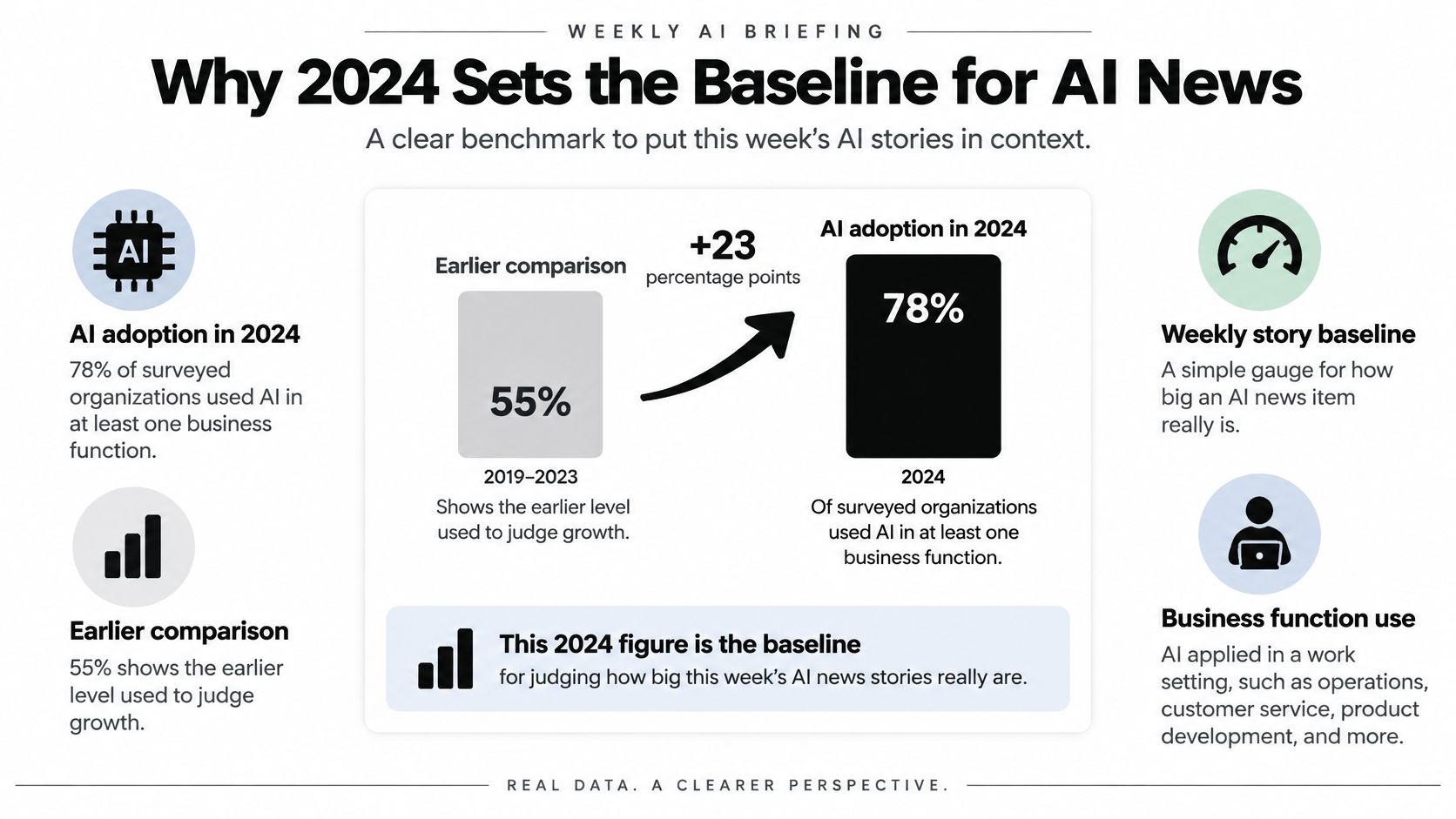
The Stanford AI Index economy chapter reported that 78% of surveyed organizations used AI in at least one business function in 2024, up from 55% in 2023. Generative AI moved faster still, with use in at least one function more than doubling from 33% to 71%. That spread reached marketing, sales, service operations, supply-chain management and software engineering, and the tools increasingly came from companies rather than labs. Nearly 90% of notable AI models released in 2024 originated from industry, compared with 60% in 2023, per the same index's research and development chapter.
What the gains actually look like
Adoption is not the same as payoff, and the payoff numbers are the corrective most roundups skip. Among organizations using AI, 49% reported cost savings in service operations, 43% in supply-chain management and 41% in software engineering, but most reported savings below 10%. In marketing and sales, 71% of AI-using respondents reported some revenue increase, and the most common increase was below 5%.
Read that carefully. The typical outcome is a modest, function-specific improvement, not a transformation. So when a launch post promises a step change, ask three questions before you believe it:
- Which function? A gain in software engineering tells you nothing about client invoicing or video production.
- How large? A 3% revenue lift is real and also not a reason to rebuild your business this quarter.
- Measured how? Self-reported improvements, before-and-after comparisons and vendor case studies are different kinds of evidence.
The baseline test: if a story can't be placed against a function, a size and a measurement, it's a preview, not a result.
Telling Real AI Progress From Launch Hype
A demo is a performance. It runs on prepared inputs, in front of an audience, with no adversarial users and no deadline. That's not dishonesty, it's theater, and theater is a poor predictor of what happens when your clients type something strange on a Friday.
NIST's GenAI evaluation program offers a better model for how to think about it. Its 2026 text evaluation plan separates performance into three roles: a Generator that produces content, a Prompter that elicits useful output through prompt engineering, and a Discriminator that detects or judges generated content. The planned challenge uses 50 topics and 100 narratives split into development and test sets.
Why does that structure matter to a creator? Because a system can write fluent copy and still collapse under an awkward brief, or produce material that neither you nor your client can reliably distinguish from a human draft. One average score hides both failures. Test the pipeline you run, not the headline number.
The claims worth challenging
| Claim you see | Question to ask | Evidence that settles it |
|---|---|---|
| Model beats rivals | Which tests, on which tasks, and who ran them? | Published evaluation with method, or an independent benchmark |
| Faster or cheaper | Compared with what baseline? | Measured results with the baseline and workload stated |
| Accurate or safe | How often does it fail, and on which inputs? | Error rates, test results or documented incident reports |
| Available now | Can a reader use it today, and where? | Public access page, pricing or availability statement from the publisher |
| Saves creators time | How much review and correction time does it add? | Documented workflow with time measured before and after |
The trust side deserves the same scrutiny. A 2026 multi-year academic survey reported in the ACM Digital Library recorded 2025 concern scores of 5.90 for misinformation or bias, 5.14 for copyright and intellectual property, and 4.93 for environmental cost. The same work reported 362 documented AI incidents in 2025, up from 233 in 2024. Reliability problems aren't hypothetical edge cases, so a story that mentions none is incomplete rather than reassuring.
For the longer trend lines behind these launches, generative AI trends on Statlyst gathers adoption and investment figures in one place, which makes it easier to see whether this week's announcement fits a pattern or breaks one.
A claim you can't trace to a stated method, a published test or a named user is unverified. File it and wait. Acting on it is a separate decision.
Where the Best Weekly AI Coverage Comes From
Every source type is excellent at one thing and weak at another, so the goal isn't the biggest reading list. It's one dependable source per category, plus discipline about what each one can prove.
| Source type | Strength | Limitation | Best use |
|---|---|---|---|
| Company blogs and release notes | First and most precise on features and dates | Written to persuade; omits weaknesses | Confirming what a tool does and when it ships |
| Research papers and evaluation reports | Methods, data and test results | Slow to publish and technical | Checking capability and accuracy claims |
| Government and standards bodies | Authoritative on rules and evaluation frameworks | Publish irregularly | Understanding what you may legally do |
| Independent newsletters and roundups | Curation, context and breadth | May repeat launch news | Finding stories to check, not final proof |
Practically, that means reading a release note for the date and the feature list, then opening the paper or the evaluation when the post makes a capability claim. Our own Scout tool is an automated publisher for Creators Toolbox, and it shares product announcements with links to the original sources, which is the minimum standard you should expect from anyone summarizing a launch.
The same rule applies to the tool categories you're shopping in. If you're weighing a cinematic AI video generator for a client project, the announcement tells you what was shipped, while a test on your own footage tells you whether it holds up under motion, faces and brand colors.
When a release changes how you research and validate what you sell, our guide to product discovery services covers the workflow side rather than the feature list.
One per category. Pick a release page, a research feed and a standards page you trust, add a single curated roundup for breadth, and drop anything that produced nothing you used in a month.
What Responsible AI Use Looks Like for Creators
Governance sounds like a topic for legal teams. In a one-person studio it shows up as four small decisions made under deadline, usually without anyone watching.
The worry is widespread enough to take seriously. The OECD reports that 54% of small and medium-sized enterprises using or considering generative AI are concerned about copyright, legal or regulatory issues and the handling of information submitted to models, and that the most common reason for not using generative AI, cited by 57% of SMEs, is that it isn't suited to the firm's work, according to the OECD's report on generative AI and the SME workforce. Non-adoption is often a rational choice, not a lag.
So make the four decisions explicitly:
- What may be uploaded. Unpublished client footage, personal data and unreleased brand assets stay out of consumer tools unless the contract and the tool's terms both allow it. When in doubt, work on a proxy version.
- How you disclose AI assistance. Agree the wording with the client before delivery, not after. A line in the scope document beats a conversation during handover.
- How you document human review. Keep a short note of what you checked, what you changed and who approved it. This is the difference between using AI and being unable to prove you edited anything.
- When you reject an output. If the model invents a product feature, misstates a price or reproduces a recognisable style too closely, the output fails regardless of how good it looks.
Energy belongs in the same ledger, because it varies with choices you control. In 2025 estimates for medium-length requests of roughly 1,000 input and 1,000 output tokens, GPT-5 high was placed at 21.9 Wh per query while Claude 4 Opus and GPT-5 mini came in around 5 to 6 Wh, and a short GPT-4o request at 0.42 Wh against roughly 0.3 Wh for a Google search, per Stanford's AI Index chapter on research and development. Treat those as comparative estimates, then act on the pattern: shorter prompts, capped outputs and smaller models for simple tasks.
If your weekly work involves campaign copy, landing pages or reporting, AI Tool Seekers on marketing analytics shows where these trade-offs land in a real marketing workflow. And if your plan is to stitch tools together rather than buy one big platform, our guide to no-code AI automation covers what to check before you connect anything to client data.
Impact ledger: for each new feature, write what it improves, who carries the risk, whether the output is traceable, and what it costs in energy, creator rights and audience trust.
Build a Thirty-Minute Weekly AI Briefing
Thirty minutes a week is enough to stay current if you stop trying to read everything. The routine below is built to end with a short, defensible list rather than a full inbox.
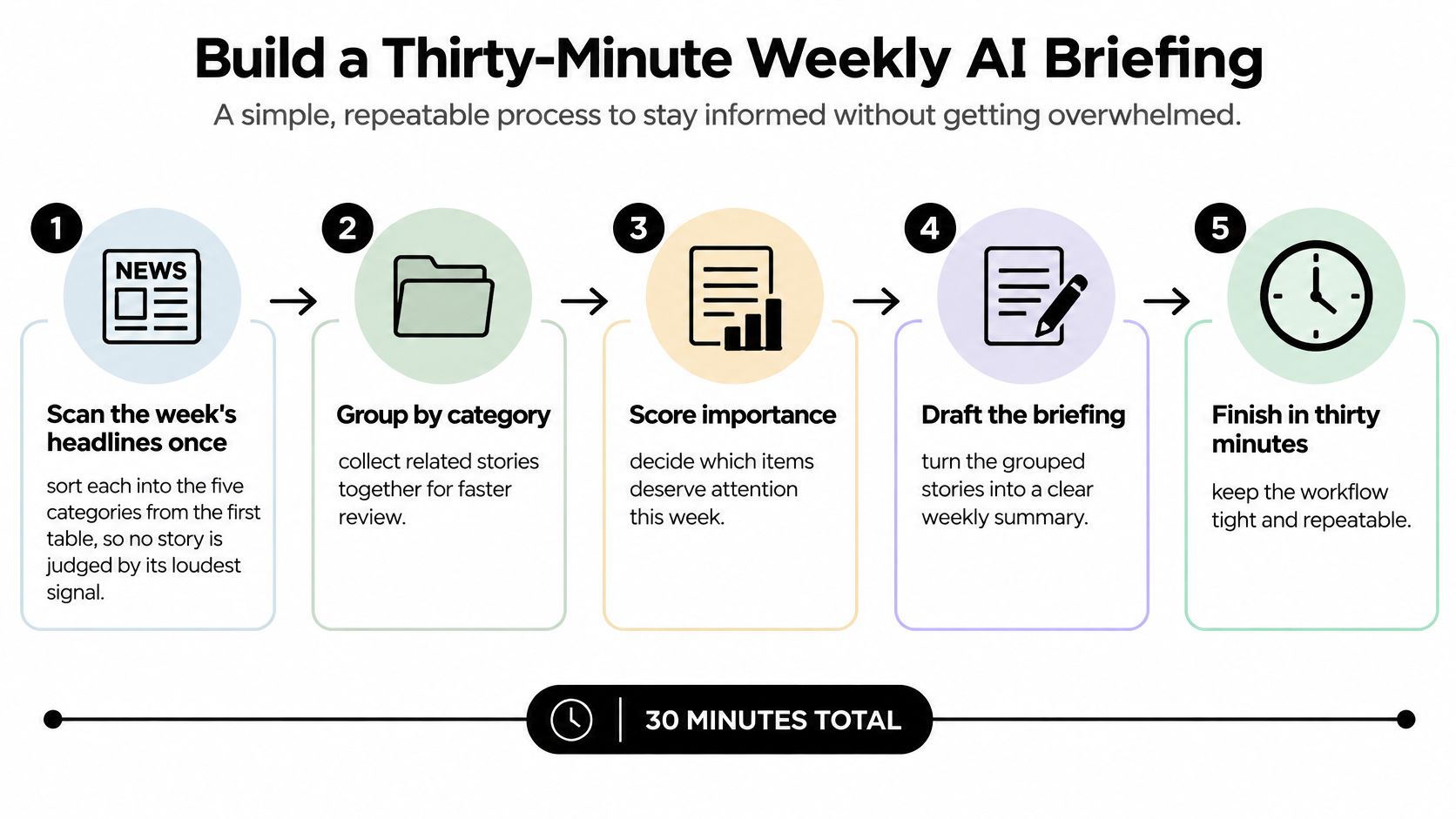
- Scan once and sort. Move every headline into one of the five categories from the first table. Nothing gets judged before it's sorted, which stops the loudest item from setting the agenda.
- Mark the status. Label each story announced, available or tested. An announced feature can take months to reach users, and a demo is not a release.
- Open the primary source. For every story you plan to keep, read the company post, the paper or the agency report. Summaries inherit launch framing, including yours.
- Check the date and the region. Rules, pricing and availability differ by country, and older stories reappear in new roundups with fresh timestamps.
- Write one line each. What changed, who it affects, what you would do differently. Three columns, one sentence, no adjectives.
- Drop what changes nothing. A popular story that alters no decision in your work is entertainment, and entertainment doesn't need a slot in the briefing.
- Review on Friday. Note any story that turned up in a second category. Appearing twice is a stronger signal than appearing loudly once.
A little context for why the routine is worth keeping: a median of 34% of adults across 25 countries said in 2025 that they had heard or read a lot about artificial intelligence, according to Pew Research Center. Coverage volume and understanding aren't the same thing, so the person who reads carefully looks informed next to the person who reads constantly.
Here's the same method walked through as a workflow, which is useful if you'd rather watch the sorting step than read it.
To set this up, choose three of the five categories that touch your work. Pick one primary source for each, whether that's a release page, a research feed or a standards page, then add one curated roundup for breadth. Every month, drop any source that produced nothing you used. The feed shrinks, the briefing gets better, and the whole thing stays inside half an hour.
The goal isn't knowing everything about AI this week. It's knowing which changes affect your work before they affect your competitors.
Creators Toolbox publishes a weekly roundup of new tools, product updates and resources for designers, developers and creators, and its Artificial Intelligence community feed is where model releases and practical uses land in one place. Use it as the scan step in the routine above, then follow the links back to the original sources before you act on anything. Visit Creators Toolbox to start with this week's roundup.