


Alex Atallah
Technical leadership
One API for 500+ AI models across 80+ providers — pay with credits that work anywhere, with automatic fallback when a provider goes down.

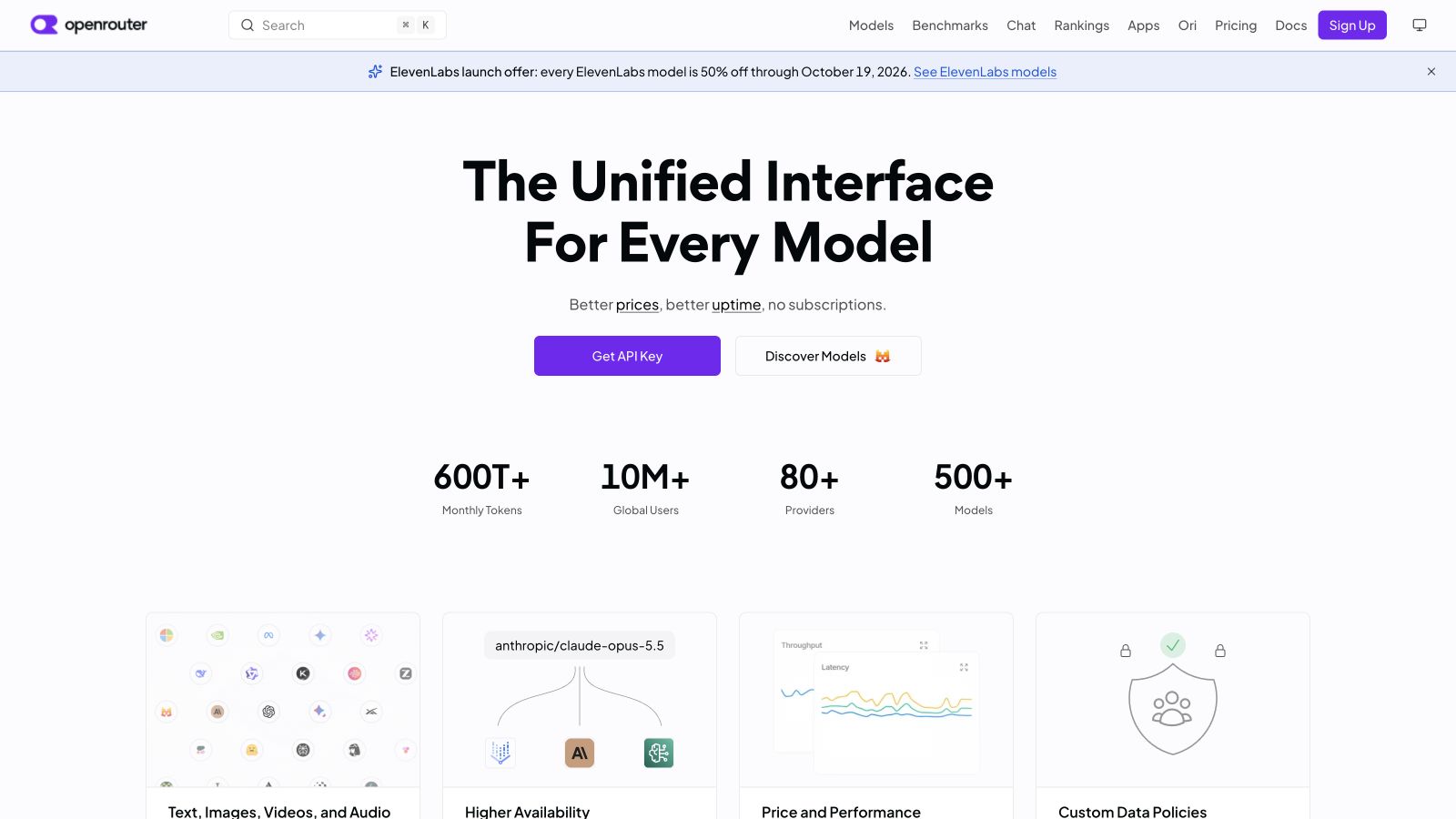
OpenRouter is a unified API for AI models: 500+ models from 80+ providers, including Anthropic, OpenAI, Google, Meta, Mistral, and Microsoft, all behind one OpenAI-compatible interface. Because routing is distributed, a failing provider falls back to another automatically, and edge infrastructure keeps latency low. Billing is credit-based rather than per-provider subscriptions, so the same balance works across every model, and custom data policies let you control which models and providers ever see your prompts.
It also surfaces live pricing and throughput per provider, so you can compare the real cost of the same model across hosts. The platform reports 200T+ monthly tokens, 10M+ users, and 250k+ apps built on it, including Replit, Hermes Agent, and Kilo Code.
Common questions about OpenRouter
Traffic and momentum for OpenRouter
Official videos and tutorials for OpenRouter.
6 similar tools
ChatGPT
AI assistant by OpenAI — chat, write, code, analyse data, generate images, and browse the web, powered by the GPT-5.6 family.
BytePlus
ByteDance's AI-native cloud platform — tap the AI powering TikTok, including Seedance video and Seedream image models, LLMs, and enterprise APIs.

fal
A generative media platform and inference API for running fast image, video, and audio AI models at scale.

Replicate
Run AI models via API — image, video, audio, and language models from the open-source community, hosted and scalable.

WaveSpeed
AI media generation platform with 1,000+ top-tier models for fast image, video, and audio generation at scale.
Runware
Fast, low-cost AI inference API for image, video, and audio generation — run top models at scale without managing GPUs.
The people behind OpenRouter
Technical leadership
Technical leadership
Technical leadership
Similar Launches
AgentMail
API-first email for AI agents — give any app or agent its own inbox to send, receive, and reply to emails programmatically.
Agent Score by Fern
Check if your documentation is AI-ready — run 22 checks and get a letter grade in seconds.
Hugging Face
The open home of machine learning: 3 million models, 500,000 datasets and 1 million apps, with hosted inference, Spaces and the Transformers libraries.
Replicate
Run AI models via API — image, video, audio, and language models from the open-source community, hosted and scalable.

Stripe
Payments and financial infrastructure for the internet — checkout, subscriptions, invoicing, marketplaces, fraud tools, and tax, in 135+ currencies.
LiveAvatar
Lifelike realtime avatar API for conversational AI agents, powered by HeyGen research.
Comments