Clément Delangue
Co-founder and CEO
The open home of machine learning: 3 million models, 500,000 datasets and 1 million apps, with hosted inference, Spaces and the Transformers libraries.
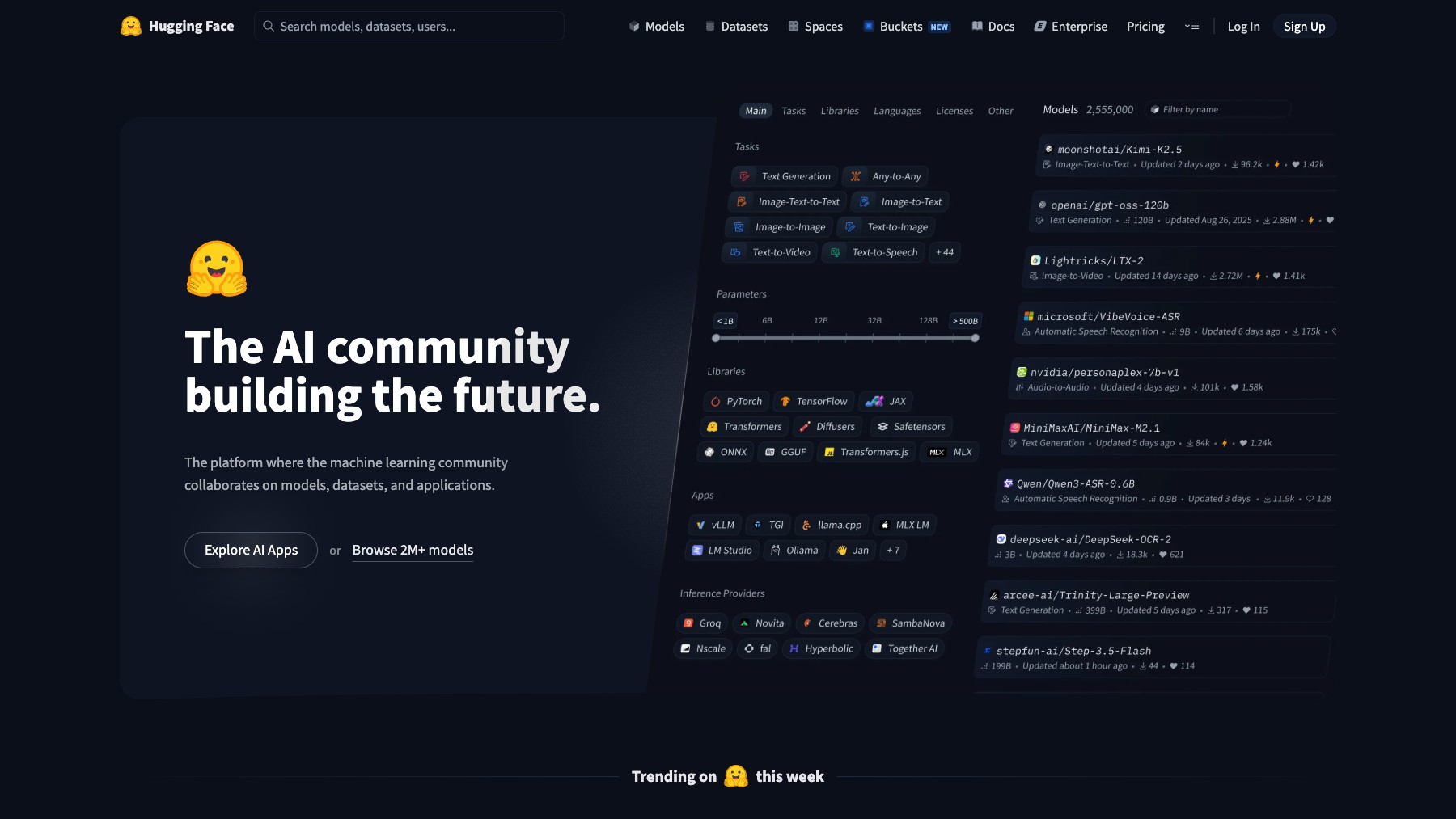
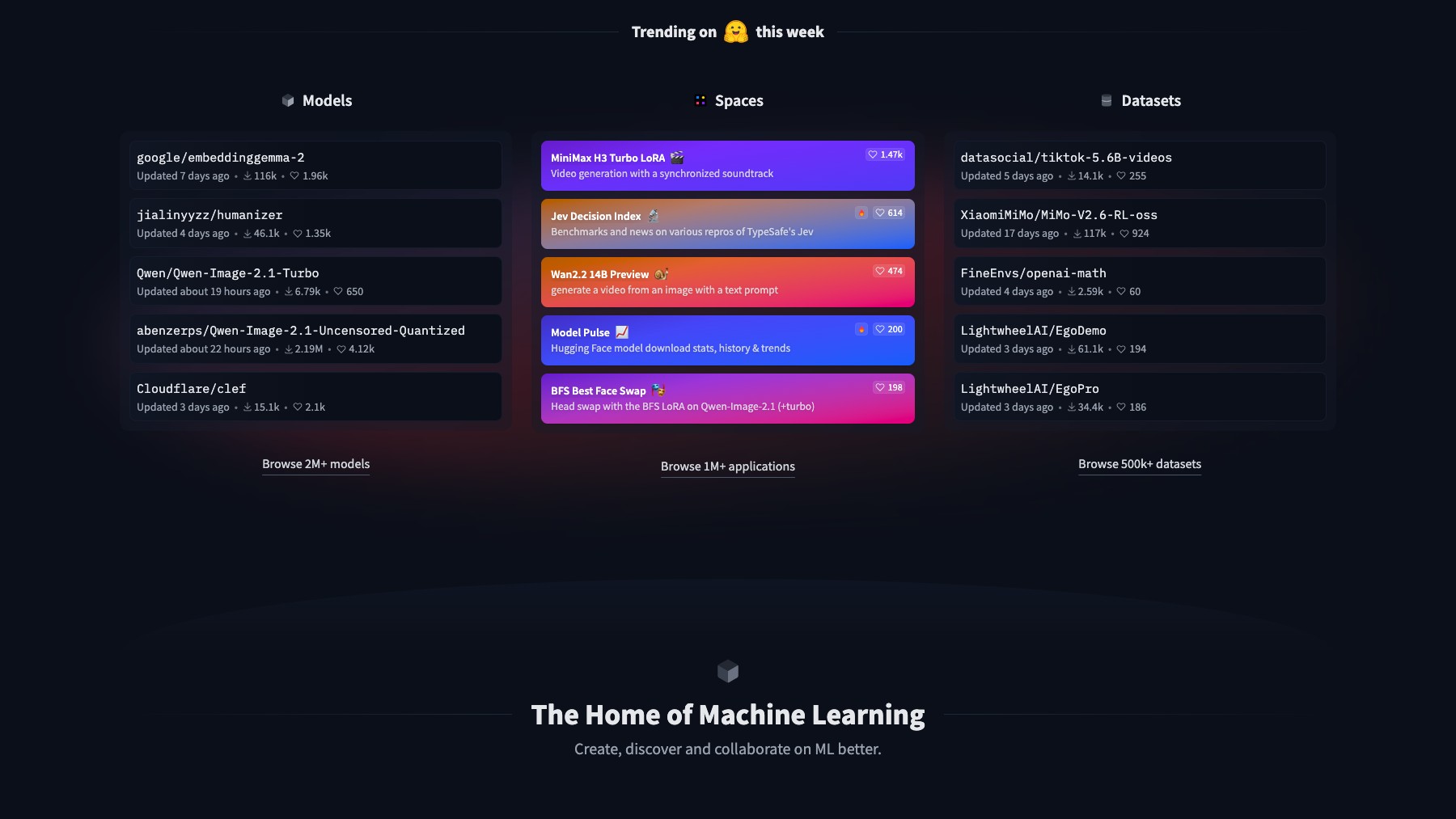
Hugging Face is the platform where the open machine learning community shares models, datasets and applications. More than 18 million developers, researchers and creators use it to publish and discover open source and open-weight models, host demos as Spaces, and run models through inference endpoints and third-party providers. Its libraries, including Transformers, Diffusers and Datasets, are the standard way most open models are loaded and fine-tuned.
Public work is free; paid plans add private repositories, compute and team features. In September 2026 NVIDIA agreed to acquire Hugging Face, saying the platform will stay open and that NVIDIA compute will not be required to build on or deploy through it.
Common questions about Hugging Face
Traffic and momentum for Hugging Face
6 similar picks

Graphify
Turn a codebase into a knowledge graph your AI assistant can trace — answers come back as graph paths with real file:line citations.
HyperFrames
Open-source framework for rendering HTML compositions into MP4 videos, built for AI agents and automated pipelines.
LanceDB
Multimodal vector database for RAG, AI agents, and hybrid search with native versioning and S3-compatible storage.
Browser Use
Open-source browser automation platform for AI agents — let LLMs drive a real browser to research, fill forms, scrape, and complete multi-step tasks.

Replicate
Run AI models via API — image, video, audio, and language models from the open-source community, hosted and scalable.

OpenRouter
One API for 500+ AI models across 80+ providers — pay with credits that work anywhere, with automatic fallback when a provider goes down.
The people behind Hugging Face
Similar Launches
Graphify
Turn a codebase into a knowledge graph your AI assistant can trace — answers come back as graph paths with real file:line citations.
HyperFrames
Open-source framework for rendering HTML compositions into MP4 videos, built for AI agents and automated pipelines.
LanceDB
Multimodal vector database for RAG, AI agents, and hybrid search with native versioning and S3-compatible storage.
Browser Use
Open-source browser automation platform for AI agents — let LLMs drive a real browser to research, fill forms, scrape, and complete multi-step tasks.
Replicate
Run AI models via API — image, video, audio, and language models from the open-source community, hosted and scalable.
OpenRouter
One API for 500+ AI models across 80+ providers — pay with credits that work anywhere, with automatic fallback when a provider goes down.
Comments