Notion opens an alpha for developer-built custom blocks
By Steven Van ·
The experimental, application-based program lets blocks read workspace databases, going further than July's HTML blocks.
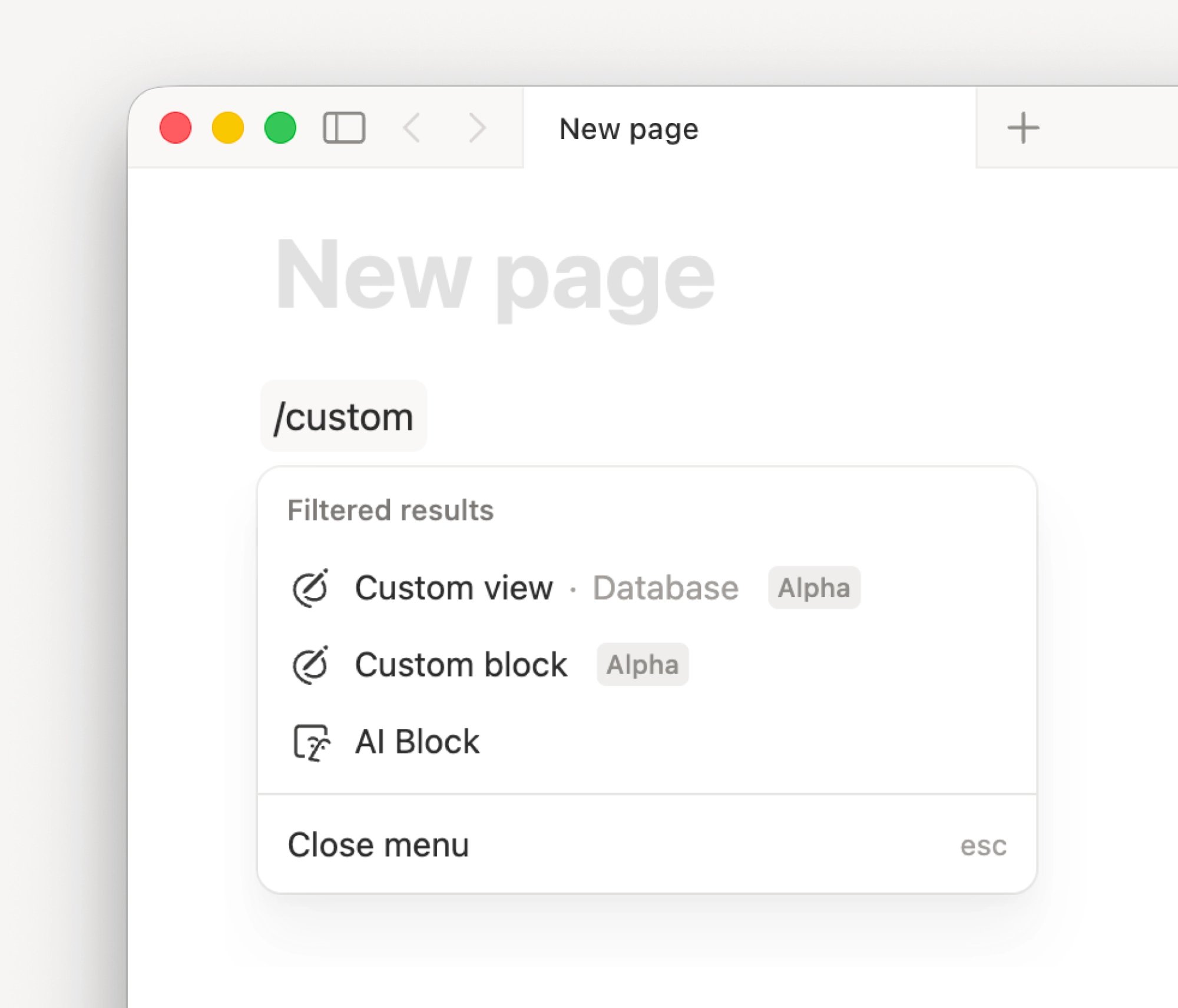
Notion is quietly opening the door to one of its most requested capabilities: blocks that developers build themselves. On August 5, Stephen Wu, an engineer on Notion's databases team, announced an early alpha for custom blocks, describing them as "a new Notion primitive for building interactive blocks that can read your workspaces and databases." The program is small, experimental, and application-based, but for anyone who has ever wished a Notion page could do more than display text and embeds, this is the clearest signal yet that the block itself is becoming programmable.
A new primitive, not another embed
Notion has always been built from blocks: paragraphs, databases, toggles, callouts. Until now, that vocabulary was fixed by Notion itself. If you wanted a countdown timer, a habit tracker widget, or a custom chart, you reached for a third-party embed service and dropped an iframe into your page. Those widgets live outside Notion, cannot see your data, and often break the visual feel of a page.
Custom blocks are different in kind. Wu calls them a primitive, which in Notion's world means a first-class building block that sits inside the page like anything native. The key detail in the announcement is that these blocks can read your workspaces and databases. A block that understands your actual content is a much bigger idea than a decorative widget: think a revenue tile that pulls live numbers from a client database, a content calendar heatmap generated from your posts table, or a progress bar wired to task status without any external sync tool in the middle.
How this differs from July's HTML blocks
If this sounds familiar, it is because Notion shipped interactive HTML blocks in its 3.6 release on July 1. Those let Notion Agents generate small interactive components, like ROI calculators, quizzes, and org charts, directly on a page from a prompt. HTML blocks are aimed at end users who describe what they want and let the agent build it.
Custom blocks appear to be the developer-grade counterpart. Instead of a one-off component an agent generates for a single page, developers get a way to build reusable, data-aware blocks as a real extension surface. It fits the pattern of Notion's broader Developer Platform push, which recently introduced Workers for running hosted custom code, a Notion CLI, and an External Agents API for bringing tools like Claude Code and Cursor into the workspace. The platform now covers custom logic, custom agents, and, with this alpha, custom UI inside the page itself.
What creators could build with data-aware blocks
For creators and small teams who already run their business in Notion, the interesting question is what becomes possible when blocks can read databases natively. Some obvious candidates: sponsorship pipelines that render as visual kanban tiles with deal values, publishing dashboards that chart output per platform from a content database, media kits with live subscriber stats, or client portals with interactive status displays that update from the underlying project tracker. Template sellers should pay particular attention. A Notion template with genuinely interactive, data-connected components would stand apart from anything on the market today.
Very early, and that is the point
Wu is explicit that this is "very early, very experimental," and that the team wants to learn from what alpha testers build. There is no public documentation yet, no announced timeline for general availability, and no detail on how custom blocks will be distributed or monetized. Developers interested in being among the first testers can apply through the thread linked in Wu's announcement on X.
The caution is warranted. Extension surfaces that can read workspace data raise real questions about permissions and review, and Notion has emphasized that its developer platform bakes in authentication, permissions, and sandboxing from the start. But the direction is unmistakable: Notion is evolving from a workspace you fill in to a platform you build on, one block at a time.
Sources: Stephen Wu (@wustep) on X, Notion: Introducing Notion's Developer Platform, Notion 3.6 release notes