The Ultimate Guide to Your Wide Lens MFT System
By Steven Van ·
Unlock stunning visuals with your wide lens MFT. Our guide covers choosing lenses, mastering focal lengths, and practical techniques for incredible photos.
If you’ve ever slapped a 12mm lens onto your Micro Four Thirds camera expecting a super dramatic, expansive view, you might have felt a little underwhelmed. It’s wide, sure, but maybe not as mind-bendingly wide as the number suggests.
This is a classic MFT moment, and it all comes down to a single, crucial concept: the 2x crop factor.
Why Your MFT Lens Needs a Crop Factor Reality Check
Think of it like this. A full-frame sensor is a huge picture window with a sweeping view of the world. A Micro Four Thirds sensor is a smaller window looking at that exact same scene. Because the window is smaller, it naturally "crops" the edges of the view, making everything inside feel a bit more "zoomed in."
This doesn't mean anything is wrong; it just means the focal length printed on the barrel of your lens doesn’t tell the whole story on its own. To really know what you're looking at, you have to do some quick mental math.
The Rule of Two: To figure out the "full-frame equivalent" field of view for any MFT lens, just multiply its focal length by two. That’s it. This simple trick is the key to translating MFT numbers into the classic focal lengths most photographers use as a reference.
Translating Focal Lengths into Real-World Views
This isn't a bug; it's a feature. Once you get the hang of it, you’ll start speaking the native language of the MFT system, which makes choosing lenses a whole lot easier.
Let's take a practical wide lens MFT example:
- Your Lens: An Olympus or Panasonic 12mm MFT lens.
- The Math: 12mm x 2 = 24mm.
- The Result: Your lens gives you the exact same field of view as a classic 24mm wide-angle on a full-frame camera.
Suddenly, the numbers start to have a real-world feel. You’re no longer just buying a "12mm lens." You’re buying a "24mm equivalent" for your landscapes. That 17mm MFT lens isn't just a number—it’s your "34mm equivalent" walking-around lens, perfect for street and documentary shots. This shift in thinking is everything.
Why This Matters for Wide-Angle Shooting
Getting a handle on this is absolutely critical when you're shopping for a wide-angle lens. A focal length that sounds incredibly wide on paper might only be moderately wide once you factor in the crop. For instance, a 15mm MFT lens gives you a 30mm equivalent view—which is nice and wide, but it’s not the ultra-expansive look you might need for sweeping architecture or tight interiors.
Knowing this prevents you from making a costly mistake and buying a lens that doesn’t deliver the creative results you're chasing. It puts you in control, so you can confidently pick the right tool for the job, whether you're capturing massive landscapes, vlogging on the go, or shooting in cramped spaces. Once you master the 2x crop factor, that initial confusion turns into creative confidence.
Decoding MFT Wide-Angle Focal Lengths
Now that we’ve wrapped our heads around the 2x crop factor, we can get to the fun part: figuring out what "wide-angle" actually means for a Micro Four Thirds camera. It's not just one thing. Think of it less as a single category and more as a creative spectrum, ranging from subtly spacious to jaw-droppingly epic.
Getting a feel for this spectrum is the key to picking the right lens that will bring your creative ideas to life.
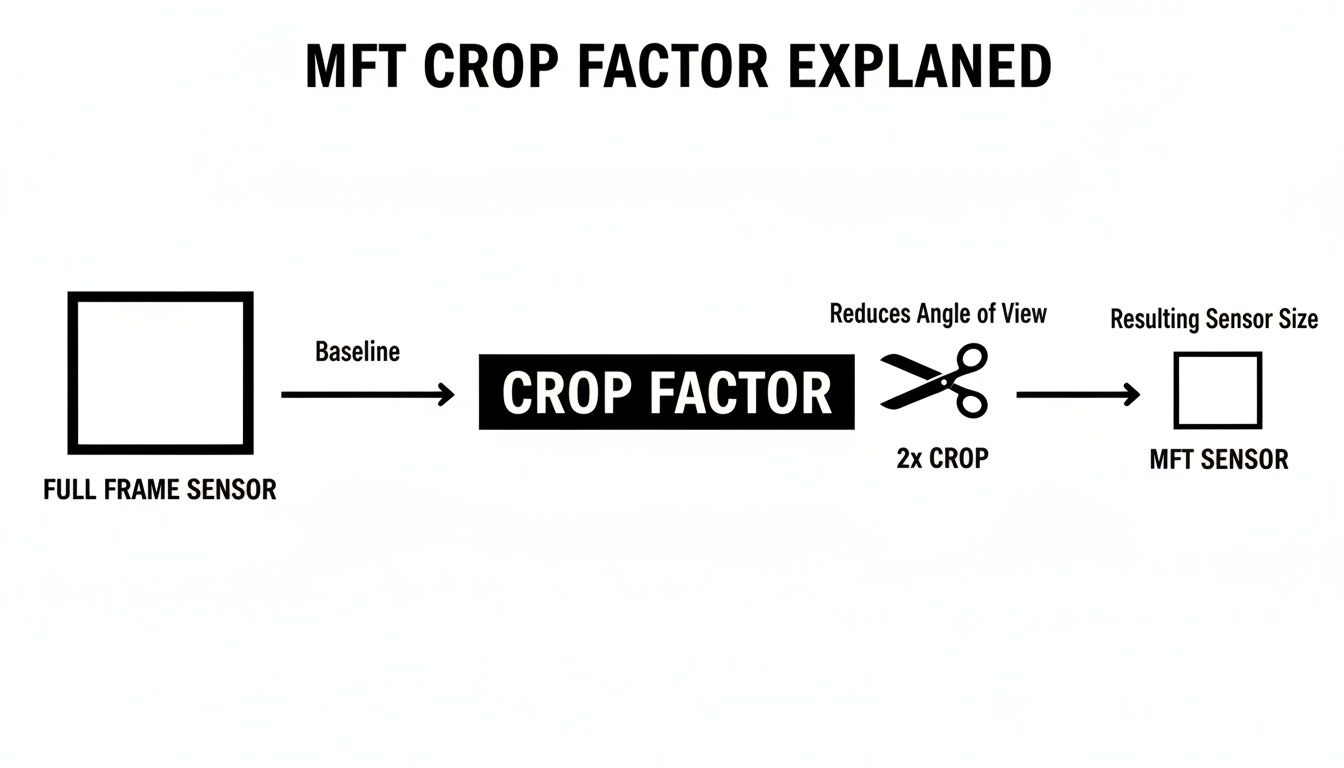
This diagram is a great visual reminder of what's happening. Every time you attach a lens, the MFT sensor is essentially "zooming in," effectively doubling the focal length to give you your final field of view.
The Three Tiers of Wide
To make things easier, we can group wide-angle lenses for MFT into three general buckets. Each one has a distinct personality and is built for different kinds of shots.
Wide-Normal (17mm-20mm): Lenses like a 17mm (34mm equivalent) or a 20mm (40mm equivalent) feel incredibly natural. They give you just enough breathing room to feel spacious without creating any obvious distortion. This makes them perfect for documentary work, street photography, or as an everyday walk-around lens when you want to capture scenes honestly, much like how you see them.
Standard Wide (12mm-15mm): This is classic wide-angle territory. A 12mm (24mm equivalent) or 15mm (30mm equivalent) lens pulls the viewer into the scene. They create an immersive, engaging look that's fantastic for sweeping landscapes, big group photos, and environmental portraits where the background is just as important as the person in it.
Ultra-Wide (7mm-10mm): When you need to go big, you go ultra-wide. Lenses in this range, like a 9mm (18mm equivalent), deliver those epic, dramatic perspectives. They are purpose-built for capturing massive mountain ranges, the grand scale of architecture, cramped interiors, or the entire night sky for astrophotography. They're incredibly powerful, but you do have to be mindful of distortion near the edges of the frame.
Looking for something even more extreme? Fisheye lenses throw the rules out the window, bending and distorting reality for a completely unique look. You can see how they differ from ultra-wides in our fisheye guide.
MFT Wide Lens Focal Length and Use Case Guide
To help you connect the numbers to your creative goals, this table breaks down the common focal lengths, their full-frame equivalents, and the types of photography they excel at. It’s a handy cheat sheet for choosing the right tool for the job.
| MFT Focal Length | Full-Frame Equivalent | Approx. Horizontal FoV | Common Use Cases |
|---|---|---|---|
| 17mm - 20mm | 34mm - 40mm | 55° - 47° | Street Photography, Documentary, Walk-Around |
| 12mm - 15mm | 24mm - 30mm | 74° - 62° | Travel, Landscapes, Vlogging, Environmental Portraits |
| 7mm - 10mm | 14mm - 20mm | 104° - 83° | Architecture, Real Estate, Astrophotography |
Ultimately, choosing a wide lens MFT is less about the numbers and more about the feeling you want to convey. This guide should give you the confidence to move beyond the specs and start thinking about what each lens can do for your photography.
The Secret Strengths of MFT Wide Lenses
So, what makes a wide lens MFT setup the go-to choice for so many photographers and filmmakers? It’s not just about matching a certain field of view. The Micro Four Thirds system itself has some core characteristics that give its wide-angle lenses a few unique, powerful tricks up their sleeve.
These strengths are exactly why many creators deliberately pick MFT for demanding travel, landscape, and video work.
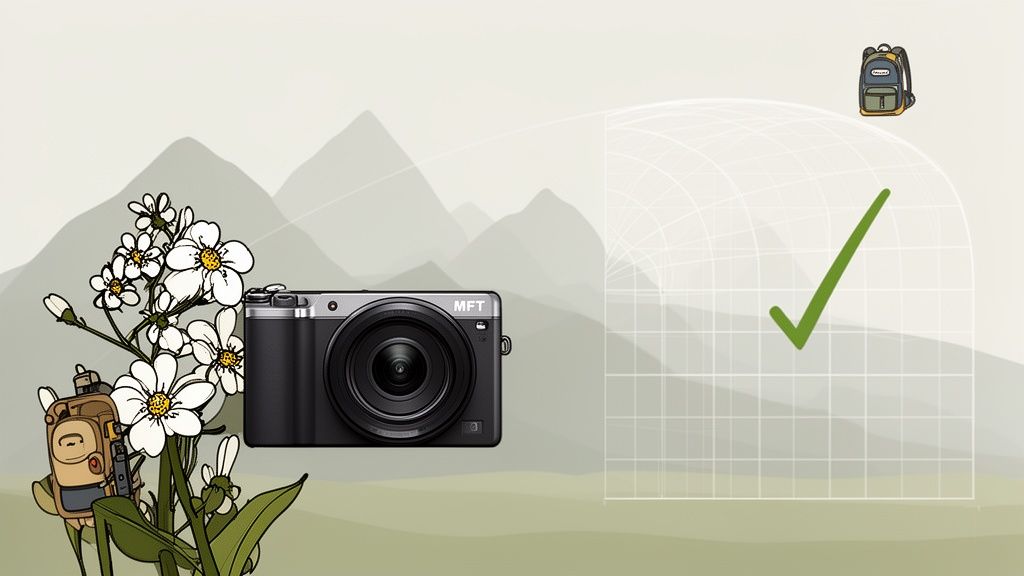
One of the biggest practical benefits is a naturally deeper depth of field (DOF). Because of the smaller sensor size, MFT systems inherently keep more of a scene in sharp focus at any given aperture. This is a huge deal for landscape and architectural shooters who need everything from the foreground flower to the distant mountain peaks to be tack-sharp.
Where a full-frame photographer might have to stop their lens down to f/11 or f/16—often forcing a higher ISO to compensate—an MFT user can get a similar deep-focus look at f/5.6 or f/8. This lets you stick to lower ISOs and faster shutter speeds, which translates to cleaner, crisper images.
Embracing Both Perfection and Imperfection
Of course, no lens is optically perfect. Wide-angle lenses, in particular, are known for producing barrel distortion, which makes straight lines near the frame's edges appear to bow outwards. It can create a subtle, almost "fisheye" look if left uncorrected.
Fortunately, managing this on an MFT system is incredibly simple:
- Software Correction: Modern editing software like Adobe Lightroom contains built-in lens profiles that fix distortion with a single click. In most cases, your camera already bakes this correction directly into the JPEGs it produces.
- Creative Use: On the other hand, you can just lean into it. Many photographers use that natural distortion to create a sense of dynamic energy, exaggerate leading lines, and pull the viewer right into the scene for a more dramatic, immersive feel.
The core appeal of the wide lens MFT combination often comes down to this: you get maximum creative potential in a minimal package. It’s a system that encourages you to get out and shoot without being weighed down by gear.
The Ultimate Advantage: Size and Weight
This brings us to the MFT system's signature benefit: its almost unbelievable compactness. A professional-quality wide-angle zoom for an MFT camera can weigh as little as 200g and fit comfortably in the palm of your hand. A full-frame lens with a similar field of view could easily be three or four times heavier and much, much bigger.
This size and weight advantage is an absolute game-changer for travelers, hikers, vloggers, and run-and-gun filmmakers. It means less fatigue on a long day, a smaller camera bag, and a greater willingness to bring your gear with you everywhere you go.
While global camera shipment data shows MFT's overall market share is modest, its loyal following persists precisely because of these practical benefits. For creators who value a lightweight rig, the compact nature of MFT lenses is a massive advantage over bigger, heavier systems. You can see more data on recent camera market trends to understand the full picture. It’s a system designed for motion, making it a perfect match for wide-angle storytelling on the go.
Putting Your Wide Lens to Work in the Real World
All the theory in the world doesn't mean much until you get out there and start shooting. This is where the magic happens—moving past the technical specs and into the real-world situations where your wide lens MFT brings your creative vision to life. Let’s look at how to translate your lens's power into the exact shots you’re aiming for.
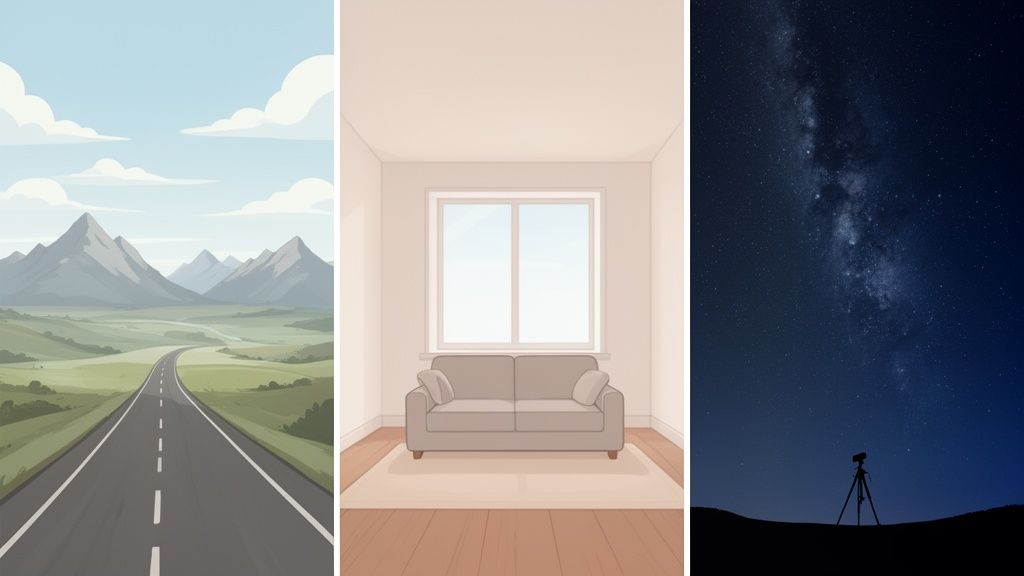
When shooting landscapes, a wide perspective is your best friend for creating those epic, sweeping views. But don’t just point your camera at a pretty scene. Instead, hunt for powerful leading lines—a winding road, a fence line, or a river—to give your image depth and direction. Try getting low to the ground; this simple trick will exaggerate those lines and pull the viewer’s eye right into the heart of the frame.
Mastering Interior Spaces
If you’re shooting architecture or real estate, you’re probably used to working in cramped spaces. This is where an ultra-wide MFT lens becomes indispensable. It lets you capture an entire room in one shot, where a normal lens would just give you a picture of a wall.
The secret is to keep your camera perfectly level. Even a tiny bit of upward or downward tilt will cause vertical lines to converge, making walls look like they’re caving in. Use your camera’s built-in level or a tripod with a bubble level to ensure your lines stay straight and professional.
A wide perspective can be your greatest asset or biggest challenge. By understanding how to control distortion and composition, you transform a potentially chaotic scene into a compelling, immersive image that directs the viewer's attention exactly where you want it.
This same idea applies to video. When you need to repurpose your footage for different platforms, knowing how to change aspect ratio for social media is a must. Each platform has its own sweet spot for framing, and getting it right ensures your wide shots look fantastic everywhere.
Capturing the Cosmos and Connecting with Viewers
Your wide lens is just as useful after the sun goes down. A wide, fast lens—think an aperture of f/2.8 or wider—is an absolute beast for astrophotography. Its expansive field of view lets you frame a huge slice of the Milky Way, while the wide aperture drinks in as much starlight as possible.
For vloggers and filmmakers, a wide angle creates a personal and engaging feel. It’s perfect for those "talking head" shots where you want to show off a bit of your environment, making the scene feel more authentic and inviting. This immersive quality is a great way to connect directly with your audience. To get a better handle on framing for video, you might want to check out our guide on using an aspect ratio calculator and how it affects your final cut.
How to Choose the Right Wide Lens MFT for You
Picking your next wide-angle lens for Micro Four Thirds comes down to weighing your creative goals against the practical demands of your shoots. The first big question you’ll face is a classic one: do you go for the specialized perfection of a prime lens, or the do-it-all flexibility of a zoom?Think of a prime lens as a specialist. It has one fixed focal length, like 12mm, and it’s engineered to do that one job exceptionally well. Primes are almost always lighter, more compact, and boast wider maximum apertures (like f/1.8 or f/1.4). This makes them the undisputed champions for low-light shooting and creating that beautiful, creamy background blur.
A zoom lens, on the other hand, is your versatile workhorse. A lens like a 7-14mm zoom packs an entire range of wide perspectives into a single body. This is a lifesaver for travel or video, where you might need to jump from an epic landscape to a tighter detail shot without ever moving your feet.
Prime vs Zoom: The Core Tradeoff
There’s no "better" option here—only what’s better for you. Your shooting style is what really dictates the right choice.
- Choose a Prime If: You value portability, need maximum light-gathering for things like astrophotography or indoor events, and demand the absolute sharpest image quality possible. Primes force you to "zoom with your feet," a creative constraint that often leads to more thoughtful and powerful compositions.
- Choose a Zoom If: Versatility is your top priority. It's the perfect tool for run-and-gun videography, unpredictable travel days, or any situation where you can't easily reposition yourself to reframe a shot.
The best approach is to match the tool to the task. A fast prime is perfect for astrophotography, but a wide zoom might be indispensable for a day of exploring a new city.
Native vs Third-Party Lenses
Once you've settled on a prime or a zoom, your next decision is the brand. Do you stick with native lenses from OM System (Olympus) and Panasonic, or do you venture into the world of third-party options from companies like Sigma, Laowa, or Voigtländer?
Native lenses are all about seamless integration. They’re built to communicate perfectly with your camera’s autofocus, in-body stabilization, and internal software corrections. Many also come with robust weather sealing, a critical feature for adventurous photographers who aren’t afraid of a little rain or dust.
Third-party lenses, however, often bring something unique to the table. You might find a lens with an even wider aperture, a highly specialized function (like a zero-distortion lens for architecture), or simply a more attractive price tag. The trade-off can sometimes be slower autofocus or, in the case of fully manual lenses, a complete lack of electronic communication with the camera.
The good news is that the Micro Four Thirds mount is incredibly healthy and competitive. Recent sales data from Japan shows MFT lenses holding a 13.8% market share, sitting comfortably in second place behind only Sony's E-mount. This proves you have a vast and vibrant ecosystem to choose from, with plenty of high-quality glass from both native and third-party makers to fit your budget and creative style.
Ultimately, picking the right wide lens MFT is a personal journey. By thinking through these factors, you can move past the spec sheets and find a lens that truly feels like an extension of your creative vision. For more guidance on gear, check out our guide on the best tools for photographers.
Answering Your Wide-Angle Questions
Once you get a wide lens MFT setup in your hands, the real-world questions start coming. It's one thing to know the theory, but it's another to face these choices out in the field.
Let's dive into some of the most common issues and creative decisions you'll encounter. Think of this as the practical advice you need to shoot with more confidence.
Why Do My Wide-Angle Photos Look Distorted at the Edges?
What you're seeing is called barrel distortion. It’s a very common optical effect where straight lines near the frame's edges seem to bend outwards, like the staves of a barrel. This is a natural side effect of wide-angle lens design, especially in the ultra-wide category.
The good news is, it's incredibly easy to fix. Your camera likely has a built-in JPEG correction profile that handles it automatically. If you shoot in RAW, a single click on a lens profile in an editor like Adobe Lightroom will straighten those lines perfectly.
Of course, you can also choose to leave it in. Many photographers lean into the distortion to create a dynamic, immersive feeling that pulls the viewer right into the scene.
Is a Wide-Angle Zoom or Prime Lens Better for MFT?
Ah, the classic debate. This really boils down to what you need more: flexibility or specialized performance. There's no "better" option—they just have different jobs.
- A wide-angle prime (like a 12mm f/2.0) is almost always smaller, lighter, and faster (meaning it has a wider aperture). This makes it a champion for low-light situations like astrophotography or indoor events where you need to soak up every bit of available light.
- A wide-angle zoom (like a 7-14mm f/2.8) gives you incredible compositional freedom. Being able to reframe from ultra-wide to a more standard wide without moving your feet is a massive advantage for fast-paced travel photography and video.
Go for a prime when you need maximum portability and low-light muscle. Grab a zoom when you need to adapt quickly to whatever a scene throws at you.
A wide lens isn’t just about capturing a vast scene; it’s about how you choose to render that scene. Your choice between a prime and a zoom, or how you handle distortion, are key parts of your creative voice.
Can I Use a Full-Frame Wide Lens on My MFT Camera?
Yes, you can physically attach a full-frame lens with an adapter, but there's a huge catch. The 2x crop factor of your MFT camera doesn't go away.
This means that a 24mm full-frame wide-angle lens will give you the field of view of a 48mm "normal" lens on your MFT camera. You completely lose that expansive, wide-angle feel.
There are special adapters called "speed boosters" (or focal reducers) that use optics to counteract this, effectively widening the field of view and even brightening the aperture. However, they introduce extra cost, weight, and complexity.
For the simplest, most reliable, and often highest-quality results, using a native lens built specifically for the MFT system is almost always the best choice.
At Creators Toolbox, we're dedicated to bringing you the guides and resources you need to master your craft. Explore our free tools and stay updated with the latest in creative tech.