Introducing the v0 composite model family
By Steven Van ·
Vercel details the RAG, base-model, and custom AutoFix pipeline behind its v0-1.5 and v0-1.0 code generation models.
Vercel published a technical breakdown of the architecture behind its v0-1.5-md, v0-1.5-lg, and v0-1.0-md models, which power Vercel's v0 code generation tool. Rather than using a single frontier model, v0 runs a composite pipeline: a state-of-the-art base model for generation, retrieval-augmented context pulled from documentation and UI examples, a Quick Edit model for small targeted changes, and a custom AutoFix model that catches errors mid-stream and in a final pass.
Because the base model is decoupled from the rest of the pipeline, Vercel can swap in newer frontier models without rebuilding the surrounding system. It gives v0-1.0-md as an example: it currently runs on Anthropic's Sonnet 3.7, while v0-1.5-md has moved to Sonnet 4.
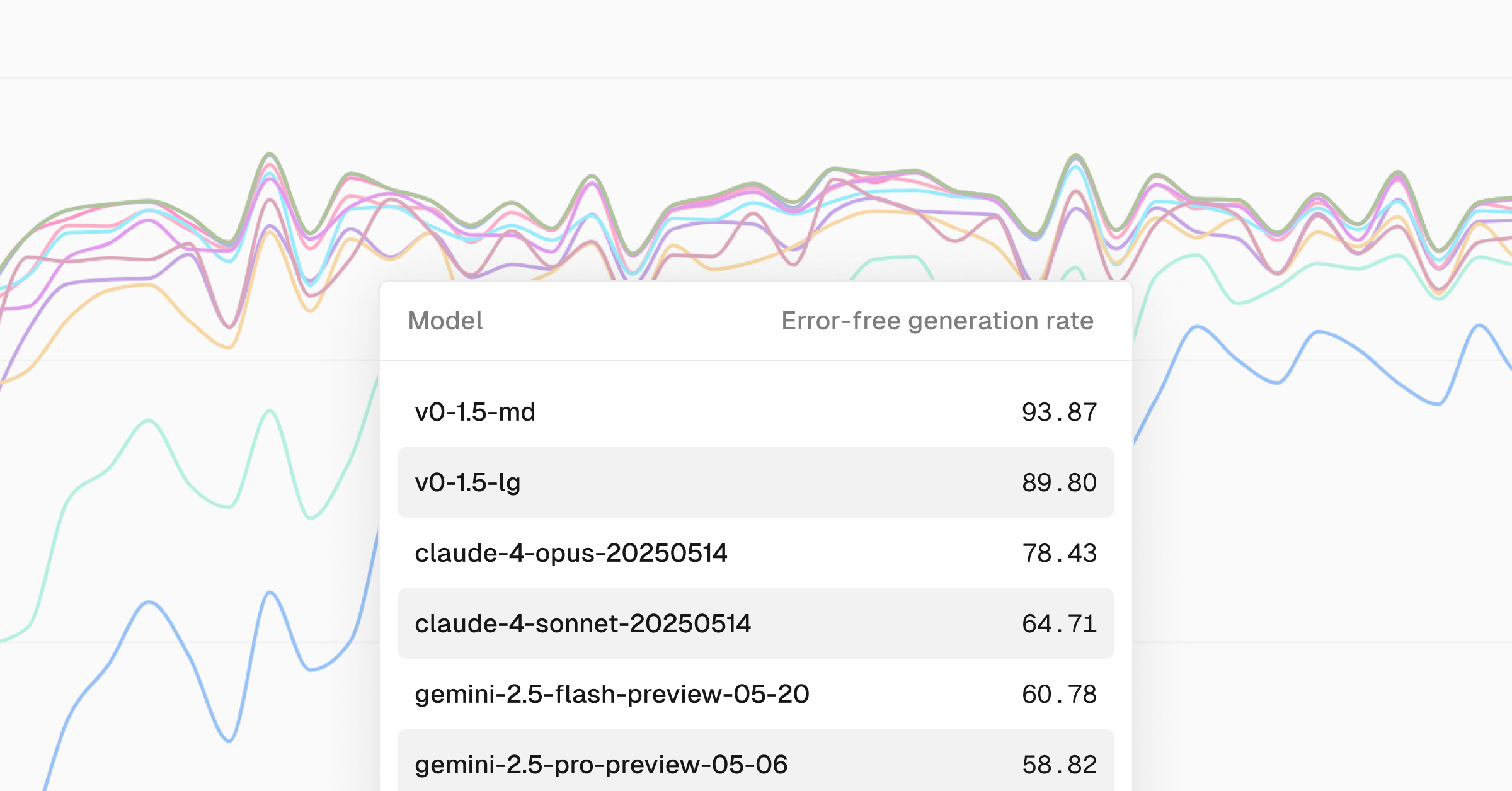
Vercel also detailed vercel-autofixer-01, a custom error-correction model it trained with Fireworks AI using reinforcement fine-tuning. On its error incidence evals it matches gpt-4o-mini and gemini-2.5-flash on error-free output rate while running 10 to 40 times faster. On Vercel's own benchmark of error-free code generation, v0-1.5-md scored 93.87% and v0-1.5-lg scored 89.80%, ahead of the base models it tested, including claude-4-opus-20250514 at 78.43%. The v0 model family is available via API and in v0.dev, and can be used in code editors or custom workflows. Read the full announcement.