Vercel opens the v0 app builder up as an API
By Steven Van ·
v0's full agent loop, not just text-to-code, is now callable for scripts, CI jobs, and custom app builders.
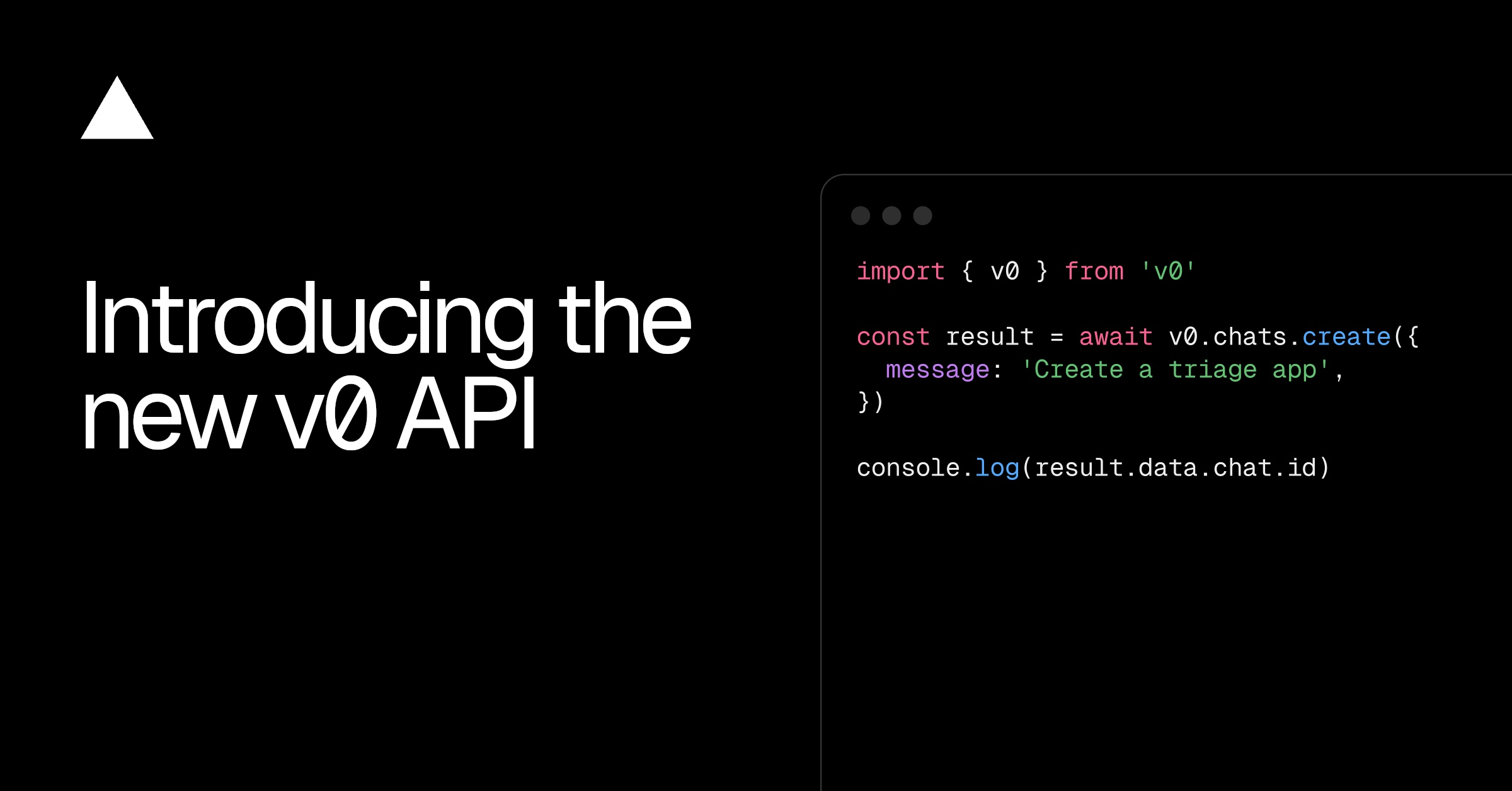
Vercel has made the new v0 API generally available, and it changes what v0 is. Until now, v0 lived behind a chat window at v0.app: you typed a prompt, watched it build a React app, and iterated in the browser. The new API strips the browser away and hands you the entire app-building agent as a programmable service. You can ship your own white-labeled app builder, give your coding agent the ability to build and deploy real apps, or generate apps automatically from a script or CI job. For creators who sell templates, run communities, or build client tools, that is a new kind of raw material.
The whole agent, not just a text-to-app endpoint
The earlier v0 Platform API was essentially a generation pipeline: send text, get code back. The new API exposes the full agent loop. Each chat you create through the API maintains an isolated workspace for one app, where v0 can read files, edit them, and execute code. It spins up a real dev server inside a Vercel Sandbox and returns a preview URL you can embed in your own product, so your users see a live, running app rather than a code dump. The agent also detects runtime errors and fixes them as it works.
You are not limited to starting from a blank prompt. Chats can be created from existing code, including a Git repo, a ZIP archive, or a set of files, which makes it practical to bolt v0 onto projects that already exist. When the app is ready, deploying it to Vercel is a single API call.
Sync, async, or streaming: three ways to consume it
The API supports three response modes. Synchronous calls block until the agent finishes, which suits scripts and CI jobs. Asynchronous calls return immediately and notify you through webhooks or polling, which suits background pipelines. Streaming pushes the agent's work to you in real time, which is what you want if you are building an interactive UI on top of it.
Responses arrive as ordered message parts: text, thinking, file operations, searches, commands, and tool calls. That granularity means you can render anything from a simple status spinner to a full execution trace showing every file the agent touched. You can also attach up to three skills per request, including Design Systems 2.0, so generated apps load your components, tokens, and starter configuration instead of generic defaults.
Built with agents in mind
Vercel is explicit that this release targets the agent era. There are three integration paths: an MCP server for IDEs and agent runtimes, AI SDK tools for TypeScript agents, and connections for agents running on Vercel's own infrastructure. The pitch is that your agent should deliver a working, deployed app with a link, not a snippet of code the user still has to wire up themselves.
Getting started is quick if you live in the JavaScript ecosystem: install the SDK with pnpm add v0@latest, or scaffold a complete app builder with pnpm create v0-sdk-app@latest. Vercel also publishes an open-source demo app builder on GitHub you can fork as a starting point.
What this unlocks for creators and small teams
The obvious play is a niche app builder: a site where your audience describes a tool and gets a working app, running on v0 under the hood with your brand on top. But the quieter use cases may matter more. A Slack or Discord bot that turns a feature request into a deployed prototype. A CI job that regenerates a landing page whenever your product data changes. A CRM flow that produces a custom calculator for each client. Anywhere the output of an idea should be a live app, this API is the shortest path.
One migration note: chats created with the previous v0 API do not carry over automatically. You need to download them as ZIPs and recreate them, and Vercel provides a migration guide with the mapping.

Sources: Vercel: Introducing the new v0 API, v0 SDK on GitHub, @v0 announcement on X