AI Video Credits: Why They Get Wasted and How to Stop It
By Steven Van ·
Synthesys's test of its own credits shows where AI video spend leaks and how checking the plan before rendering cut one quote from 1,664 to 240.
Synthesys has published a post on where AI video credits get wasted, built on a test it ran on 28 September 2026. The post says crashes are usually refunded, and that most lost credits go on Synthesys renders and other tools' renders that finished but missed the brief.
Where the credits go
The post compares how six tools publish their rates, checked on 30 September 2026:
- Runway: credits per second. Gen-4.5 uses 12 a second, so a 10-second clip is 120 credits.
- HeyGen Video Agent: credits per minute. About 30 to 40 in Standard mode and 90 to 120 in Seedance mode.
- Google Flow: credits per generation. Veo 3.1 Lite costs 10 and Veo 3.1 Quality costs 100, for non-Ultra subscribers.
- TopView: per video or per second. Its Viral Video Agent costs 5 credits for a 15-second standard video and 7.5 at high quality.
- Yapper: monthly credits shared across 36+ video models, with per-model rates not listed on its pricing page.
- Synthesys: credits per approved render, with the price shown on the approve button before it starts.
Runway and Higgsfield return credits automatically when a generation errors out. The post says none of the tools it checked refunds a finished video with the wrong line, length or look. It cites Higgsfield's estimate, not a measured figure, that most creators need three to ten attempts per usable clip.
It lists five leaks: re-rolling one detail at a time, finding mistakes after the render, using the wrong model, guessing the price, and credits that expire unused. On expiry, Runway's monthly credits lapse on the billing date on Standard, Pro and Unlimited plans. HeyGen rolls unused plan credits over for one extra cycle, and Yapper lets them build up to about twice the monthly allowance.
The Synthesys test
The team ran a brief for a 10-minute faceless YouTube explainer on compound interest in its own account. The storyboard had 62 scenes, planned at 832 seconds, and the approve bar quoted 1,664 credits. The team declined it and typed "Make it 90 seconds instead of 10 minutes." The new plan ran 120 seconds for 240 credits, and nothing was charged for the declined render.
A separate 60-second project then went as follows:
- The estimate under the prompt box said about 60 credits.
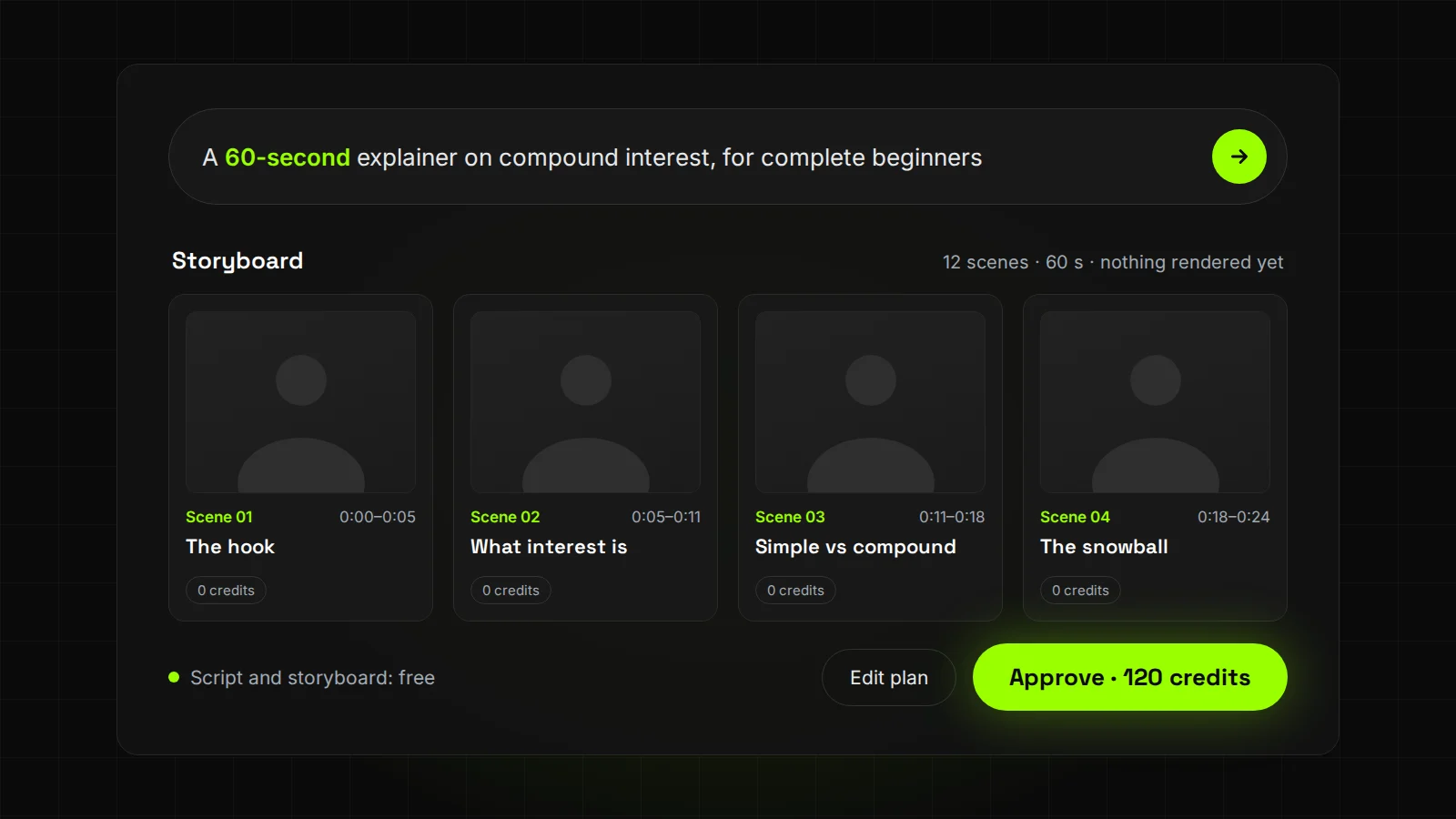
- The storyboard came back after 40 seconds with 12 scenes, and the approval card asked for 120 credits.
- A script check caught a wrong figure in scene 10: it said 100 dollars at 10% passes 700 after 20 years, when it takes 21.
- The approved render was charged exactly 120 credits, and the video ran 61 seconds.
In the Faceless Story format, the quote tracked planned length at 2 credits a second in all three plans. The early estimate was half the real price, so the post says to trust the number on the approval card.
Model choice and attempts
The post says the model changes cost twice: through its price per second or generation, and through how many attempts a shot takes. HeyGen says Seedance mode costs around three times Standard. TopView lists 0.06 credits a second for Avatar 4 Fast against 0.1 for Avatar 4.
Its worked example uses Google Flow prices with illustrative try counts. A Quality model with a loose prompt costs 300 credits for one usable clip, Lite alone costs 60, Lite for drafts plus one Quality final costs 130, and a carefully written prompt on Quality, rendered once, costs 100. In Synthesys the agent picks the model, and each approve card shows the editable prompt, model, resolution and credit cost.