The Creator's Guide to Release Forms for Video
By Steven Van ·
Master release forms for video with our guide. Get templates, legal insights, and workflows to protect your creative projects and avoid costly legal issues.
Think of a video release form as your project’s get-out-of-jail-free card. It’s a simple legal document that gives you permission to use someone’s face, a private location, or even a piece of property in your video. Without one, you’re leaving your best work vulnerable to legal claims and takedown notices.
Your Best Defense Against Video Takedowns and Lawsuits
Picture this: your latest video project explodes overnight, hitting millions of views. You're riding high, but then an email lands in your inbox—a takedown notice. It turns out a person who was on screen for just three seconds never signed a release, and now they want the video gone or a fat check.
This is the stuff of creator nightmares, but it’s 100% preventable. A video release form is your first and most effective line of defense against these exact headaches.
To help you get started, here's a quick look at the main types of release forms we'll be breaking down in this guide.
Quick Guide to Video Release Form Types
| Form Type | Who or What It Covers | When You Need It |
|---|---|---|
| Model/Talent Release | Anyone appearing on camera (actors, interviewees, extras). | Always, for anyone whose face is recognizable. |
| Location Release | Private property (homes, offices, stores). | When filming on property you don't own. |
| Property Release | Distinctive personal items (art, branded items, unique vehicles). | If the item is a key feature or central to the shot. |
| Minor Release | Anyone under the age of 18 appearing on camera. | Required in addition to a standard talent release. |
Getting these signed is the foundation of a professional, secure production.
A Permission Slip for Professionals
The simplest way to think about a release form is as a professional-grade permission slip. It’s a binding contract where a person—whether it's the talent, a property owner, or a minor's parent—gives you their clear consent to feature them or their property in your video.
This single document provides the legal backbone that keeps your creative work safe. By getting a signature before you hit publish, you secure the rights to use and distribute your content without worrying about future disputes or demands for video removal.
Why Releases Are More Critical Than Ever
In the breakneck world of online content, skipping this step can be a massive financial blunder. The global short-form video market blew up to USD 1,628.2 million in 2024, with North America making up over 40% of that pie.
More importantly, a staggering 70% of video disputes in 2023 were traced back to missing permissions. This trend has pushed the adoption of e-signature tools up by 150% as creators scramble to protect themselves. For a deeper dive, check out the full market report.
A signed release form transforms a potential legal liability into a secured asset. It’s the difference between owning your content and merely borrowing it until someone asks for it back.
Making release forms a standard part of your workflow isn’t just about paperwork; it's about building a bulletproof business. For those serious about their craft, check out the resources we've gathered for video editors to help you establish a secure and professional process. This guide will walk you through everything you need to know.
The Four Essential Release Forms for Video Production
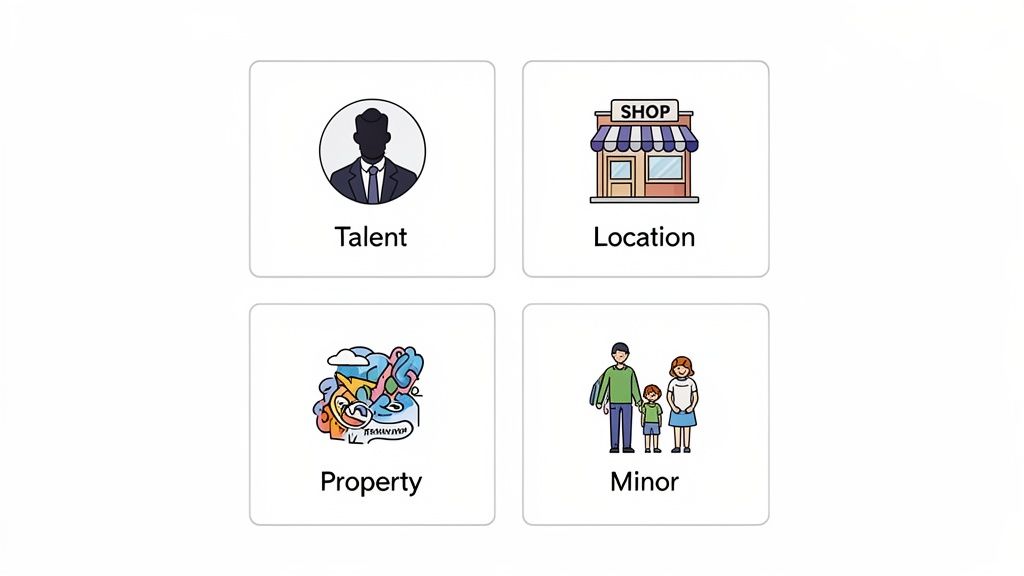
If you've ever felt a little overwhelmed by the paperwork in video production, you're not alone. The good news is that when it comes to release forms for video, it all boils down to four main types. Each one is designed to cover a specific legal base for your project.
Think of these four forms as your specialized toolkit. You wouldn't use a screwdriver for a nail, and you don't use a location release for a person. Getting the right form for the right situation is what keeps your production safe and sound. Let's break down each one.
Talent or Model Release Forms
This is the big one. A talent release form, often just called a model release, is your contract with anyone who appears recognizably in your video. This covers everyone from your lead actor to the person you're interviewing for a documentary.
The form gives you permission to use their likeness—their face, image, and even their voice. Without a signed release, anyone you filmed could come back later and demand you pull the footage or pay up.
You'll need one for:
- Every actor in a scripted film, even if they don't have any lines.
- The subject of a documentary interview before you can use their clips.
- An employee in a corporate video whose face is clearly identifiable.
A talent release is your proof of consent. It's the legal handshake that says, "I agree to be in your video, and I understand how you plan to use it."
Location Release Forms
Just like people, places need permission slips, too. A location release form is the agreement you sign with a property owner to film on their private land or inside their building.
This goes for both indoor and outdoor spaces. Whether you're shooting in a hip coffee shop, a private home for a short film, or even just the front lawn of a house, you need the owner's signature on a location release.
Skipping this step can land you in serious hot water. With the global video production market valued at a staggering USD 94 billion, the stakes are incredibly high. A 2024 survey found that 42% of creators have received takedown notices because of missing location permissions. For those using platforms like Creators Toolbox, having signed releases is shown to reduce legal disputes by 78%, saving an average of $12,000 per incident. Considering over 1.2 million YouTube videos were demonetized last year for consent-related issues, proper documentation is non-negotiable.
Property Release Forms
This form is a bit more nuanced but just as critical. A property release form gets you permission to feature specific, recognizable private property in your video. We're not talking about the building itself, but the unique items inside or on it.
This typically includes things like:
- Artwork: Distinctive paintings, sculptures, or murals.
- Logos and Branding: When a specific brand is a focal point and not just incidental background clutter.
- Unique Vehicles: A one-of-a-kind custom car that plays a role in a scene.
- Pets: Yes, even Fido might need a release signed by his owner, especially if the animal is a key "character."
If a painting is just a blurry shape in the background, you’re probably fine. But if your shot lingers on a famous piece of art hanging on the wall, you absolutely need a property release from the artist or copyright holder.
Minor Release Forms
This one is a hard-and-fast rule: when you're working with anyone under the age of 18 (or the local age of majority), you must get a minor release form signed. This is a special kind of talent release that has to be signed by the child's parent or legal guardian.
A minor cannot legally give consent to be in a commercial video project. A release form signed only by the child is worthless in the eyes of the law. The parent or guardian's signature is the only thing that makes the agreement valid.
There are no exceptions. Whether you’re filming a child actor for a national TV spot or a group of teens for a local skate shop ad, their guardians must sign for them. Forgetting this step is a huge legal risk that could make your entire project unusable. Always have a specific minor release form on hand if anyone under 18 is on the call sheet.
Essential Clauses Your Video Release Form Must Have
Alright, let's pop the hood on a standard video release form and look at the legal engine inside. While they can seem intimidating, most are built from a few key parts. Once you know what these clauses do, you’ll understand exactly what rights you're getting and what you’re promising in return.
Think of it like a pre-flight checklist. Each clause is an item you need to tick off to ensure your video has a smooth, legally-sound journey. Miss one, and you could ground the entire project before it ever takes off.
The Consideration Clause
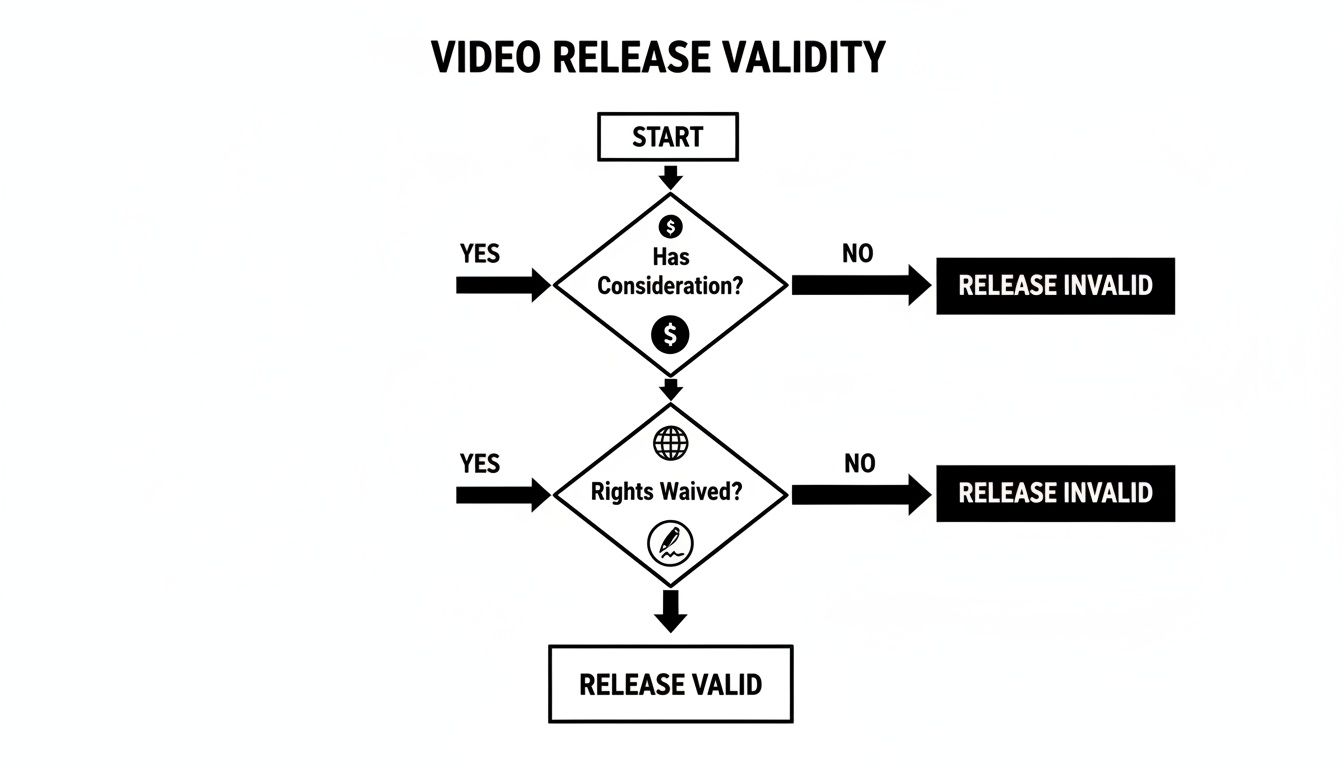
At its core, any valid contract involves an exchange of value. The consideration clause is simply the part that spells out what the person signing the release gets in exchange for giving you rights to their image, property, or performance. This "consideration" doesn't always mean a fat paycheck.
Sure, professional talent gets a fee, but consideration can be much simpler. Things like:
- A nominal amount, often just $1.00, to make the contract legally binding.
- The promise of exposure for an up-and-coming artist or influencer.
- A high-quality copy of the final video for their own portfolio.
- The simple opportunity to be part of a project they believe in.
The important thing is that something of value changes hands, even if it's not cash. This is what makes the agreement a two-way street and, more importantly, legally enforceable.
Scope of Use Grant of Rights
This is, without a doubt, the most important clause in the entire document. The scope of use, or "grant of rights," section details precisely how, where, and for how long you can use the footage. The more detailed you are here, the better protected you'll be down the road.
A rock-solid scope of use clause should grant you the right to use the footage:
- In Perpetuity: This means forever. You won't have to chase people down to renegotiate rights years from now.
- Worldwide: Your permission isn't limited by country or region.
- In Any and All Media: This covers today's platforms (web, social media, TV) and any future technologies that haven't even been invented yet.
A well-written scope of use clause is your future-proofing tool. It ensures that as technology and distribution channels change, your rights to the content remain intact without needing to track down every participant for new signatures.
Waiver of Rights and Release of Claims
This part works directly with the scope of use. In the waiver of rights clause, the person agrees not to sue you for how you use the footage, provided it falls within the scope you both agreed on. It essentially releases your production from future claims of libel, invasion of privacy, or right of publicity.
Basically, the person is saying they understand the context of the shoot and approve of it. It stops them from coming back later claiming they didn't like their portrayal or suddenly want more money. This clause is your primary legal shield.
For instance, a waiver will often say something like: "The Releasor hereby waives any right to inspect or approve the finished product... and releases the Producer from any and all claims... arising out of the use of the footage." That kind of language shuts the door on potential disputes.
Finally, a complete release form for video must also include your right to edit, alter, or combine the footage with other content. This gives you the creative freedom to cut, color correct, add music, and shape the final product without having to ask for permission for every little tweak. Getting all these clauses signed and sealed upfront is the mark of a pro.
When You Need a Release and When You Can Skip It
Figuring out exactly when you need a video release form can feel like guesswork on a busy set. While the safest answer is always "get one," reality often demands you make quick, smart decisions on the fly. It almost always boils down to two simple questions: can you clearly identify the person, and how do you plan to use the footage?
Think of it this way. If a person is just a random face in a massive crowd shot for your travel vlog, you're probably okay. But the moment you zoom in on that same person, making their face clear and central to the shot, the game changes completely.
When a Release Form Is Non-Negotiable
Some situations don't have a gray area. They scream for a signed release form, and skipping this step is just asking for trouble. If your project involves any of the following, make getting that signature your top priority.
- Commercial Use: This is the big one. If your video is meant to sell a product, promote a service, or make money in any way, you absolutely need a signed release from every single identifiable person. This covers everything from TV ads and social media promos to internal corporate videos.
- Identifiable Individuals: Anytime a person can be reasonably recognized—by their face, voice, tattoos, or other unique features—a release is a must. This is true even if they're just in the background.
- Filming on Private Property: You need a signed location release to film in a house, an office, a coffee shop, or any other space that isn't public property. This signature from the property owner is your proof that you weren't trespassing and have permission to use the footage.
The stakes for commercial projects are higher than ever. With digital video ad spending projected to jump from USD 187.52 billion to a staggering USD 659.16 billion by 2030, release forms are your best legal protection. One recent analysis even found that a whopping 66% of advertising disputes in 2022 were tied to missing releases. You can dig into more stats on the exploding video ad market here to see just how critical this is.
Release Form Decision Matrix
To make things even clearer, here's a quick decision matrix. Use this table to quickly assess whether you're likely to need a release for your specific scenario.
| Scenario | Subject/Location | Intended Use | Release Form Required? |
|---|---|---|---|
| Talent in a TV Commercial | Actor speaking directly to the camera | Commercial (Advertisement) | Yes (Model/Talent) |
| Background Crowd at a Public Festival | Unidentifiable faces in a wide shot | Editorial (Documentary) | No |
| Interview with a Bystander on the Street | A specific person's face and voice are the focus | Both (Could be editorial or commercial) | Yes (Model/Talent) |
| Filming Inside a Privately-Owned Cafe | The interior, branding, and layout of the cafe are visible | Commercial (Brand Video) | Yes (Location) |
| Footage of a Famous Building's Exterior | Exterior of a public landmark from a public sidewalk | Editorial (Travel Vlog) | Generally No |
| A Child Playing in a Brand's T-shirt | A minor's face is clearly visible, wearing branded apparel | Commercial (Social Media Ad) | Yes (Parental/Minor) |
| Your Own Home as a Film Set | Your personal living room used for a short film | Non-Commercial (Student Project) or Commercial | Yes (Location) |
This matrix isn't a substitute for legal advice, but it's a solid starting point for making informed decisions in the field. When in doubt, always err on the side of getting a signature.
The Gray Areas: Public Spaces and Editorial Use
This is where things can get a little tricky. When you're filming in a public place like a park or on a city street, the concept of a "reasonable expectation of privacy" comes into play. For the most part, people in public spaces can't expect total privacy, which sometimes means you don't need a release—but only under very specific circumstances.
The rule of thumb is this: if someone is just an incidental, anonymous part of a public scene, you're usually safe. If you single them out, interview them, or make them a focal point of the action, you need their permission.
This chart helps visualize what makes a release form legally sound. It needs to be a fair exchange.
Just as important is the line between commercial and editorial use. Editorial content, like a news report or a documentary, is created to inform the public, not to sell something. Because of this, it gets more flexibility. But if you take that same documentary footage and drop it into a paid advertisement, you've crossed the line into commercial use, and now you need releases for everyone. You can dive deeper into this topic in our guide on free vs. commercial use rights for digital assets.
At the end of the day, if you find yourself in a gray area, always play it safe. Taking a minute to get a signature can save you from months of legal headaches and thousands of dollars down the road.
How to Build Your On-Set Release Form Workflow

Knowing you need release forms for video is one thing. Actually getting them signed on a chaotic film set is a whole different ball game. A sloppy process for collecting signatures is just as bad as having no forms at all—it leaves you legally exposed.
The secret is to stop treating it like a last-minute chore and build it into your production routine. A solid, repeatable system makes getting releases signed a smooth and professional part of the day for your talent, crew, and yourself.
Pre-Production: Laying the Groundwork
Your success on set starts way before you ever yell "action!" Getting your paperwork in order during pre-production is the key to a stress-free shoot day.
Prep Your Templates: Get all your essential release forms—Talent, Minor, Location, and Property—finalized and ready to go. Store them in a shared cloud folder where your key production team can easily access them.
Have a Backup Plan: Digital is fast and efficient, but technology can fail. Always keep a few printed copies of each form in your kit. A dead tablet or weak signal should never be the reason you miss a crucial signature.
Assign a Point Person: Make sure your producer or production assistant knows exactly who needs to sign, which form they need, and when it should happen. The best practice is to designate one person as the "Release Manager" to own this entire process on the day.
On-Set Execution: Getting the Signature
When you're on location, every minute counts. Your talent and property owners are busy, and making the signing process quick and easy shows you respect their time.
One of the biggest mistakes I see is waiting until wrap to ask for signatures. People are tired, they want to go home, and some may have already left. Your leverage is gone. Make it one of the first things you do when they arrive on set.
This simple change turns a potential headache into a routine part of the check-in process.
Why You Should Go Digital-First
Switching your release forms for video to a digital workflow isn't just a trend; it's a massive upgrade. Using e-signature apps on a tablet is now the professional standard.
- Maximum Efficiency: Apps like DocuSign, PandaDoc, or Adobe Sign let you pre-fill project details. All the talent needs to do is enter their info and sign with their finger.
- Automatic Organization: Once signed, the forms are instantly saved to the cloud, timestamped, and backed up. This completely removes the risk of losing that one critical piece of paper.
- A Professional Look: Handing someone a tablet looks far more polished than a crumpled form on a clipboard. It instantly elevates the feel of your entire production.
The On-Set Signing Checklist
To ensure every signature you get is valid and complete, follow this simple process every single time.
- Explain the "Why": Politely and clearly tell the person what they're signing. A simple, "This is just a standard release so we have permission to use the footage we're shooting today," usually does the trick.
- Do a Quick Scan: Before they walk away, give the form a quick once-over to make sure every required field is filled in. The most commonly missed spots are the date, the witness signature (if you require one), and the signer’s printed name.
- Offer a Copy: Always ask if they'd like you to email them a copy of the signed form for their records. It's a small gesture that builds a lot of trust.
By making these steps a non-negotiable part of your production process, you create an ironclad system that protects your project. You can then put the paperwork out of your mind and focus on the creative work.
How to Store and Manage Your Signed Releases
Getting that signature on a release form is a great feeling, but your work isn’t quite finished. The final, and equally critical, step is to store these legal documents safely for the long haul. It's best to think of a signed release less like a permission slip and more like a permanent legal deed for your footage.
You need to hold onto these forms for the entire lifespan of your content. Seriously. If a legal issue comes up five or even ten years down the road, you'll need to pull out that signed form as proof of consent. A lost release is as bad as never getting one at all.
A signed release form is only useful if you can actually find it. A well-organized digital storage system means your legal protection is ready the moment you need it, no matter how much time has passed.
Build a Digital Fortress, Not a File Cabinet
Let's be honest, the days of dusty file cabinets are long gone. A physical system is just too risky—it's vulnerable to fire, water damage, or simply getting lost in a move. The professional standard is a solid digital storage system. It's more secure, searchable, and you can access it from anywhere.
For a truly efficient workflow, try linking your release forms directly to your video files. Many modern editing programs and asset management systems let you attach documents or add metadata right to your clips. Imagine being able to right-click a video file and instantly see the signed releases for everyone in that shot.
Professional Organization Best Practices
A messy cloud drive is just a digital junk drawer. To build a system that actually works, you need a consistent and logical structure, and that starts with a clear naming convention.
Adopt a standard format for every single file. A simple, effective method is: ProjectName_TalentName_ReleaseType_Date
For example:
SummerAd_JaneDoe_ModelRelease_2024-08-15.pdfDowntownCafe_LocationRelease_2024-08-14.pdfSmithFilm_JohnSmithJr_MinorRelease_2024-09-01.pdf
This simple habit makes it possible for anyone on your team to find a specific release form for video in seconds. This level of organization turns your archive from a potential headache into a powerful asset. You might also find that some of the most popular video review tools include features for managing these types of project assets. This foresight ensures that when a question pops up, you have the answer in minutes, not days.
Common Questions About Video Release Forms
Even the most buttoned-up production can hit a snag with paperwork. Let's tackle some of the most common "what if" scenarios that pop up with release forms, so you know exactly what to do when you're in a tight spot.
What if Someone Refuses to Sign After the Shoot?
This is a tough one, and it puts you in a real bind. But you do have a few moves. The absolute first rule: do not use the footage of them. Using someone’s likeness after they've explicitly refused to sign is a one-way ticket to a legal headache.
Here’s what you can do in the edit bay:
- Creative Editing: Is there a way to cut around them? Sometimes a different take, a new camera angle, or a quick trim is all you need to solve the problem.
- Shot Removal: This one hurts, but if they are the focus of a crucial shot, you may have to scrap it entirely. It's a painful decision, but it’s far safer than facing a lawsuit.
- Blurring or Obscuring: If their presence is unavoidable but not central to the story, digitally obscuring their face is a solid option. You see this all the time in documentaries and reality TV for people in the background.
This is exactly why getting signatures before you even hit the record button is the industry gold standard. It saves you from capturing incredible footage you can never, ever use.
Is a Verbal Agreement Enough?
In a single word: nope. A verbal "sure, go ahead" might feel reassuring on set, but it offers almost zero legal protection down the road. Verbal agreements are notoriously hard to prove in court. What were the exact terms? What did they actually agree to? It quickly devolves into a messy "he said, she said" standoff.
A written and signed release form for video is the only reliable and enforceable proof of consent. It removes all ambiguity by clearly documenting the who, what, where, when, and how of the agreement.
To get a better handle on the legal nuts and bolts, it helps to understand what is a release of liability form in a wider context. It makes it crystal clear why a handshake deal just doesn't cut it when things get serious.
Do I Need a New Release for a New Ad Campaign?
This question brings us right back to the importance of the "Scope of Use" clause we talked about earlier. The answer is completely dependent on what your original release says.
If your form gives you rights "in perpetuity, throughout the universe, in any and all media now known or hereafter devised," then you're probably in the clear. This kind of broad language is written for this exact situation, giving you the freedom to repurpose footage for new projects without chasing down new signatures.
But, if your original release was super specific—something like, "for use in the 2024 'Summer Sizzle' web campaign only"—then yes, you absolutely need a new release. Using that footage for a different ad would be a direct breach of your original contract. This is why a rock-solid, comprehensive scope of use clause is a creator's best friend.
At Creators Toolbox, we're dedicated to giving you the resources you need to produce professional, protected content. Sign up for our free weekly newsletter to get the latest tools, guides, and industry news delivered right to your inbox. Visit us at https://creatorstoolbox.co to learn more.