The Filmmaker's Guide to Release Forms for Film
By Steven Van ·
Master the legal side of filmmaking with our guide to release forms for film. Protect your project with templates for talent, location, and music releases.
Think of film release forms as the unsung heroes of your production. At their core, they are legally binding contracts that give you permission to use someone's likeness, a specific location, or copyrighted material in your film. These documents are your critical legal armor, protecting you from future lawsuits and clearing the path for distribution. Without them, your film could be dead on arrival, blocked from festivals, streaming platforms, and any chance of making money.
Why Release Forms Are Your Film's Legal Armor
I like to think of a film production like building a house. Every actor's performance, each location scouted, and every piece of music chosen is a brick. A release form is the legal mortar binding those bricks together, making sure the whole structure is solid.
Without that mortar, the entire project is one shaky step away from crumbling. Imagine spending months, or even years, pouring your heart into a film, only to have a key actor change their mind. Or maybe the owner of that perfect coffee shop from your pivotal scene decides they don’t want their business on screen after all. Just like that, your project is stalled.
Securing Your Creative Investment
Ultimately, getting release forms signed is all about protecting your creative and financial investment. These simple documents are your proof—your undeniable evidence—that you have the legal right to use every single element you've captured. For any kind of public screening or sale, this isn't just a good idea; it's non-negotiable.
One of the most important jobs of a release form is to ensure complete Intellectual Property Protection for your work. By getting every signature, you're building a clean chain of title, which is just the fancy industry term for the documented history proving you own your project. Distributors and major platforms like Netflix, Hulu, or Amazon Prime Video won't even look at a film without a perfect chain of title.
A film without proper release forms is like a product without a patent. It’s a brilliant idea with no legal protection, making it commercially vulnerable and nearly impossible to sell or distribute widely.
Here’s a quick breakdown of the most common release forms you’ll encounter on set. Think of this as your starting checklist for every production.
Quick Guide to Essential Film Releases
| Release Form Type | Who It's For | Why You Need It |
|---|---|---|
| Talent/Model Release | Actors, extras, interviewees, or anyone appearing recognizably on screen. | Grants you permission to use their image, likeness, and voice in your film and for promotional materials. |
| Location Release | Owners of private property (homes, businesses, land) where you film. | Gives you the legal right to film on their property and depict it in your final project. |
| Music Release | Composers, artists, or labels who own the rights to music used in your film. | Secures the license to use a specific song or score, covering both synchronization and master use rights. |
| Archival/Materials Release | Owners of copyrighted materials like photos, stock footage, or artwork shown in the film. | Provides permission to include third-party intellectual property in your project. |
| Minor/Guardian Release | The parent or legal guardian of any performer under the age of 18. | A legally required addendum to a talent release, as minors cannot consent for themselves. |
Getting these forms signed is the foundation of a legally sound production, allowing you to move forward with confidence.
More Than Just a Legal Formality
It’s easy to look at paperwork as a boring chore, but release forms are fundamental to your film's very existence. They’re proactive tools, not reactive fixes. They stop legal fires before they can even start, saving you from headaches and potentially devastating lawsuits down the road.
A huge part of being a professional creator is knowing what you can use for free and what requires explicit permission. If you want to go deeper on this, our guide on free versus commercial use rights for digital assets is a great resource. In short, getting your releases in order provides:
- Legal Peace of Mind: The confidence that comes from knowing your project is fully protected from claims of unauthorized use.
- Distribution Readiness: The ability to sell your film to any distributor or platform without hitting a legal wall.
- Professional Credibility: It shows your cast, crew, and investors that you run a tight ship and take the business of filmmaking seriously.
In the end, these forms aren't just about avoiding trouble. They are about creating opportunity. They transform your creative vision into a real, tangible asset that you can protect, market, and share with the world.
The 5 Essential Release Forms Every Filmmaker Needs
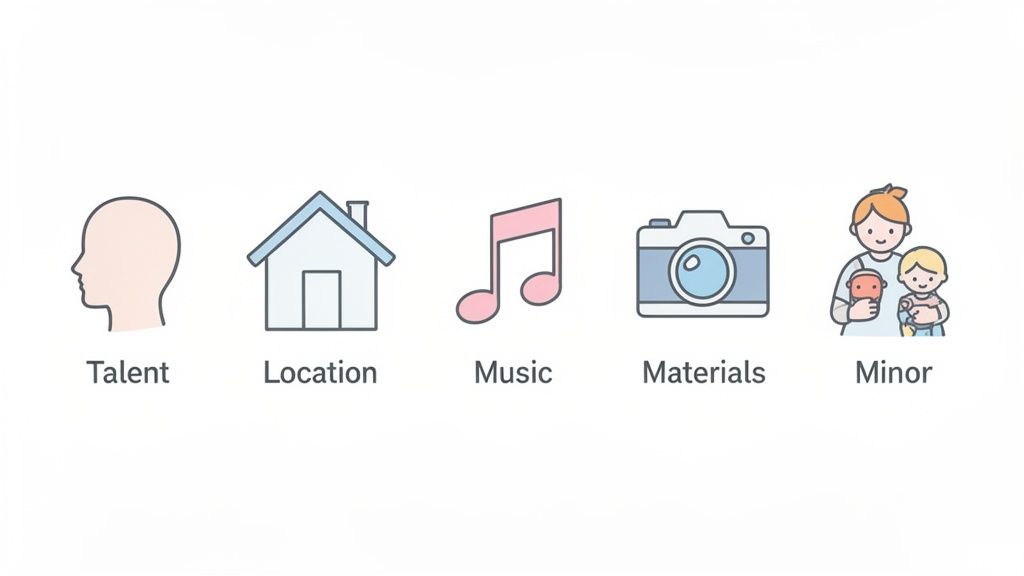
Diving into the world of film release forms can feel overwhelming, but it's more straightforward than you think. At the end of the day, not all releases are the same. Each one is designed for a specific job, protecting a different piece of your production. Getting a handle on these differences is your first step to building a bulletproof legal foundation for your film.
It’s like packing for a big trip. You wouldn’t just throw random clothes in a bag; you'd pack for the climate and activities. The same logic applies here—you need the right form for the right situation. Let's walk through the 5 core types you'll use on almost every project. As you start putting together your production binder, it's a smart move to work from well-drafted legal document templates to make sure you're not missing any crucial details.
1. Talent or Model Release
If you only learn about one release form, make it this one. The talent release is your golden ticket for anyone who appears recognizably on screen. It’s the contract that grants you permission to use their likeness, image, and voice in your project.
- Who Signs It: Any actor, interview subject, on-screen expert, or even a paid extra. If the audience can point them out, you need their signature.
- Why It's Essential: This form is your proof of consent. It stops someone from coming back later and claiming you used their image without permission, a situation that could derail your distribution or force you into a costly re-edit. For documentary filmmakers, this is everything.
Without a signed talent release, any footage featuring that person is practically useless.
2. Location Release
Think of a location release as renting the image of a property. This is your agreement with the owner of any private property where you film, giving you the legal right to both shoot on their premises and show that property in your finished film.
This covers all kinds of private spaces:
- An character's home or apartment
- The inside of a business, like a café or office
- A privately-owned farm, field, or forest
Even if your best friend lets you film in their house for free, you absolutely must get a signed location release. This protects you if they have a change of heart or if a future owner of the property doesn't want it seen in your movie.
Think of a location release as a deed for the visual rights to a space. It confirms you have permission not just to be there, but to capture and broadcast what it looks like to the world.
3. Music Release
Music can make or break a film's emotional impact, but using a track without clearing it is a surefire way to get into legal trouble. A music release, often called a music license, is the formal agreement you need to secure the rights to a copyrighted song.
Getting the rights is usually a two-part process. You need to clear both:
- Synchronization (Sync) License: This license comes from the music publisher, who represents the songwriter. It lets you pair, or "sync," the song with your video.
- Master Use License: This one comes from the record label, which represents the artist who performed the song. It gives you permission to use their specific recording.
If you miss either one of these, you could face massive fines and be forced to pull the music from your film.
4. Materials or Archival Release
Is your film going to feature old family photos, a clip of stock footage, or a clear shot of a painting on the wall? If the answer is yes, you'll need a materials release. This form grants you permission to include third-party copyrighted materials in your project.
This is especially critical for documentaries, which often lean on historical photographs, newsreels, and other pre-existing media. Trying to justify it as "fair use" is a gamble that rarely pays off. The only way to be completely safe is to get a signed materials release. It’s always a good idea to check out our most popular film resources to make sure you're covered in situations like these.
5. Minor or Guardian Release
This isn't really a separate type of release, but a critical, legally-required addition to a talent release. Anyone under the age of 18 is legally considered a minor and can't sign a binding contract on their own.
Because of this, their talent release form must be countersigned by a parent or legal guardian. This is a non-negotiable rule in most places. A release signed only by a minor is legally worthless. Always, always make sure a guardian signs to provide the necessary legal consent to film a young performer.
The Legal Anatomy of an Ironclad Release Form
So, what makes a film release form legally solid? It’s not about using dense legal jargon or making the document ten pages long. It’s actually just a few key sections, or clauses, that do all the heavy lifting.
Think of these clauses as the foundation of your project’s legal protection. If even one is missing or poorly written, the whole structure can become unstable. Getting to know these four critical elements will help you read any release with confidence and make sure your own paperwork is airtight.
Consideration: The Value Exchange
Every legally binding contract needs what’s called consideration. This is just a legal term for an exchange of value. It proves that both parties got something out of the deal, making it a formal agreement rather than just a casual promise.
This doesn't mean you have to pay a fortune. In fact, most release forms use a token amount.
You’ll often see language like "for one dollar ($1.00) and other good and valuable consideration." That dollar is usually enough to make the contract stick. The "other consideration" part can also cover non-monetary benefits, like the exposure an actor gets from being in your film.
Sample Clause Language "In consideration of the sum of one dollar ($1.00) and other good and valuable consideration, the receipt and sufficiency of which is hereby acknowledged, I hereby grant the Producer the rights outlined in this agreement."
This one sentence is incredibly important. It establishes that a value exchange happened, turning a simple permission slip into a real contract that can't be easily taken back. Without it, a court could decide no valid agreement was ever made.
Scope of Use: Defining Where and How
The scope of use clause is arguably the heart of your release form. It spells out exactly how, where, and for how long you can use the footage, likeness, or location. If this section is vague, you’re leaving yourself open to major legal headaches down the road.
Your goal here is to be as broad as possible. You need to think about every way you might use your film now and in the future—even for technology that hasn't been invented yet.
A strong scope clause should cover:
- All Media: This includes everything from film festivals and theatrical runs to TV broadcasts, streaming on platforms like Netflix or YouTube, and any future media formats.
- All Purposes: You need rights not just for the film itself, but for all promotional materials—trailers, posters, social media clips, advertisements, and behind-the-scenes content.
- Modification Rights: This gives you the right to edit, color-correct, cut, or alter the material as you see fit for the final product.
A weak scope is like a fence full of holes. It looks like it’s providing protection, but it leaves you exposed. A bulletproof scope gives you the creative and commercial freedom you need to get your film out into the world.
Term: How Long the Permission Lasts
The term defines how long your permission lasts. For any film project, the industry standard is to secure rights forever. In legal terms, this is called "in perpetuity."
Why is this so critical? Imagine you only secured the rights for 10 years. After that decade, the actor or property owner could suddenly demand more money or even tell you to stop showing the film. No distributor or streaming platform will touch a project with an expiration date on its rights.
Sample Clause Language "The rights granted herein shall be worldwide, in perpetuity, and for use in any and all media now known or hereafter devised."
This language makes sure your rights never expire. Securing rights "in perpetuity" protects your film as a long-term asset and ensures its commercial potential isn't cut short.
Waiver of Claims: The Promise Not to Sue
Finally, the waiver of claims is your legal shield. With this clause, the person signing agrees to give up their right to sue you over things related to their appearance in the film. This covers potential claims like defamation, invasion of privacy, or infringement on their right of publicity.
This section protects you if someone has a change of heart after seeing the finished film. By signing the release, they're formally acknowledging your right to portray them as outlined in the agreement and are waiving their right to take legal action later. It's the final piece of the puzzle that lets you move forward with production and distribution with peace of mind.
How to Manage Your Production's Paperwork Like a Pro
Having the right film release forms is just the first step. How you manage that paperwork is what really protects your project, turning a stack of paper into a legal fortress. A disorganized system can easily lead to lost forms, missing signatures, and a film that's legally impossible to sell.
Let's walk through a clean, repeatable workflow for handling all your releases. This isn't just for big studio features; this process works just as well for a weekend short film as it does for a multi-week commercial shoot. The goal is to make documentation a smooth, natural part of your production rhythm, not a chaotic mess you clean up later.
Before You Roll Camera, Preparation Is Key
Your management process begins long before anyone shows up on set. Being proactive here is the difference between a smooth shoot day and a frantic scramble for signatures.
- Prepare Forms in Advance: Get all your necessary releases—talent, location, minor, and so on—printed out and organized in a production binder. It's also smart to have digital copies ready to email or pull up on a tablet.
- Pre-fill Known Information: Save precious time on set by filling in the production company name, project title, and date on every form beforehand. The only thing left should be for the person to fill in their details and sign.
- Create a Tracking Sheet: Make a simple spreadsheet or checklist. List every single person, location, or piece of material that needs a release. As you get each signature, you check it off. This gives you a live look at where you stand legally.
A little prep work transforms what could be a time-consuming hassle into a quick, professional exchange.
The diagram below shows the core principles that need to be clearly documented in every form for your management process to be truly effective.
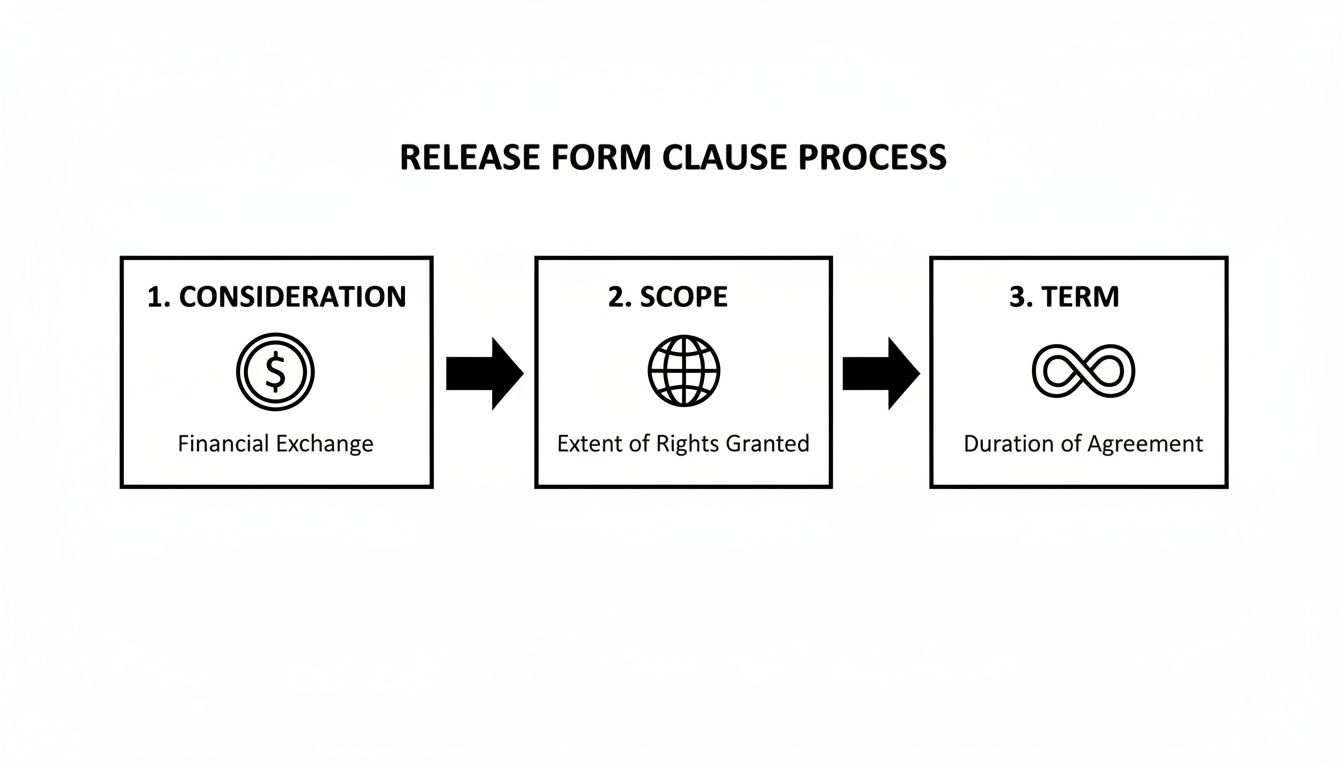
This visual flow emphasizes that from the exchange of value to the scope and duration of rights, each step builds on the last to create a legally solid document.
Getting Signatures Without Slowing Down Production
The moment of signing is critical. You have to be efficient and clear, making sure everyone understands what they’re signing without bringing the entire shoot to a standstill.
Designate one person—usually a producer or production coordinator—as the Release Manager. This person is solely responsible for tracking who has signed and who hasn't. This prevents any confusion and makes sure nobody slips through the cracks. It's their job to politely get that signature as soon as talent arrives on set or a location owner hands over the keys.
Don't wait until the end of the day to collect signatures. People are tired and just want to go home, making it easy to miss someone. The best practice is "No Signature, No Set," meaning talent signs their release before they even step in front of the camera.
The Rise of Digital Signatures
A wet ink signature on paper is the old-school standard, but digital e-signature platforms like DocuSign or Adobe Sign offer some serious advantages. In fact, some studies show businesses can cut their document handling costs by up to 85% by going digital.
- Speed and Efficiency: You can email a release and get it signed in minutes, no matter where the person is.
- Clear Audit Trail: Digital platforms create a concrete record of who signed, when they signed, and where they signed from, adding another layer of legal security.
- Centralized Storage: Signed forms are automatically saved to the cloud, which means you don't have to worry about a physical piece of paper getting lost or damaged.
Creating a Permanent Archive
Once a release is signed, your job isn't over. You need to create a secure, permanent archive for these critical legal documents. Years from now, your ability to produce these forms could be the deciding factor in a distribution deal.
It’s best to maintain both a digital and a physical archive:
- Digital Archive: Scan every physical release and save them with your digitally signed ones. Organize everything in a clearly labeled folder system (e.g., "Project Name" > "Releases" > "Talent," "Location"). Back this main folder up in at least two places, like on an external hard drive and a cloud service (Google Drive, Dropbox). For extra help on more complex projects, you can look into tools built for producers. To learn more, check out our insights on how Producer AI can help organize your workflow.
- Physical Archive: Keep the original signed paper copies in a safe, dry place, like a fireproof filing cabinet. These originals are your ultimate backup if a digital copy is ever questioned.
Of course. Here is the rewritten section, following all your requirements for a natural, human-written style.
Navigating Special Cases and International Productions
Your standard talent and location releases will get you through most shooting days, but filmmaking loves to throw a wrench in the works. Sooner or later, you’ll run into a situation that your basic paperwork doesn't cover, whether you're filming overseas or just trying to capture a busy city street.
Think of it this way: your go-to release form is like a trusty Phillips head screwdriver—it handles most jobs perfectly. But every so often, you’ll encounter a specialized screw that requires a specific tool. Knowing how to handle these special cases is what separates a smooth production from a legal nightmare.
Crossing Borders and Jurisdictions
What works for a shoot in New York won't necessarily fly in Paris. Legal requirements for release forms can change dramatically from one country to another, and even between states. Different places have their own laws on privacy, publicity rights, and what makes a contract legally binding.
For any international production, this is non-negotiable:
- Consult Local Counsel: Always hire a lawyer who knows the local laws inside and out. They can either give your existing forms a stamp of approval or draft new ones that are fully compliant.
- Consider Language Barriers: If your talent or property owner speaks another language, you absolutely need to provide a translated version of the release. This ensures they know exactly what they’re signing.
- Address GDPR and Privacy Laws: Filming in Europe? The General Data Protection Regulation (GDPR) has strict rules on using a person's image. Your releases will likely need specific clauses to meet these standards.
Union Rules and SAG-AFTRA
If you're working with union talent, like actors from SAG-AFTRA, you play by their rules. Forget your standard production release; unions have their own detailed contracts that cover everything from pay and working hours to how an actor's performance can be used.
A union contract almost always supersedes a generic talent release. Trying to hand a SAG-AFTRA performer your own form isn't just unprofessional—it will be rejected, and it could bring your production to a halt.
Handling Crowds and Incidental Appearances
So, you’re filming in a public square packed with people. You can't possibly get a signed release from every person in the background. This is where crowd notices save the day.
You just need to post large, easy-to-read signs at every entrance to your filming area. The sign should clearly state that filming is in progress and that by entering the space, people consent to being filmed and having their likeness appear in your project. This creates a form of implied consent for anyone who happens to be in the background.
Speaking of precision, it’s interesting to see how that concept applies in totally different fields. For instance, the market for high-performance release films—used in manufacturing high-tech electronics—was valued at around $800 million in 2023. The meticulous specs for these industrial films are a world away from our legal forms, but it shows how critical precision is everywhere. You can read the full research on high-performance release films to see how that industry is growing.
Clearing Logos and Trademarks
Watch out for brand logos or trademarks creeping into your shots. If a Coca-Cola can or a Nike swoosh is clearly visible, you’re opening yourself up to a potential trademark infringement claim. While getting a release from a major brand is the safest route, it's often a long and difficult process.
Instead, you have a few practical options:
- Avoid It: The easiest solution is to frame your shots to exclude logos altogether.
- Art Department Magic: Your art department can work wonders by "greeking" props—altering logos just enough to make them unrecognizable.
- Get Clearance: If a specific brand is essential to your story, you have no choice but to contact the company’s legal department and get written permission.
How Release Forms Fuel Your Film's Financial Success
It’s easy to think of release forms as just boring legal paperwork—a box-ticking exercise to keep lawyers happy. But that’s only half the story. The real value of your release forms for film is financial. They’re the engine that turns your creative project into a product you can actually sell.
Think of it like this: a distributor, broadcaster, or streaming service is basically an investor. Before they put a single dollar into acquiring or marketing your film, they perform their due diligence. They need to see a perfect chain of title, which is the unbroken paper trail proving you own every single part of your film, free and clear. Your stack of signed releases is the most critical link in that chain.
Turning Paperwork into Profit
What happens if a release is missing? Your film suddenly has a “clouded title.” That’s a massive red flag for any potential buyer.
No major platform like Netflix, Hulu, or a theatrical distributor will even consider a project with potential legal bombs waiting to go off. They can’t risk investing millions in distribution only to get hit with a lawsuit from an actor who never signed on the dotted line or a coffee shop owner whose location appeared without permission.
Your film is not a commercially viable asset until every single release is signed and accounted for. It's the final step that transforms your creative vision into a marketable product ready for the global marketplace.
This need for a clean legal slate isn't unique to filmmaking. Imagine a real estate developer trying to sell a skyscraper but they can't prove they actually own the land it's built on. No one would buy it, right? Your film is that skyscraper, and your release forms are the land deeds. Without them, you don't really own what you're trying to sell.
For a bit of industry context, the global release film market—a different kind of "release"—was valued at $7,626.81 million in 2021. This market makes adhesive liners for products, where a flawless release is essential for manufacturing. Just as those industries need precision for a smooth production run, filmmakers need flawless legal releases for a smooth distribution run. You can discover more about the release film market's growth and see how precision enables success across completely different fields.
From Protection to Opportunity
So, getting those signatures isn't just about avoiding problems; it's about creating opportunity. Every signature you collect opens another door to getting your film seen and securing its financial future. It’s what allows you to walk into negotiations with confidence.
Here’s the bottom line:
- Monetization Requires Releases: You cannot legally sell, license, or stream your film without them.
- Investors Demand Them: A clean chain of title is a non-negotiable for any serious buyer or distributor.
- They Create Asset Value: Proper releases are what turn your creative work into a tangible, sellable asset.
So next time you're chasing down a signature, don't think of it as a chore. You're building your film’s value, one signature at a time.
Common Questions About Film Release Forms
Even after you’ve got a handle on the basics, tricky situations always seem to pop up on set. Figuring out the gray areas of release forms for film can feel like a minefield, but knowing the answers to a few common questions will give you the confidence to protect your project.
Think of this as your go-to guide for those "what if" moments. Getting these scenarios right is what keeps your production's legal footing solid from day one.
Do I Need a Release for Someone in the Background?
This is the classic "it depends" answer that drives filmmakers crazy. The safest route? If you can clearly recognize someone's face in the background, get a signed talent release. It only takes one person to spot themselves and cause a major distribution headache later.
Of course, getting a release from every single person in a massive, unidentifiable crowd just isn't practical. This is where a Crowd Notice comes in. You simply post large, easy-to-read signs at every entrance to your filming location. The sign should clearly state that filming is in progress and that by entering the area, people are consenting to be filmed.
A crowd notice works as implied consent for people who just happen to be in the shot. But remember, this is only for incidental appearances. If you feature, interview, or have someone interact with your main talent, you absolutely need a direct, signed release. That part is non-negotiable.
Is a Verbal Agreement to Be Filmed Legally Binding?
In nearly every situation, the answer is a hard no. While you might technically have a verbal contract, proving it in court is incredibly difficult and expensive. More importantly, no distributor, broadcaster, or streaming service will ever accept a verbal agreement as part of your film’s official paperwork.
They need written proof, plain and simple. A signed, written release form is the undisputed industry standard and the only way to reliably secure the rights you need to sell or screen your film. Always, always get it in writing.
What if Someone Wants to Withdraw Consent After Signing?
This is exactly why your release forms need to be ironclad. A properly drafted and signed release form is almost always irrevocable, which means the person can't just take it back. This is where those "in perpetuity" and "waiver of claims" clauses really earn their keep.
As long as the release was signed by a legal adult (or a minor's guardian), without any force or deception, and for some form of "consideration" (even just $1), it’s a binding contract. Their change of heart doesn't undo the agreement, which means your right to use the footage is secure.
At Creators Toolbox, we're dedicated to giving you the resources you need to succeed. Stay ahead of the curve with our weekly roundup of the latest news, tools, and guides for digital creators at https://creatorstoolbox.co.