Perplexity Computer defaults its subagents to GPT-5.6 Terra
By Steven Van ·
Automations now run on Luna instead, splitting agent work by cost and speed across OpenAI's new model tier.
Perplexity announced on August 6 that OpenAI's GPT-5.6 Terra and GPT-5.6 Luna are now live in Perplexity Computer, its agentic workspace. Terra becomes the new default model for all Computer subagents and is also available as an orchestrator model, while Luna takes over as the primary model for scheduled automations. It is a quiet update on the surface, but it decides which brains run the agents doing your research, coding, and recurring tasks, so it is worth understanding what changed and why.
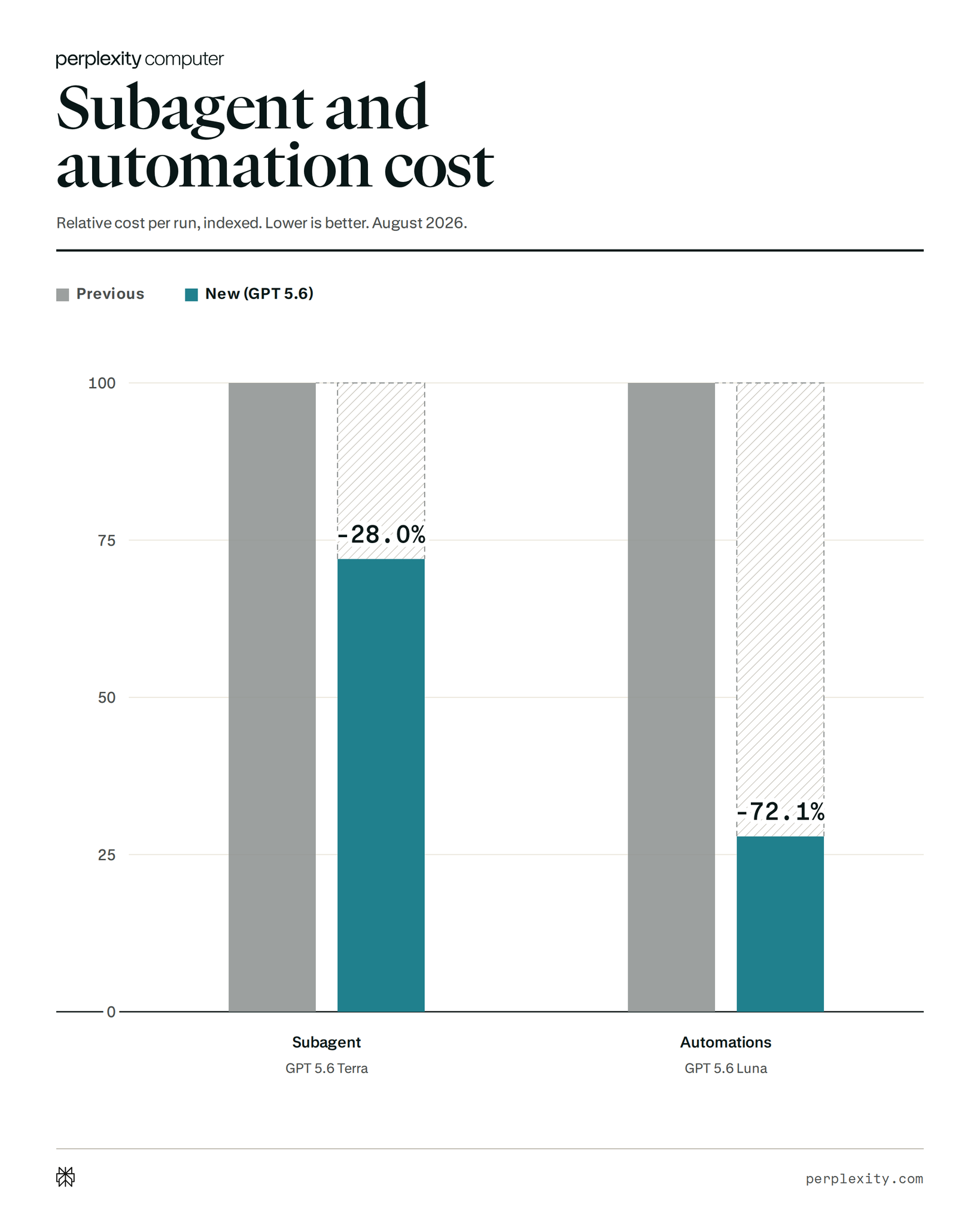
Terra runs the subagents, Luna runs the schedule
Perplexity Computer works on an orchestrator-and-subagents pattern: an orchestrator model takes your high-level goal, breaks it into discrete tasks, hands each task to a subagent, and stitches the results back together. With this update, every subagent defaults to GPT-5.6 Terra, the mid-tier model in OpenAI's 5.6 family, and you can also pick Terra as the orchestrator itself. Luna, the fastest and cheapest member of the family, becomes the workhorse for scheduled automations: the recurring digests, monitors, and reports that fire on a timer and reward speed over deliberation.
The price-performance math behind the assignments
The role split maps directly onto OpenAI's pricing for the GPT-5.6 family. As Crypto Briefing lays out, Sol sits at the top at 5 dollars per million input tokens and 30 dollars per million output tokens, Terra lands in the middle at 2.50 dollars in and 15 dollars out, and Luna is the budget tier at 1 dollar in and 6 dollars out. Subagent work involves many parallel model calls per task, so running it on Terra rather than a flagship model cuts costs roughly in half while keeping reasoning quality high enough for research and coding. Automations run constantly in the background, which makes Luna's speed and price the sensible default there. Routing each layer of the system to the cheapest model that can handle it is becoming the standard playbook for agent platforms, and this update is Perplexity applying it at the defaults level so users get the benefit without touching a setting.
Computer keeps shipping at a weekly pace
The model swap lands on top of a busy stretch for Computer. Perplexity's own changelog from early August lists Projects with shared files and Brain, Personal Computer for Windows, and a Model Council mode for comparing answers across models side by side. Add Terra and Luna, and the picture is a product iterating weekly on both capability and cost, which is exactly what you want from a tool positioned as the place your agents live.
What it changes for your Computer workflows
If you use Computer for multi-step jobs, the practical effect is that the same subscription credits should stretch further, and Perplexity's recently launched Computer Analytics lets you verify that by tracking credit consumption per model. The update also reinforces Perplexity's core pitch of model flexibility: GPT-5.6 variants sit alongside options like Claude Sonnet 5 and Grok 4.5 for Pro and Max subscribers, so you can match the model to the job instead of being locked to one vendor. For creators running scheduled briefs, competitor monitors, or content pipelines through Computer, nothing needs reconfiguring. Your subagents simply switched to Terra, your automations to Luna, and the sensible move is to spot-check the next few runs and watch your credit usage trend down.