Location Release Forms: Essential Guide for Creators
By Steven Van ·
Discover essential location release forms: key clauses, mistakes to avoid, and tips to protect your film or photo projects.
So, what exactly is a location release form? At its simplest, it's a legal contract giving you permission to film or photograph on someone else's private property.
Think of it as your official passport for any creative project. It’s the document that proves you have the right to use the footage or photos you capture commercially, saving you from a world of legal headaches down the road.
Why a Location Release Form Is Your Best Insurance Policy
Picture this: you've just wrapped a tough, multi-day shoot for a big ad campaign. The footage is stunning, the client loves it, and you're ready to celebrate. But then your phone rings. It's the owner of that cool, rustic barn you filmed in. They saw a post about the shoot online and are now threatening to sue, claiming they never agreed to their property being used for a project of this size.
Without a signed location release, that phone call could tank your entire project. This piece of paper isn't just a formality; it's a critical insurance policy protecting you, your client, and your work from expensive legal battles.
Securing Your Creative Rights
Fundamentally, a location release transfers specific rights from the property owner to you, the creator. It’s the official green light that lets you feature their property in your work. This is absolutely essential for commercial projects—anything designed to make money, promote a service, or be sold.
Most distributors, broadcasters, and major streaming platforms won't even look at your project without a clean "chain of title," which is just a fancy term for a complete paper trail of all your legal permissions. A single missing location release can stop distribution dead in its tracks and make your project impossible to sell.
A well-executed location release form is your first line of defense against legal claims. It clearly lays out the agreement between you and the property owner, preventing any confusion over payment, how the footage will be used, and who is responsible for what.
Protecting Both Parties Involved
This agreement isn't a one-way street. It also offers real protection for the property owner, which often makes them much more comfortable with signing on the dotted line. A solid release form clearly defines the boundaries of the production so there are no surprises for anyone.
Here’s how it protects both sides:
- Defining Access: It specifies exactly when and where your crew can be, so you don't have people wandering into unauthorized areas.
- Outlining Compensation: It details any payment, on-screen credit, or other compensation you've agreed on, preventing future financial disputes.
- Addressing Alterations: It sets clear rules for any changes you might make to the property (like hanging new art or painting a wall) and your responsibility to return it to its original state.
- Limiting Liability: It can include an indemnification clause to protect the property owner if a crew member gets hurt, and it can also protect you if your production activities cause unintentional damage.
Ultimately, a location release turns a simple handshake into a solid, enforceable agreement. It establishes a sense of professionalism and trust right from the start, giving you the peace of mind to focus on your creative vision without worrying about a legal nightmare derailing all your hard work.
Knowing When You Absolutely Need a Release Form
So, when do you really need a location release? The easiest way to think about it is by asking one simple question: is the property private? If you’re shooting on private property for any kind of commercial project, the answer is always yes. You absolutely need a signed release form.
It’s surprisingly easy to get tripped up by places that feel public but are actually privately owned. We see it all the time. Think about all the great spots you might want to film:
- The cool, vibey interior of a local coffee shop.
- The massive, brightly-lit concourse of a shopping mall.
- A beautifully landscaped plaza right outside a corporate skyscraper.
Even though anyone can walk into these places, they are private property. The owner has every right to say how their property's image is used, especially if it’s for a project that makes money. Trying to get by without a release in these situations isn't just cutting a corner; it's taking a huge risk.
This simple decision tree can help you figure out what to do.
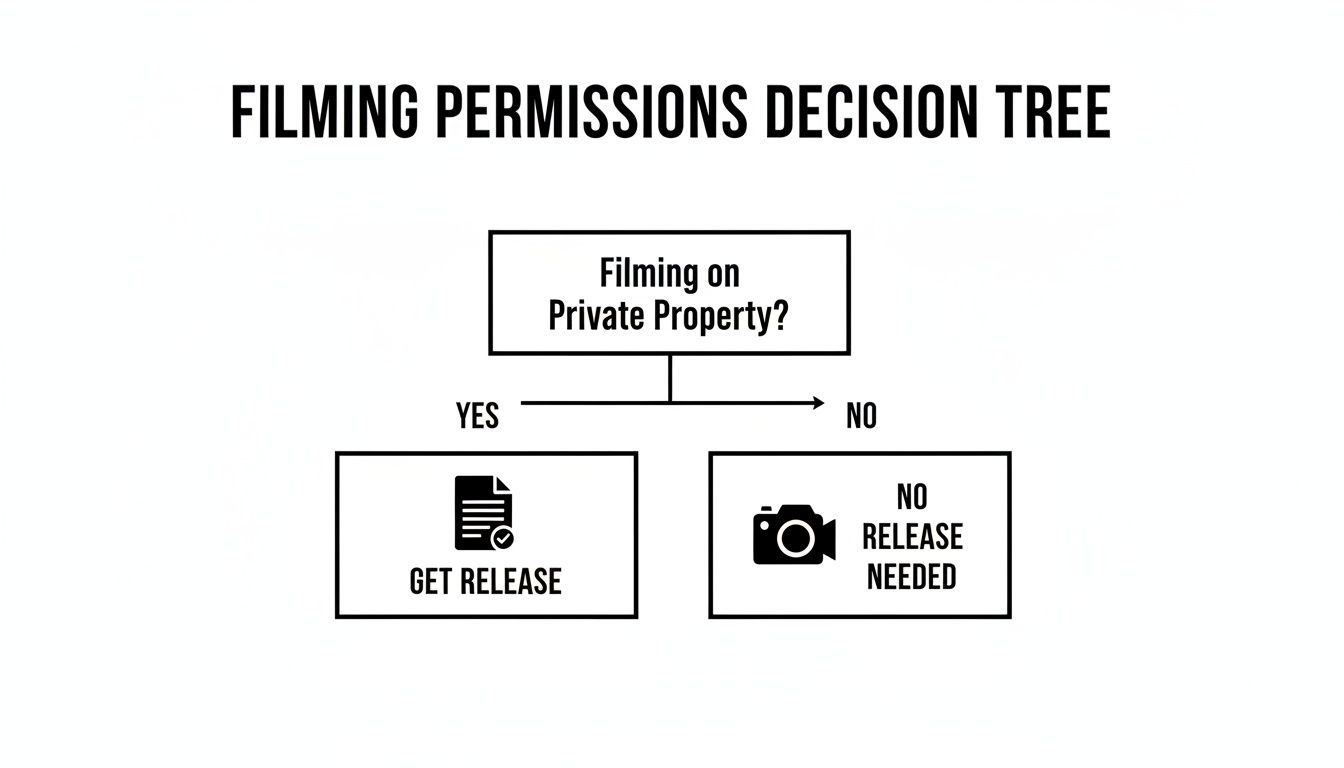
The bottom line is clear: if you’re shooting on property someone else owns, getting a signed release should be your default move. It's just smart practice.
The Gray Areas and Hidden Risks
The need for a release goes beyond just planting your tripod inside a building. Some situations are a bit murkier, but the legal risks are just as real. Getting a feel for these nuances is what separates amateurs from pros.
Imagine this: you're filming a scene for your indie film on a public sidewalk, but the stunning, one-of-a-kind facade of a private home is featured prominently in the background. Even though you’re on public land, if that house is a key, recognizable part of your shot, the owner might have a claim.
The same goes for that B-roll you're shooting for a client. If you're filming an interview on the street and the inside of a high-end boutique is perfectly visible through the window, you're wading into a gray area. The more a private property is featured and the more identifiable it is, the stronger the argument that you need a location release.
Real-World Consequences of Skipping the Form
Forgetting—or deciding to skip—a location release isn't a minor paperwork slip-up. It can completely derail your project. A crew we know filmed a short for a viral video challenge in a cool, rustic warehouse. The video blew up, pulling in millions of views and attracting brand deals.
The problem? The warehouse owner recognized their property and, since they never signed anything, demanded a huge cut of the profits. Without a release form, the crew's negotiating power was practically zero.
Think of a location release as a way to solve problems before they happen. It turns a verbal "sure, you can film here" into a clear, written agreement, preventing the property owner from changing their mind or demanding more money after you've wrapped.
The numbers back this up. Globally, it's estimated that properly signed location release forms prevent around 90% of property-related lawsuits in media production. In the U.S. entertainment industry alone, these simple agreements head off more than 15,000 potential legal fights every single year.
This one document is your best shield. Once all your releases are signed and the footage is in the can, you can start putting it all together. If you're new to that part of the process, check out our guide on video editing for beginners to get started.
Anatomy of a Legally Sound Location Release Form
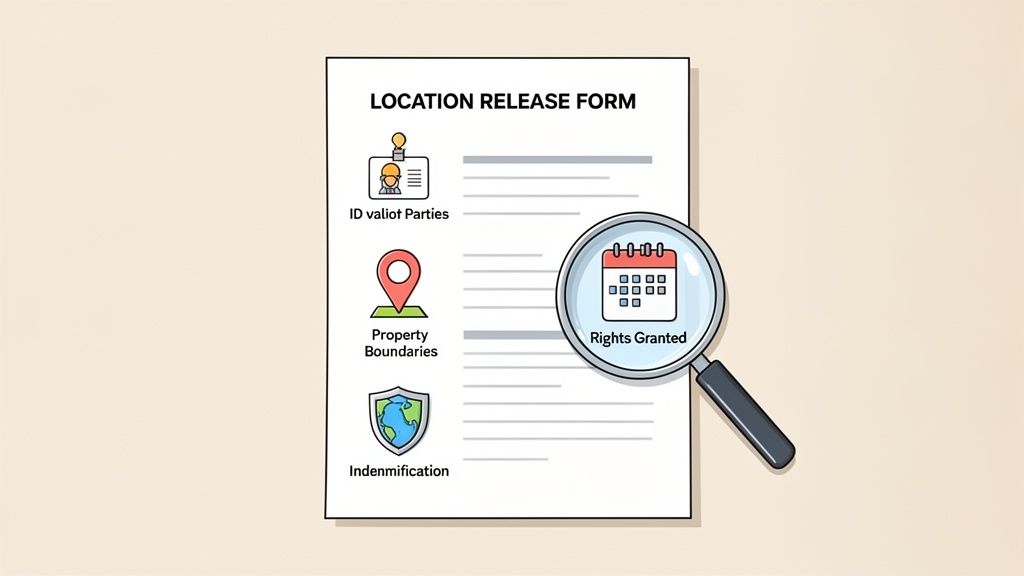
Think of your location release form less like a single document and more like a set of legal building blocks. Each clause is a brick in the wall protecting your project. If you miss one, you risk the whole structure coming down on you.
Let’s get into the essential components you absolutely need to build a rock-solid agreement.
Identifying the Key Players and Property
First things first, your form needs to answer the basics: who, what, and where? This isn't a place to be vague; precision is your best friend.
- Parties Involved: Clearly name the production company (the "Producer") and the property owner (the "Owner"). Use their full legal names and business names to eliminate any confusion down the road.
- Property Description: Write out the full, official address of the location. If your access is limited—say, you can only shoot in the kitchen and living room but not the upstairs bedrooms—spell that out explicitly. This simple step can save you from a trespassing claim later.
- Project Title: Always include the working title of your project. This tethers the release directly to your specific film, video, or photoshoot.
Getting these foundational details right sets the stage for the entire agreement, ensuring everyone is on the same page before you even roll the first take.
Defining the Rights Granted
Now for the engine of your release form: the Rights Granted clause. This is the section that dictates what you’re actually allowed to do with the footage you capture. Without a strong rights clause, your release is just a piece of paper.
Your goal here is to be as broad as possible. A solid clause will grant you the right to record the property and use those recordings however you see fit. Look for language that gives you rights "in perpetuity" (forever), "worldwide" (in any country), and across "all media now known or hereafter devised" (which smartly covers any future tech that hasn't been invented yet).
This forward-thinking language stops a property owner from claiming you can’t use the footage on a new social media platform just because it didn't exist when you signed the form. You’ll also want to specify your right to show the location as-is or alter its appearance in post-production. You can learn more about the nuances between free and commercial use rights for digital assets.
The Indemnification Clause and Other Legal Safeguards
While the rights clause gives you power, the Indemnification Clause gives you protection. This is your legal shield. It’s a formal agreement where both you and the property owner agree not to hold each other responsible for certain types of problems.
For example, a standard indemnification clause protects you, the producer, from any claims that arise if the owner didn't actually have the authority to grant you permission to film. This protection is invaluable. In production hubs like Los Angeles and New York, over 80% of independent productions rely on these forms for a reason.
In fact, a well-written indemnification clause reportedly saved one production company $250,000 in legal fees during a 2022 property damage dispute. To ensure every clause holds up, it helps to understand the fundamentals of drafting effective release agreements.
An indemnification clause is a "hold harmless" agreement. It's a formal way of saying, "If a problem arises that is your responsibility, you agree to handle it and not sue me, and I'll do the same for you."
To pull it all together, let's look at the must-have clauses you’ll find in any professional location release form.
Here’s a quick breakdown of what each part does and why it matters.
Key Clauses in a Location Release Form
| Clause Title | Purpose and Importance | Sample Wording Example |
|---|---|---|
| Identification of Parties | Clearly names the producer and property owner to make the contract legally binding between the correct entities. | "This agreement is made between [Production Company Name] ('Producer') and [Property Owner Name] ('Owner')." |
| Property & Scope | Defines the exact physical address and the specific areas where filming is permitted to prevent access disputes. | "Owner grants Producer the right to enter and use the property located at [Full Address], specifically the [e.g., backyard and patio area]." |
| Compensation | Outlines the agreed-upon payment, credit, or other considerations to prevent future financial disagreements. | "In consideration of the rights granted herein, Producer agrees to pay Owner the sum of [Amount] on or before [Date]." |
| Rights Granted | Grants the producer the legal authority to use the footage of the property commercially and without restriction. | "Producer shall have the right to use, distribute, and exhibit the footage in all media throughout the universe, in perpetuity." |
| Indemnification | Protects both parties from liability. For example, it protects the producer if the owner didn't have the right to sign. | "Owner agrees to indemnify and hold harmless the Producer from any and all claims arising from a breach of Owner's warranties." |
| Signatures | The legally binding confirmation from both parties, making the agreement official and enforceable. | "[Signature Lines for Both Producer and Owner with Printed Name, Title, and Date]" |
Nailing these clauses doesn't just give you a document; it gives you peace of mind. You can focus on creating great work, knowing the legal foundation of your project is secure.
Embracing Digital Workflows for Location Releases
Let's be honest, chasing down property owners with a clipboard and a pen is a headache. Juggling stacks of paper on a busy set is a recipe for misplaced forms, delays, and a whole lot of unnecessary stress. Thankfully, modern productions are ditching the paper chase for a faster, cleaner digital workflow.
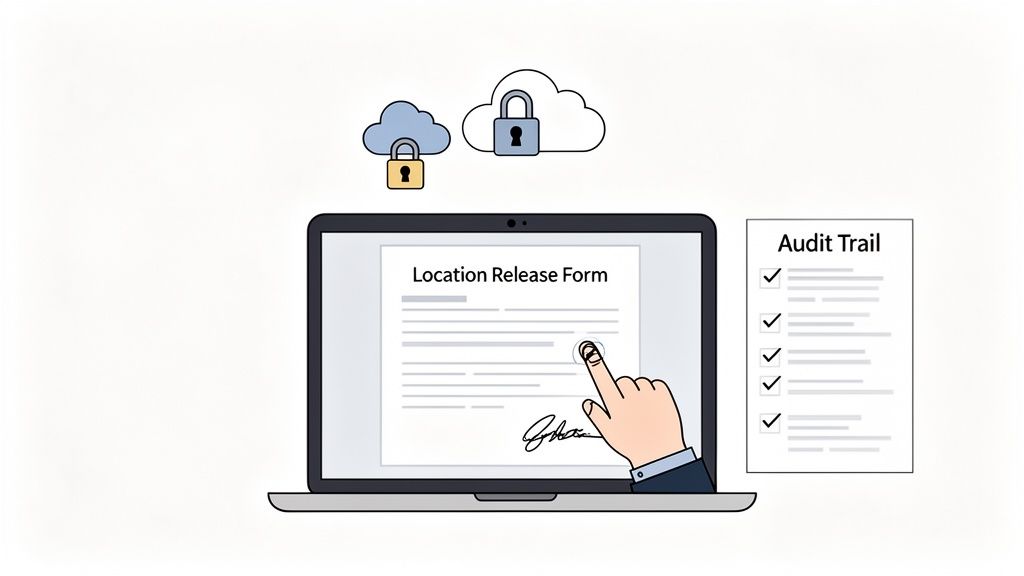
Think of the old paper method like mailing a physical letter. It gets there eventually, but it's slow, you can't track it, and it might just get lost. A digital workflow is like sending a secure, instant message with a read receipt—it's immediate, verifiable, and gives you a clear record of every step.
This isn't just a minor tweak; it’s a huge improvement. The adoption of digital location release forms skyrocketed by over 300% in the film and event industries after 2020. According to eSignGlobal, a process that once took 2-5 days with paper can now be done in under 15 minutes. For productions handling over 100 locations a year, that can mean cutting storage costs by 75%. It's no wonder that 82% of freelancers now prefer digital methods for the pure convenience. You can read more about how digital forms are changing production on eSignGlobal.
Key Advantages of Going Digital
Making the switch is about so much more than saving paper. It's about saving time, money, and your sanity on set. The right tools can completely transform how you handle legal paperwork.
Here are the main benefits you'll see right away:
- Speed and Efficiency: A property owner can review and sign a release on their phone in minutes. No printing, scanning, or mailing required. This is a game-changer when you're on a tight schedule.
- Centralized Organization: Forget digging through a filing cabinet. All your signed documents are stored securely in the cloud, ready for you to access from any device, anytime.
- Enhanced Legal Security: This is a big one. Digital signature platforms provide a detailed audit trail—a digital log that tracks every single action, like who opened the form, when they signed, and from what IP address. This adds a powerful layer of legal proof that a simple wet-ink signature can't offer.
These features simplify permissions for everyone, from a solo photographer on a day shoot to a large agency juggling multiple projects. You can also check out our guide to the best tools for photographers, which covers other software that can streamline your work.
Building Your Digital Release Form Process
Getting started with a digital system is surprisingly simple. It really just comes down to picking the right tools and creating a solid, reusable template.
To make this truly seamless, you should use an online form builder to create and send your location releases. These tools let you build professional, mobile-friendly forms that property owners can fill out and sign with zero friction.
Your process will look something like this:
- Create a Digital Template: First, take your standard location release and turn it into a digital template using a form builder or e-signature service. Double-check that all your essential clauses are there and that the fields are clearly marked.
- Send the Form Instantly: As soon as you have a verbal agreement, you can text or email the owner a link to the form. They can open it, enter their info, and sign with their finger or a stylus right on the spot.
- Receive and Store Securely: The moment they hit "submit," the signed PDF is sent to you and automatically saved in your account. The document is timestamped and legally binding, compliant with laws like the ESIGN Act in the U.S.
By going digital, you create a single source of truth for all your location permissions. No more "he said, she said" disputes or lost paperwork—just clean, organized, and legally defensible records.
This modern approach does more than just organize your admin work. It shows property owners that you're professional and prepared, which helps build trust right from the start.
Common Mistakes That Can Invalidate Your Release
Getting a signature on your location release form is a critical step, but it’s not the final one. A few simple, avoidable errors can render that signed paper completely useless, leaving you exposed to the exact legal headaches you were trying to prevent.
Think of it this way: a release isn't just a formality; it's your legal armor. These common slip-ups are the chinks in that armor where productions, both large and small, get into trouble. Knowing what they are is the best way to make sure your agreements are always solid.
Vague and Ambiguous Descriptions
This is one of the quickest ways to undermine your release. Describing the location as simply "the cafe on Main Street" is asking for trouble. What if the owner also owns the apartments upstairs or the alleyway behind the building? Ambiguity is your enemy.
Your release needs to be crystal clear. Always, always include the full, exact street address. If you only have permission to shoot in specific parts of the property—like the "main dining room and kitchen only"—spell it out explicitly. The more detail you include, the less wiggle room a property owner has to claim you filmed somewhere you weren't supposed to.
Getting the Wrong Signature
It sounds basic, but this mistake happens all the time and can instantly void your agreement. The person signing the release must have the legal authority to grant permission. A friendly shift manager or a helpful tenant might be happy to sign, but they almost never have the legal power to bind the property owner.
Imagine you're filming in a cool downtown loft. You get the tenant to sign your form, and everything seems great. A week later, you get a cease and desist letter from the actual building owner who never approved the shoot. That release you have from the tenant? It's probably worthless, and your project is now in jeopardy.
Always verify that the person signing is the legal property owner or their official, designated agent. For a business, this means getting the signature of an owner or a corporate officer, not just the employee who happens to be on duty. A quick check of public property records or simply asking for proof of ownership can save you from a world of hurt.
Taking a few moments to confirm you have the right person is a non-negotiable part of the process.
Forgetting Key Details and Special Uses
Grabbing a generic, one-size-fits-all template online is a risky move. Every shoot is different, and your release needs to reflect the reality of what you plan to do on the property. If you don't account for specific activities, you might find your permission doesn't actually cover what you filmed.
Pay close attention to these common oversights:
- Property Alterations: Are you planning to paint a wall, bring in new furniture, or even just hang a different picture? Your release must explicitly grant you permission to make temporary changes and clarify your responsibility for restoring the property afterward.
- Drone Footage: Flying a drone introduces a whole new set of concerns, from privacy to safety. If you plan to capture any aerial shots, you need a specific clause giving you the right to do so.
- Night Shoots or Stunts: Any activity that could be disruptive—like filming late into the night, using loud equipment, or performing stunts—should be clearly outlined. This ensures the owner has given informed consent to the full scope of your production.
Here’s a real-world example of how this can go wrong. An indie film crew used a boilerplate release to shoot at a beautiful historic farm. The form didn't mention anything about drones. When the crew released a trailer featuring stunning aerial shots of the property, the owner sued, arguing the release only covered filming on the ground. The lawsuit put the film's distribution on hold for months—a disaster that a single sentence in the release could have easily prevented. Your location release forms have to match what you’re actually doing on set.
Frequently Asked Questions About Location Releases
Even after you get the hang of location releases, a few specific "what-if" scenarios always seem to pop up. Let's walk through some of the most common questions we get from creators to help you handle these situations with confidence.
What Is the Difference Between a Release and a Permit?
This is probably the number one question people ask, and it's easy to get them mixed up. The simplest way to think about it is that a location release is a private agreement, while a film permit is a public one.
- A Location Release Form is your contract with a private property owner. It’s what gives you the legal right to film inside their house, in their store, or on their farm.
- A Film Permit comes from a government agency, like your city’s film office. This document grants you permission to film on public property—think streets, sidewalks, or city parks.
You'll often find you need both. Say you're filming inside a coffee shop; you'll need a location release from the shop owner. But if your gear, crew, and production trucks are taking up the public sidewalk and street parking outside, you’ll also need a film permit from the city.
Do I Need a Release for My Own Property?
It sounds a bit strange, but yes, you often should. This is especially true if you've set up your production company as a separate legal entity, like an LLC or corporation. Signing a release is how you formally grant the filming rights from yourself (the individual property owner) to your business.
This one simple document creates a clean and undeniable "chain of title" for your project. It’s a small step that can save you from massive legal headaches down the road if you ever sell the property, bring on investors, or change the company's ownership. It proves to any future distributor that you have the clear, undisputed right to use the footage.
Think of it as a formal transaction between your two roles: property owner and producer. This small piece of internal paperwork makes your project far more secure and valuable from a legal standpoint.
Can One Release Cover Multiple Shoot Dates?
Absolutely. A good location release form won't just lock you into a single day. Instead, it should define a "shooting period." This gives you flexibility to structure the shoot however you need.
You can set it up to cover:
- A single, specific date.
- A block of consecutive days (e.g., May 10th-14th).
- Specific, non-consecutive dates (e.g., "every Tuesday in May").
For even more breathing room, it’s a smart move to include a clause for "reshoots" or "additional photography." This gives you the right to come back to the location later on a mutually agreed-upon date, all without needing to draft and sign a brand new contract.
What About Logos or Artwork in the Shot?
This is a huge and often overlooked detail. Your location release only covers the physical property—the building, the furniture, the land itself. It does not give you the rights to any separate intellectual property that happens to be in the frame.
If you have a copyrighted painting on the wall, a prominent brand logo on a product, or a recognizable sculpture in the background, you might need to get separate permission. This is called "clearance," and you have to get it directly from the owner of that intellectual property. While some releases try to include a clause where the property owner guarantees they have the rights to everything on site, that’s a risky bet. The safest move is to either get separate clearance or plan to remove or blur those items in post-production to avoid an infringement claim.
At Creators Toolbox, we're dedicated to giving you the resources you need to succeed. Stay ahead of the curve with our weekly roundup of the latest news, tools, and guides for digital creators. Visit https://creatorstoolbox.co to learn more.