Film Equipment for Rent: A 2026 Guide to Gear, Budgeting, and Contracts
By Steven Van ·
Discover how to secure film equipment for rent in 2026 with budgeting tips, contract basics, and gear selection for your next production.
Renting film equipment gives you cost-effective access to professional, high-end gear without the massive upfront investment of buying it outright. This lets you scale your tools to the specific needs of each project, so your production quality is never limited by the gear you happen to own.
Why Renting Film Gear Is a Smarter Move
For any filmmaker, the question isn’t just what to shoot on, but how to get your hands on the right gear without completely blowing your budget. Renting is often the answer, offering a powerful alternative to the financial weight of ownership.
Think of it this way: you wouldn't buy a Formula 1 car just for a weekend road trip. You’d rent the perfect vehicle for that specific journey. The same logic applies to your creative projects.
The financial upside is the most immediate win. High-end cinema cameras, lenses, and lighting can easily run into the tens or even hundreds of thousands of dollars. Renting turns that massive capital expense into a manageable operational cost, freeing up cash for other critical parts of your production.
This isn't just a niche strategy; it’s a major market trend. The global film and video equipment rental market was valued at $26.91 billion in 2025 and is projected to hit $42.78 billion by 2032. This growth shows a huge shift in how creators think about gear, prioritizing access over ownership.
Renting vs Buying Film Gear At a Glance
To make the choice clearer, let's break down the key differences between renting and buying. This table offers a quick snapshot to help you decide which path makes the most sense for your situation.
| Factor | Renting Equipment | Buying Equipment |
|---|---|---|
| Upfront Cost | Low, typically a small percentage of the gear's value. | High, requires a significant capital investment. |
| Long-Term Cost | Can add up over many projects, but is paid per use. | One-time purchase, but includes depreciation and insurance. |
| Technology Access | Always have access to the latest models and tech. | Locked into the gear you own until you upgrade. |
| Maintenance | None. The rental house handles all repairs and updates. | Your responsibility. Includes repairs, firmware, and cleaning. |
| Flexibility | High. Choose the perfect gear for each specific project. | Low. Limited to the equipment in your personal kit. |
| Storage | Not your problem. Return it when the shoot is done. | Requires secure, climate-controlled storage space. |
Ultimately, the right choice depends on how often you shoot and what your long-term goals are. For most independent filmmakers and production companies, renting offers a clear advantage in flexibility and financial sense.
Beyond the Budget
Renting is about more than just saving money. It gives you access to the latest and greatest technology on a project-by-project basis. The tech behind filmmaking moves incredibly fast, and the camera that was top-of-the-line last year might already have a successor.
Renting separates your creative potential from your gear ownership. You can always choose the right tool for the job, not just the tool you happen to own.
This flexibility is a creative superpower. You can experiment with different looks, from vintage anamorphic lenses for a stylized music video to a lightweight, high-speed camera for a fast-paced documentary. Renting also lets you try out exciting new gear, like an affordable Super 16 cinema camera, that might be out of reach to purchase.
In the end, looking for film equipment for rent is a strategic move that delivers:
- Financial Flexibility: Avoid the high upfront costs and long-term depreciation of owning expensive equipment.
- Technological Access: Use the most current cameras, lenses, and accessories without needing to constantly upgrade.
- Creative Freedom: Match your equipment perfectly to the unique vision of every single project.
- No Maintenance: Forget about repairs, firmware updates, and sensor cleanings. The rental house handles all of it.
For a deeper look into the tools of the trade, check out our guide on the most popular film resources that successful creators rely on.
Building Your Essential Rental Kit
Before you even think about browsing for film equipment for rent, you need a solid game plan. Putting together your rental list is like prepping for a shoot; you have to know what you’re trying to achieve to pick the right tools for the job.
We'll break down the essential gear into the three core departments: camera, lighting, and audio. This will help you build a package that truly serves your story.
This diagram lays out exactly why so many filmmakers prefer renting over buying.
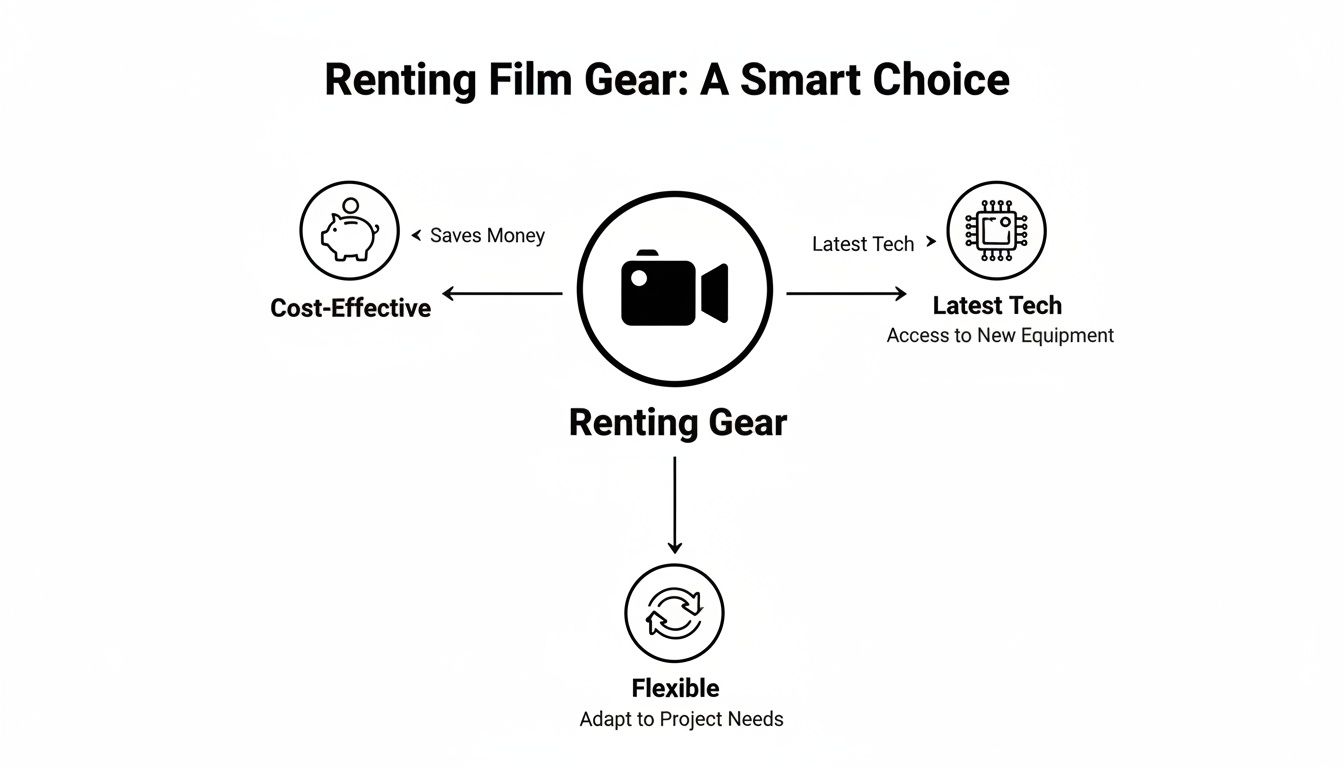
As you can see, renting gives you a powerful mix of cost-savings, access to the latest gear, and the flexibility to adapt to any project. These benefits let you punch above your weight and boost your production value without the massive financial hit of ownership.
Cameras and Lenses The Heart of Your Image
The camera and lens combo is the absolute foundation of your visual storytelling. It’s not just about getting a high-resolution image; it's about defining the character, feel, and perspective of your film.
Camera Body: This is your starting point. Do you need the gorgeous color science and cinematic look of an ARRI Alexa 35? The incredible high-speed options of a Sony Venice? Or the raw power and compact size of a RED Komodo? Your decision here will ripple through your entire workflow, from the media you use to your post-production process.
Lenses: If the camera is the heart, lenses are the eyes. They’re your paintbrushes. Prime lenses have a fixed focal length (like a 50mm) and are known for producing sharper images and wider apertures, giving you that beautiful, blurry background (bokeh). Zoom lenses (like a 24-70mm) offer versatility, letting you reframe your shot on the fly without physically moving the camera.
And for those epic aerial shots, researching the best drones for cinematography can completely change the scale of your project. A drone is a flying camera system, and the right one can capture perspectives that were once impossible for most budgets.
Lighting and Grip Shaping the Scene
Lighting is what turns a flat, boring shot into something with depth, emotion, and style. Grip equipment is all the hardware that holds, positions, and shapes that light. Never skimp on this category—it’s often what separates amateur-hour footage from professional work.
A great place to start is with three-point lighting, the classic setup for making subjects pop. Your basic rental kit should have lights that can fill these three key roles:
- Key Light: Your main, most powerful light source on the subject.
- Fill Light: A softer light used to "fill in" the dark shadows created by the key.
- Back Light: Placed behind the subject, this light creates a subtle outline that separates them from the background.
To control all this light, you'll need grip gear. We're talking about C-stands to mount your lights, flags to block light where you don't want it, and diffusion materials like silks or bounce boards to soften it. Any good rental house can help you bundle these items into a cohesive package.
Think of it like this: your camera captures the image, but your lighting and grip gear create the image. They work together to build mood, direct the viewer's eye, and bring your world to life.
Audio Capturing Clean and Clear Sound
Bad audio will kill a good film faster than anything else. Your audience might forgive a slightly out-of-focus shot, but they have zero patience for muffled, noisy, or inaudible dialogue. A basic audio rental package is non-negotiable.
Your essential audio kit should include:
- Shotgun Microphone: This is a highly directional mic that captures sound from whatever it's pointed at. You'll usually see it on a boom pole, getting it as close to the actors as possible without dipping into the frame.
- Lavalier Microphones: These are the small mics that clip onto an actor's shirt or collar. They're perfect for interviews or any scene where a boom operator can't get close enough to the talent.
- Audio Recorder/Mixer: Instead of recording sound directly into the camera (which is often lower quality), you'll want a dedicated device. A recorder gives you much cleaner audio and more control over your sound levels.
Once the shoot is wrapped, having the right software is just as important. If you're curious about what programs can best handle your footage and audio, check out our guide on the best tools for video editors. A smart plan for both production and post-production will save you a world of headaches.
Choosing Your Rental Partner: Local vs. Online
Deciding where you get your film equipment for rent is a huge piece of the puzzle, almost as critical as the gear itself. The right rental partner can make your pre-production a breeze, while the wrong one can throw a wrench in everything. You've got two main roads to go down: the traditional local rental house or one of the modern online platforms. Each has its own rhythm and benefits.
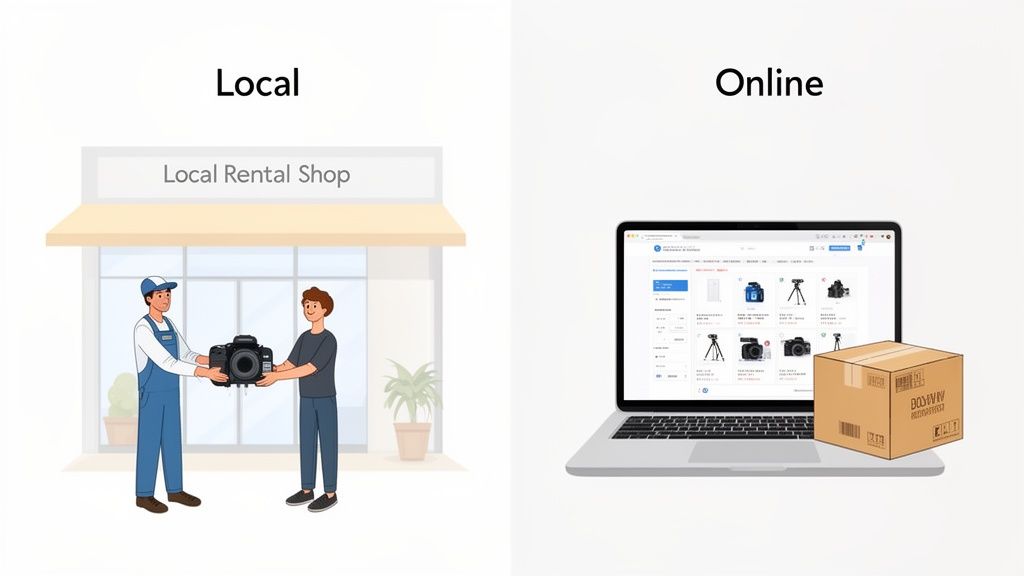
The best choice really boils down to what your project needs. You'll need to weigh things like hands-on support, gear availability, price, and your own comfort level. Let’s look at what each option really brings to the table so you can make the right call.
The Case for Local Rental Houses
A good local rental house is so much more than just a warehouse full of gear. Think of it as an industry hub, a place packed with hands-on experience and expertise you just can't find with a click.
The single biggest advantage is the ability to physically prep your equipment. This means you can walk into the shop before your shoot, build your entire camera package, test every last cable, and inspect each lens for dust or damage. If a battery is dead or a cable is finicky, an experienced tech is right there to swap it out or fix it on the spot.
On top of that, building a relationship with the folks at your local rental house pays dividends. When they know you and your work, they're more likely to cut you a deal, suggest a better (or cheaper) piece of gear, and even help you find a last-minute camera assistant. That personal connection is a safety net you'll be glad to have.
- Hands-On Prep: Build and test your entire package in person to catch problems before they happen on set.
- Immediate Support: Get access to expert technicians who can troubleshoot issues instantly.
- Industry Connections: Forge relationships that can lead to better deals, advice, and networking.
- No Shipping Delays: You can physically pick up your gear, eliminating the risk of a critical item not showing up on time.
The Advantages of Online and Peer-to-Peer Platforms
Online rental platforms and peer-to-peer (P2P) services have completely changed the rental landscape by offering a massive selection and seriously competitive pricing. They function like huge digital marketplaces, connecting filmmakers with gear owners all over the country.
Their main draw is the sheer breadth of inventory. If you need a rare anamorphic lens or a specific camera body that isn't available in your city, online platforms open up a nationwide catalog. All that competition naturally pushes prices down, often making them a much more budget-friendly option.
The U.S. audio and visual equipment rental market is a staggering $10.6 billion industry with over 2,300 businesses, which fuels intense competition that ultimately benefits you, the renter. This is especially true for online platforms that focus on logistics and user experience to win your business. You can learn more by checking out the findings from this industry report on IBISWorld.com.
Whether you go local or online, always do your homework. Check recent reviews, read their insurance policies carefully, and ask what their process is for handling gear that malfunctions mid-shoot. A good rental partner is invested in your production’s success.
The convenience of having everything shipped directly to your door or production office can't be overstated. For filmmakers who don't live in a major production hub like L.A. or New York, this is a game-changer that saves a ton of time and hassle.
Online Platform Benefits:
- Wider Selection: Find nearly any piece of specialized or rare equipment from a nationwide inventory.
- Competitive Pricing: The marketplace model often results in lower daily and weekly rates.
- Convenience: Get gear shipped right to you, saving you a trip across town.
How to Budget for Your Rental Without Surprises
Renting film equipment is a smart financial move, but your budget can blow up fast if you only look at the advertised daily rate. Think of it like booking a flight—the ticket price is just where you start. The real cost only comes out after you add baggage fees, seat selection, and taxes. The same thing happens when you look for film equipment for rent.
To build a real budget and avoid those nasty surprises, you have to look at the total cost of the rental. This means planning for every single line item, from the big-ticket camera to the less obvious fees that pile up quickly. A solid financial plan is your best defense against unexpected costs that could derail your whole production.
Deconstructing the Rental Bill
The first move in creating a solid budget is knowing all the potential charges you might face. A rental quote is more than a gear list; it's a breakdown of fees and costs you absolutely need to plan for. Let’s pull apart the common items you'll see.
Daily and Weekly Rates: Most rental houses have a daily rate, but you can get major savings on longer jobs. A common deal is the "3-day week," where you pay for three days but keep the gear for seven. Always ask about weekly or multi-day discounts.
Insurance Costs: This one is non-negotiable. Rental houses need you to have insurance that covers their equipment. If you don't have an annual policy, you'll need to buy short-term production insurance, which can add 1-3% of the gear's total value to your bill.
Security Deposits: Lots of rental providers, especially the peer-to-peer sites, ask for a security deposit. This is a refundable hold on your credit card to cover any potential damage. It's usually a percentage of the equipment's replacement value.
These are the big chunks of your rental expenses, but the devil is in the details. Paying attention to the small stuff is what separates a well-managed budget from a financial nightmare.
To give you a clearer picture, here’s what a typical budget might look like for a small-scale production.
Sample Rental Budget Breakdown for a 3-Day Shoot
| Expense Item | Estimated Cost | Notes |
|---|---|---|
| Camera Package (3-Day Rate) | $600 | Includes camera, lenses, media, and batteries. |
| Tripod & Support | $75 | A sturdy tripod is a must. |
| 3-Point Lighting Kit | $150 | Basic lighting for interviews or small scenes. |
| Audio Kit (Mic, Recorder) | $90 | Don't forget sound! |
| Production Insurance | $125 | Based on a percentage of the gear's total value. |
| Damage Waiver (Optional) | $50 | Covers minor cosmetic damage and wear. |
| Taxes (e.g., 8%) | $87.20 | Applied to the subtotal of gear and waivers. |
| Security Deposit | ($500) | Refundable hold, not an actual cost unless there's damage. |
| Total Out-of-Pocket Cost | $1,177.20 | This is your true rental cost, excluding the refundable deposit. |
As you can see, the final cost is significantly more than just the price of the camera package. Planning for these extra expenses is key to keeping your production on track.
Hidden Costs and Common Fees
Beyond the main items, a handful of smaller charges can sneak onto your final bill. Knowing about them ahead of time means they won’t become a last-minute headache.
The goal isn't just to rent gear; it's to rent it predictably. A comprehensive budget checklist turns unknown variables into fixed costs, giving you complete control over your production's finances.
Here’s a checklist of other potential costs to factor into your budget:
- Taxes: Standard sales tax will be added to your rental total. Know the local tax rate and work it into your math from the start.
- Delivery and Shipping Fees: If you're using an online rental platform or having gear delivered locally, you'll need to budget for shipping costs both ways.
- Late Fees: Bringing gear back even a few hours late can stick you with a bill for a full extra day. Always confirm the exact return time and plan your wrap-out accordingly.
- Cleaning or Damage Waivers: Some rental houses offer an optional damage waiver for a small fee. It can limit your liability for minor wear and tear and give you peace of mind.
Proven Tips for Stretching Your Rental Budget
Once you’ve got a handle on all the potential costs, you can start looking for ways to make your money work harder. A few smart moves can often get you more bang for your buck without inflating your budget.
1. Leverage Pre-Configured Packages Ask the rental house about their camera packages. These bundles often include the camera body, a lens set, batteries, and media for a discounted price compared to renting every piece separately.
2. Choose Battle-Tested Older Gear You don't always need the absolute newest camera. A workhorse like the ARRI Alexa Mini has shot countless professional films and now rents for way less than its newer cousins. For a lot of projects, your audience will never know the difference.
3. Optimize Your Rental Period If your shoot is over a weekend, picking up gear on a Friday afternoon and returning it Monday morning often counts as a single rental day at many local shops. Ask about their specific weekend policies to get the most shooting time for the lowest cost.
By planning ahead and actively looking for these kinds of opportunities, you can get the best possible gear for your project. And if you're always on the hunt for a good deal, keep an eye out for seasonal sales. You can see some great examples in our guide to the best creator deals to get a sense of how timing can lead to big savings.
Understanding Rental Contracts and Insurance
Let's talk about the not-so-glamorous side of renting film gear: the paperwork. It might seem like a bunch of legal jargon, but contracts and insurance are your best friends on a shoot. Think of them as the professional safety net protecting you, your crew, and the rental house from those expensive "oops" moments.
Once you know what to look for, this stuff is pretty straightforward. The goal here is to cut through the legal-speak so you can sign on the dotted line with total confidence.
Decoding Production Insurance Requirements
Before any rental house hands over thousands of dollars worth of equipment, they're going to ask for one thing first: proof of insurance. This isn't a suggestion; it's a hard requirement to protect their gear. You’ll generally need to get two types of coverage.
Equipment Insurance: This is the big one. It covers the gear itself. If a camera gets dropped, a lens gets stolen, or a light kit takes a tumble, this policy is what pays for the repair or replacement. The rental house will need you to name them as the “Loss Payee” on this policy.
General Liability Insurance: This covers injuries and property damage on your set. If a C-stand scratches a location's hardwood floor or, worse, someone gets hurt, this is the policy that shields you from massive legal and financial headaches.
Getting these policies is easier than it sounds. Plenty of companies specialize in short-term production insurance that you can buy for a single project or even a full year.
Your Certificate of Insurance (COI) is the golden ticket. It's the standard document that proves you have all the necessary coverage. Without a COI, the rental process comes to a dead stop.
Navigating the Rental Agreement
After you’ve got your insurance sorted, the next step is the rental agreement. You should treat this document just like a lease for an apartment—it spells out all the rules, your responsibilities, and the consequences if something goes wrong.
Don't make the rookie mistake of just skimming and signing. Take a few minutes to actually read it. Most of it is standard boilerplate, but a few key clauses can have a real impact on your shoot and your budget.
Key Clauses to Watch For
Zero in on the sections that define your obligations. These are the parts that matter most when things don't go exactly as planned.
1. Liability Limits and Damage Waivers The contract will clearly state what you're on the hook for if gear is damaged or lost. Some rental houses offer an optional damage waiver for a small extra fee. This can be a really smart buy, as it often limits your financial liability for minor, accidental dings and normal wear-and-tear, which gives you some valuable peace of mind.
2. Cancellation Policies Life happens. Shoots get postponed, and sometimes they get canceled altogether. Make sure you understand the rental house's cancellation policy. If you cancel too close to your pickup date, you could be on the hook for a percentage of the rental fee since they held that gear for you.
3. Equipment Malfunction Procedures What's the plan if a piece of gear just stops working in the middle of a take? The contract should spell this out. It will tell you who to call, what their support hours are, and how they handle replacements. Knowing this process before you're in a panic on set is absolutely critical for minimizing downtime.
Your Final Pre-Production Rental Checklist
You’ve navigated the contracts, the budget is locked in, and the shoot is officially a go. Now comes the final, crucial phase of pre-production: actually getting your hands on the gear. This isn't just about picking up boxes; it's a methodical process that can make or break your shoot days.
Let’s walk through the essential checklist, from the initial booking to the moment you walk out of the rental house, ready to roll.
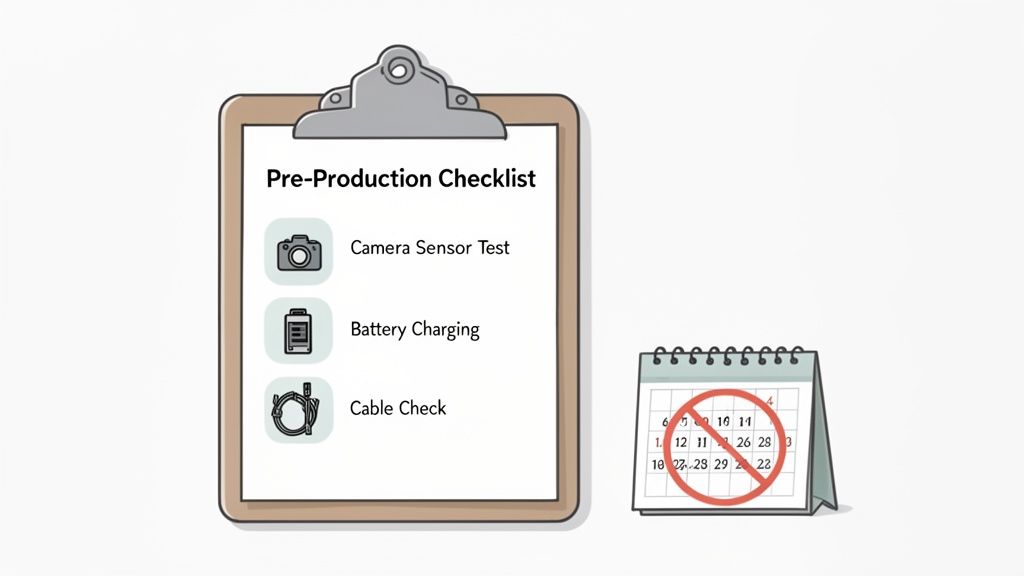
Booking and Paperwork
The journey from a gear list quote to a confirmed order is where things get real. Don’t get complacent here—popular equipment gets snatched up fast.
Confirm and Book Immediately: The second your shoot dates are confirmed, call your rental agent and lock in your gear. High-demand film equipment for rent, like the newest ARRI or RED cameras and specific anamorphic lenses, can be booked out weeks, sometimes months, in advance. Hesitation is not your friend.
Get Your COI In ASAP: Your Certificate of Insurance (COI) is the golden ticket. It's the document that proves you're covered if anything happens to the gear. Send this to the rental house the same day you book. A delay in sending your COI will cause a delay in your pickup, which can throw your entire first shoot day into chaos.
Getting these two steps done early clears the biggest administrative hurdles and lets you focus on what is arguably the most important day of pre-production.
The Gear Prep: Your Most Important Day
Your "gear prep" or "checkout" day is your scheduled time at the rental house to build, inspect, and test every single piece of equipment on your order. This isn't just a quick look-over; it's a full-on dress rehearsal for your gear.
This is your one and only opportunity to find a problem before it shows up on set. You must treat this day as a sacred, non-negotiable part of your schedule.
Here's what you need to test:
- Camera Body: Power it up with both AC and battery power. Record test clips and play them back. Check the sensor for any dead pixels or dust. Critically, test every single port—SDI, HDMI, audio, timecode—to ensure they all send and receive a signal.
- Lenses: Mount every lens to the body. Shine a penlight through both ends to check for any internal scratches, fungus, or excessive dust that could affect your image. Run the focus and iris rings through their full range to feel for any grinding or stiffness.
- Power: Put every battery on the charger. Does it take a charge? Great. Now, put every single charged battery on the camera and power it on. Don't assume they all work just because one does.
- Media: Confirm you have the right type of memory cards for your camera. Insert a card, make sure the camera recognizes it, and perform an in-camera format.
- Cables and Accessories: Lay out every item and physically check it off your list. More importantly, plug everything in. Connect the monitor, the wireless transmitter, the follow focus motor. A single bad cable is one of the most common—and infuriating—issues to discover on set.
The rule is simple: if it fails in the prep bay, it's the rental house's problem to fix. If it fails on your set, it's your problem to solve, costing you precious time and money.
Pickup and Transportation
After you’ve thoroughly tested everything and given your stamp of approval, it’s time to pack up. The rental staff will help you organize the gear back into its cases.
Before you sign that final checkout form, do one last count of the cases. Make sure the number of cases you're taking matches the number on the rental agreement.
Think of this whole process as your production's insurance policy against technical failure. A meticulous gear prep is what separates the pros who are ready for anything from the amateurs who leave their shoot's success to chance.
Common Questions About Renting Film Equipment
Renting gear for the first time can feel a little intimidating. You've got questions, and we've got answers pulled from years of experience dealing with rental houses and last-minute shoot changes.
Let's clear up some of the most common things filmmakers wonder about before they book their equipment.
Can I Rent Gear Last Minute?
The short answer is yes, you can. But it's a huge gamble.
While rental houses will do their best to help you out, their inventory isn't infinite. High-demand items, like a Sony FX3 or a workhorse Canon 24-70mm lens, are often booked solid for weeks.
Walking in the day before a shoot means you're picking from the leftovers. To get the specific tools you actually need for your vision, you have to book as far in advance as you possibly can.
What Happens if I Damage the Equipment?
Accidents happen. That's exactly why production insurance is a non-negotiable part of the rental process. If a piece of gear gets damaged, your first move is to stop and call the rental house immediately.
Your rental agreement and insurance policy work together as your financial safety net. Understanding both documents before you shoot is the best way to handle any on-set mishaps with professionalism and clarity.
The costs for repair or replacement will almost always be handled by your production insurance policy, after you pay your deductible. For smaller dings or cosmetic issues, an optional damage waiver (if you bought one) might cover it and save you some out-of-pocket cash.
What if the Gear Malfunctions on Set?
This is precisely why a thorough gear prep day is so important. But even with perfect prep, electronics can fail. If gear goes down on set, your first call should be to the rental house’s support line.
Most professional rental shops have technicians on call who can walk you through troubleshooting steps over the phone. If a remote fix isn't possible, they’ll work to get you a replacement unit as fast as they can to keep your shoot from grinding to a halt. This on-call support is a crucial part of the service you're paying for.
Do I Really Need Insurance?
Yes. 100%. Let's be blunt: no professional rental house is going to hand you tens of thousands of dollars worth of equipment on a handshake.
It protects you from a catastrophic financial hit and it protects their business. Providing a Certificate of Insurance (COI) is a standard, mandatory step for securing any professional film equipment for rent.
Staying informed with the latest tools and resources is key to a successful creative career. At Creators Toolbox, we deliver a weekly roundup of news, guides, and inspiration directly to you. Check out https://creatorstoolbox.co to join for free and never miss an update.