fal adds Seedance 2.5, letting sketched paths drive camera moves
By Steven Van ·
The model takes up to 50 mixed references and generates 30-second clips at $0.0214 per 1,000 tokens.
Seedance 2.5, ByteDance's new flagship video model, is now live on fal, the generative media API platform. fal announced the launch on August 7 with a demo that explains the whole pitch in ten seconds: the input is a still image with a red squiggle drawn on it, and the output is a continuous FPV-style run through a torii gate with a full lap around a monorail. In fal's words, nobody keyframed anything. For creators who have been fighting with camera-motion prompts, and for developers who want this power behind an API, that one clip is the headline.
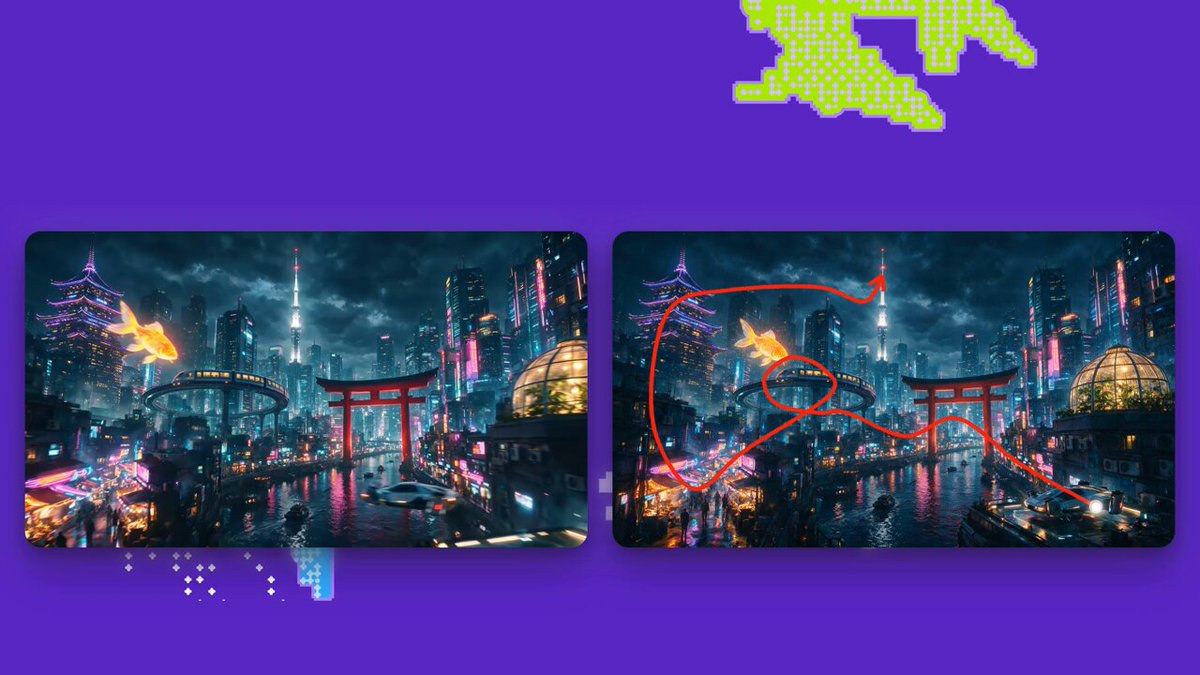
The red squiggle is the camera path
The demo shows the direction video generation is heading: you sketch what you want instead of describing it. Camera movement has always been the hardest thing to control with text. Words like "smooth FPV drone shot circling the tower" leave a lot of room for the model to improvise, and it usually does. Drawing a line on the source frame removes the ambiguity. The squiggle in fal's demo traces a route through the gate and around the monorail, and the generated shot follows it as one continuous take, no cuts, no stitched segments, no keyframes.
This kind of reference-driven control is the core idea behind Seedance 2.5. Rather than relying on a single text prompt, the model accepts up to 50 multimodal references in one request: images, video clips, audio, and style inputs. Video references can carry motion style, audio references can drive rhythm and timing, and image references lock characters, sets, and palettes so they stay consistent across the entire shot. That is a big jump from Seedance 2.0, which topped out at 9 images, 3 videos, and 3 audio clips combined.
Native 30-second takes with audio baked in
The other major upgrade is length. Seedance 2.5 generates up to 30 seconds in a single pass, double the 15-second ceiling of Seedance 2.0, with no stitching and no visible seams. On fal, you pick a duration from 4 to 30 seconds or set it to auto and let the model choose based on the prompt. Output runs at 480p or 720p across six aspect ratios, from 21:9 widescreen down to 9:16 vertical.
Audio is generated in the same latent space as the visuals, which means sound and picture are produced together rather than bolted on afterward. fal notes this improves lip-sync and timing alignment, and it pairs naturally with audio references: feed the model a track and the motion can cut to the beat. fal also cites roughly 20 percent better prompt adherence compared to Seedance 2.0.
What it costs on fal
fal exposes Seedance 2.5 through multiple endpoints, including image-to-video and reference-to-video. Billing is token-based at $0.0214 per 1,000 tokens, where tokens scale with resolution, duration, and frame rate. In practice that works out to roughly $0.47 per second of 720p output and about $0.22 per second at 480p. Reference-to-video requests that include video inputs get a 0.6x multiplier, bringing 720p down to around $0.28 per second. Input images are free; you only pay for generated output, and there is no subscription.
So a 10-second 720p clip like the torii gate demo runs a little under $5, and a full 30-second 480p draft costs about $6.60. That is cheap enough to iterate on camera paths the way you would iterate on thumbnails.
Why the API route matters for builders
Seedance 2.5 is rolling out across many creative platforms this week, but fal's version is aimed at people who ship products. The model sits behind the same inference API as the rest of fal's catalog, with queue-based async requests, webhooks, and client libraries for JavaScript and Python. If you are building a video tool, an ad-creative pipeline, or an in-app effects feature, you can wire in sketch-guided, reference-locked 30-second video generation without touching a GPU. The start-frame plus end-frame controls on the image-to-video endpoint also make programmatic loops and transitions straightforward.
For solo creators, the takeaway is simpler: the most controllable version of ByteDance's best video model is now a pay-as-you-go API call away, and the control surface is literally a drawing on top of your image.