Design a Review Process That Produces Actionable Feedback
By Steven Van ·
Replace scattered opinions with timestamped observations, intent, priority, and decision ownership

AI-generated conceptual illustration; not a product screenshot, measured result, or factual diagram.
“Make it more engaging” is a real reaction, but it is not yet a decision an editor can implement. It might mean the opening is too slow, the audience is unclear, the visual treatment feels restrained, or the reviewer expected a different story. Starting revisions before resolving that ambiguity can create more work without solving the original concern.
A useful review process turns reactions into located observations, connects them to the intended result, and assigns someone to resolve competing requests. The process does not eliminate taste. It gives taste a place in the conversation without treating every opinion as an instruction.
The worked example is a fictional sixty-second launch film for a repair workshop. An editor, a producer, and a program lead need to agree on the opening, the service description, and the closing invitation. The workflow below is a proposed operating method, not a claim about measured improvements in a real team.
State what this round can change
Before sharing the review copy, identify the round’s purpose. A story review asks whether the sequence makes sense and includes the right information. A finishing review checks details such as captions, graphics, audio, and delivery. Those rounds can overlap, but reviewers should know which decisions are still open.
For the workshop film’s first round, the producer asks three questions: Is the audience clear in the first section? Does the demonstration explain what happens at the workshop? Does the final invitation match the approved offer? Temporary color and sound treatment are labeled so they do not absorb the whole discussion.
Do not use the round label to dismiss a serious issue. If a reviewer notices an inaccurate statement during finishing, it still needs attention. The label helps prioritize expected feedback; it does not make the film immune to newly discovered errors. Record a late structural change as a scope decision rather than quietly pretending it is a minor polish note.
Give every reviewer the same object
Share one identified review version with a stable location. Include the version label, runtime, review deadline, and questions. If people review different exports, identical timestamps can refer to different shots, and a conversation about one version can accidentally drive changes to another.
Keep earlier versions available where the workflow permits, but make the active round unmistakable. A message saying “latest is attached” becomes ambiguous as soon as another message arrives. A review page or shared record should name the exact export under discussion and show whether the round is open or closed.
A timestamped review tool can help locate comments. For example, Frame.io documents timestamped comments alongside media. The process should still work in a simple document. The essential fields are version, location, observation, desired outcome, priority, owner, and status. A tool can capture coordinates; it cannot decide whether the requested change serves the brief.
Turn an opinion into an observation
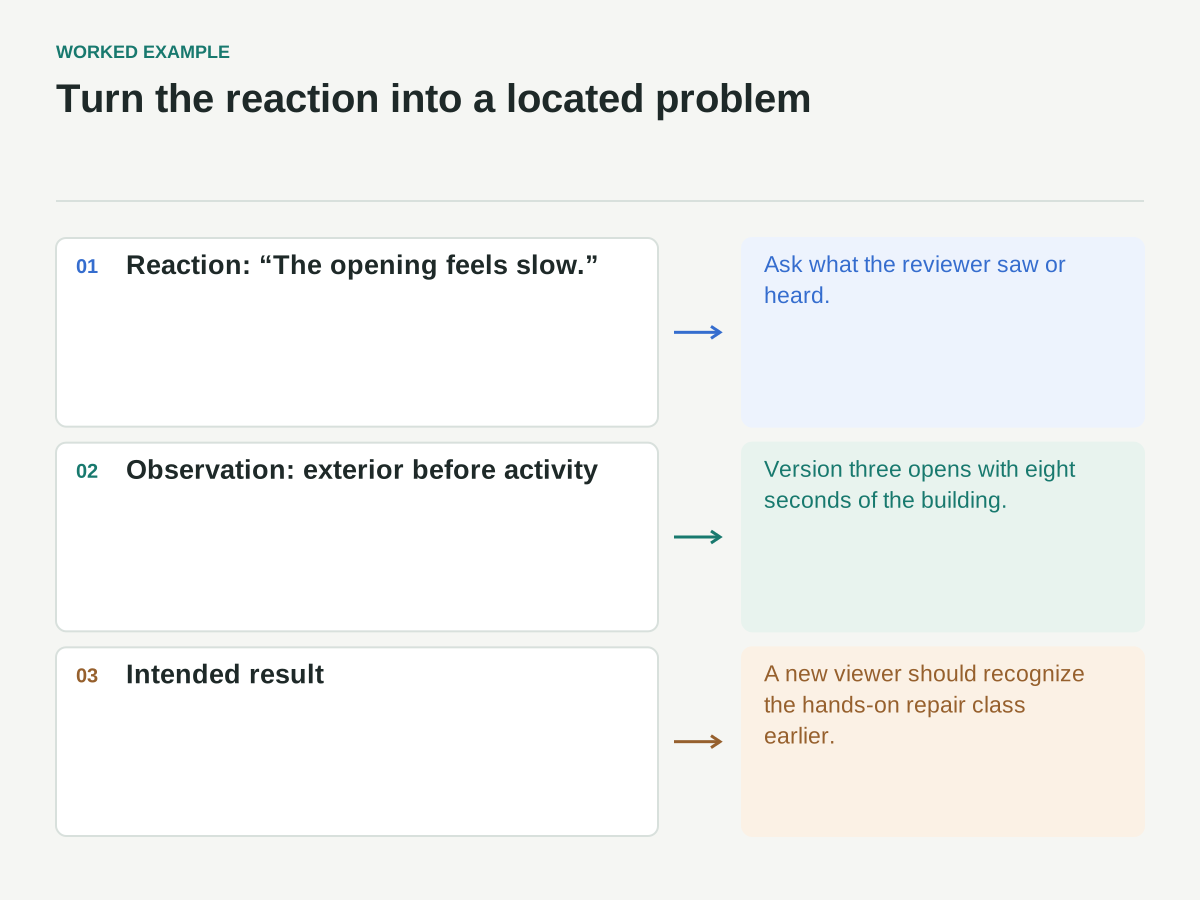
Suppose the program lead writes, “The opening feels slow.” Ask what they saw or heard that produced that reaction. In the fictional film, the first eight seconds show the building exterior before the workshop activity appears. The reviewer expected to understand the service sooner.
The revised note becomes: in version three, from the opening to the first interior shot, the film shows only the building; a new viewer cannot yet tell that this is a hands-on repair class; introduce the activity earlier. This preserves the concern while giving the editor a problem to solve.
Avoid demanding a particular solution too early. “Delete the first eight seconds” may be a useful proposal, but it could remove an important location cue. Separating observation from suggestion lets the editor try a shorter exterior, an earlier voiceover, or a different opening shot while addressing the same underlying need.
Attach intent and priority
Every actionable note should say why the change matters. “Increase the title size” becomes more useful when paired with “the workshop name is difficult to read in the portrait preview.” The reason helps the designer choose an appropriate fix and test it in the right context.
Use a small priority vocabulary. For this film, required means the piece is inaccurate, unusable, or fails an agreed acceptance condition. Important means the change materially improves the intended task but needs a scope decision. Optional means a preference or experiment that can be considered if time allows.
Do not let reviewers invent priority labels independently. One person’s urgent may mean personal preference, while another reserves urgent for a blocked delivery. Define the labels in the review invitation and let the decision owner resolve disagreements. The classification should describe consequences, not the seniority of the person commenting.
Assign decision ownership before disagreement
The editor owns implementation choices within the agreed direction. The program lead confirms service accuracy. The producer resolves scope, consolidates feedback, and records approval. These are fictional roles for this example; another project may distribute authority differently.
Name one person who can decide between conflicting creative requests. Without that owner, an editor may receive “make the opening faster” and “give the setting more room” as equally mandatory instructions. The conflict should be resolved before the editor is expected to satisfy both simultaneously.
Ownership also prevents silent escalation. A reviewer can raise a concern outside their specialty, but raising it does not automatically authorize a major change. The decision record should show who accepted the change and why. This is especially important when the change affects an approved claim, budget, deadline, or another team’s deliverable.
Build a decision-ready review card
A compact card for the fictional opening might read: version three; opening through first interior shot; observation: service remains unclear; intended result: a new viewer recognizes a practical repair class; priority: important; proposal: introduce hands-on activity before the exterior ends; decision owner: producer; implementation owner: editor.
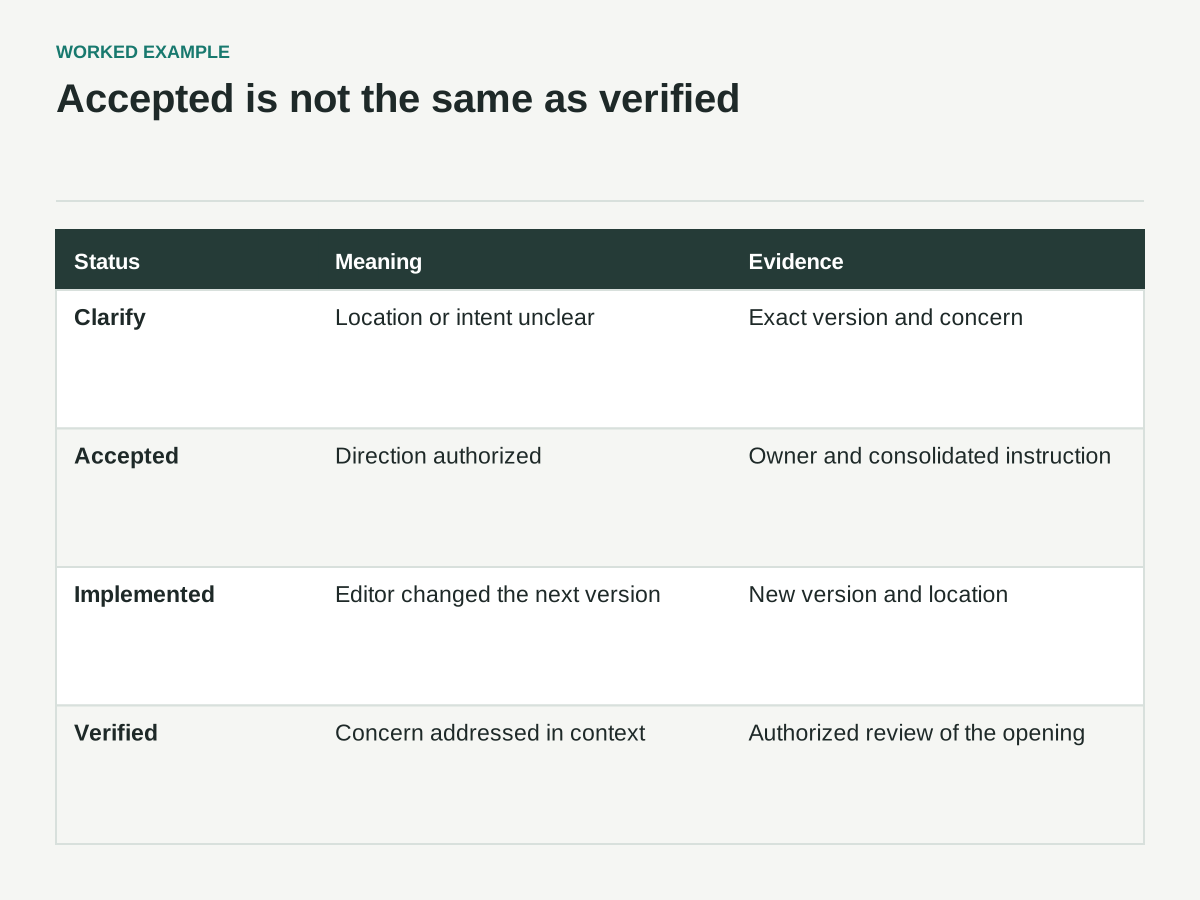
Add a status that describes the next action. Needs clarification, accepted, declined, deferred, implemented, and verified are more useful than a single checkbox. A checked box can mean the editor saw the note, made the change, or confirmed the result. Those are different states.
When declining a note, preserve a brief reason. For example: retain the short exterior because the venue entrance must be recognizable, but move the workshop explanation earlier in audio. The reviewer can see that the concern was considered, even when the exact proposed edit was not adopted.
Separate a decision from a completed repair
The fictional opening note is “Introduce the hands-on activity earlier so the service becomes clear.” Track its lifecycle instead of using one ambiguous checkmark.
| Status | Meaning | Evidence needed to move on |
|---|---|---|
| Needs clarification | The concern is known but the location or intent is ambiguous | Exact version, opening range, intended viewer understanding |
| Accepted | Producer authorizes the direction within agreed scope | Consolidated instruction and implementation owner |
| Implemented | Editor has changed the opening in the next version | New version and location of the change |
| Verified | Authorized reviewer confirms the concern is addressed | Review of the complete opening at normal speed and any remaining limitation |
These are example status definitions, not approvals already granted. A note may instead be declined or deferred with a reason and a named decision owner.
Consolidate without erasing disagreement
The producer should merge duplicate concerns while retaining any meaningful differences. If three people say the service is unclear, that may be one issue with several observations. It does not necessarily mean the editor needs three separate changes.
Do not rewrite all comments into artificial consensus. One reviewer may prioritize beginners; another may expect experienced makers. That disagreement points to an audience decision, not merely copy cleanup. Record the conflict and resolve the brief-level question before changing the film’s terminology.
Also separate factual corrections from preferences. A wrong workshop date is not a matter of taste. A preference for a warmer music track is not automatically an error. The same review sheet can hold both, provided their status and decision path remain clear.
Make the revision plan before editing
After the round closes, group accepted notes by dependency. Change the opening structure before polishing its transitions. Correct the service description before retiming captions. Resolve the closing offer before rendering several delivery formats.
Estimate the work at an appropriate level of confidence. If replacing a shot depends on finding unused footage, label that uncertainty. Do not promise a fixed completion time based on a note that appears small but requires a new shoot or external approval.
Send the consolidated plan to the decision owner when scope has changed. A request for feedback does not automatically authorize every resulting revision. The plan should identify accepted work, unresolved questions, and anything deferred. Once the plan is clear, the editor can work without repeatedly interpreting contradictory comments.
Verify the change against the original concern
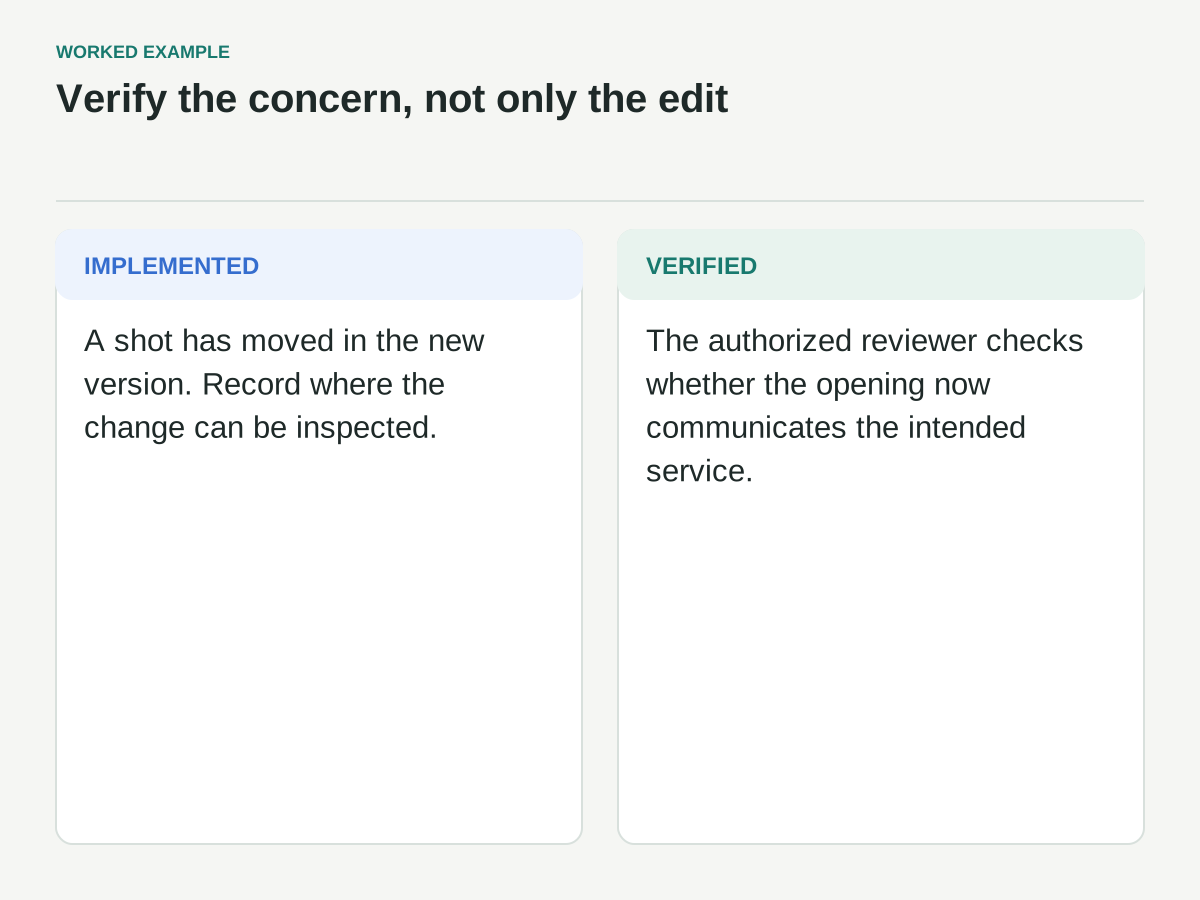
In the next version, do not mark the opening issue complete merely because a shot moved. Replay the opening and ask whether the service is now understandable at the intended moment. The implementation is evidence of work; the observed result determines whether the concern was addressed.
Keep a short response on each accepted card: what changed, where to inspect it, and whether any limitation remains. If the available footage could not support the preferred solution, say so. A clear partial resolution is better than a silent compromise disguised as completion.
For factual corrections, check the revised text against the approved source. For layout or readability concerns, inspect the actual delivery format. For rhythm concerns, watch the surrounding sequence at normal speed. The verification method should match the original problem rather than using the same generic “looks good” response for every issue.
Handle late feedback predictably
A review deadline should trigger a clear transition: the round closes, accepted changes are consolidated, and new comments are assessed for impact. It should not imply that genuine errors are ignored after a clock expires. Distinguish a necessary correction from a newly preferred creative direction.
If a late note requires structural work, record the tradeoff: revised scope, changed delivery timing, or another approved adjustment. Do not let the editor absorb invisible work simply because the comment arrived in a casual message. The process protects the quality of the piece by making those choices explicit.
Keep external approvals separate when needed. Internal agreement on a cut does not prove that a client, subject, rights holder, or distribution partner has approved their relevant part. The review record should identify the scope of each sign-off without inventing authority that a reviewer does not have.
Review checklist
Before opening a round, confirm the exact version, purpose, questions, deadline, and decision owner. During the round, locate observations, explain intended outcomes, distinguish priority from preference, and surface conflicts. Before editing, consolidate an authorized revision plan.
Before closing, verify the changes against the original concerns and record unresolved limits. A review process has done its job when the next person can see what was requested, what was decided, what changed, and why the result is acceptable. That is more valuable than collecting a large number of comments or reaching agreement through exhaustion.