Compare AI Outputs With a Repeatable Evaluation Rubric
By Steven Van ·
Score a small fixed set against brief adherence, accuracy, editability, and artifacts without claiming universal model rankings
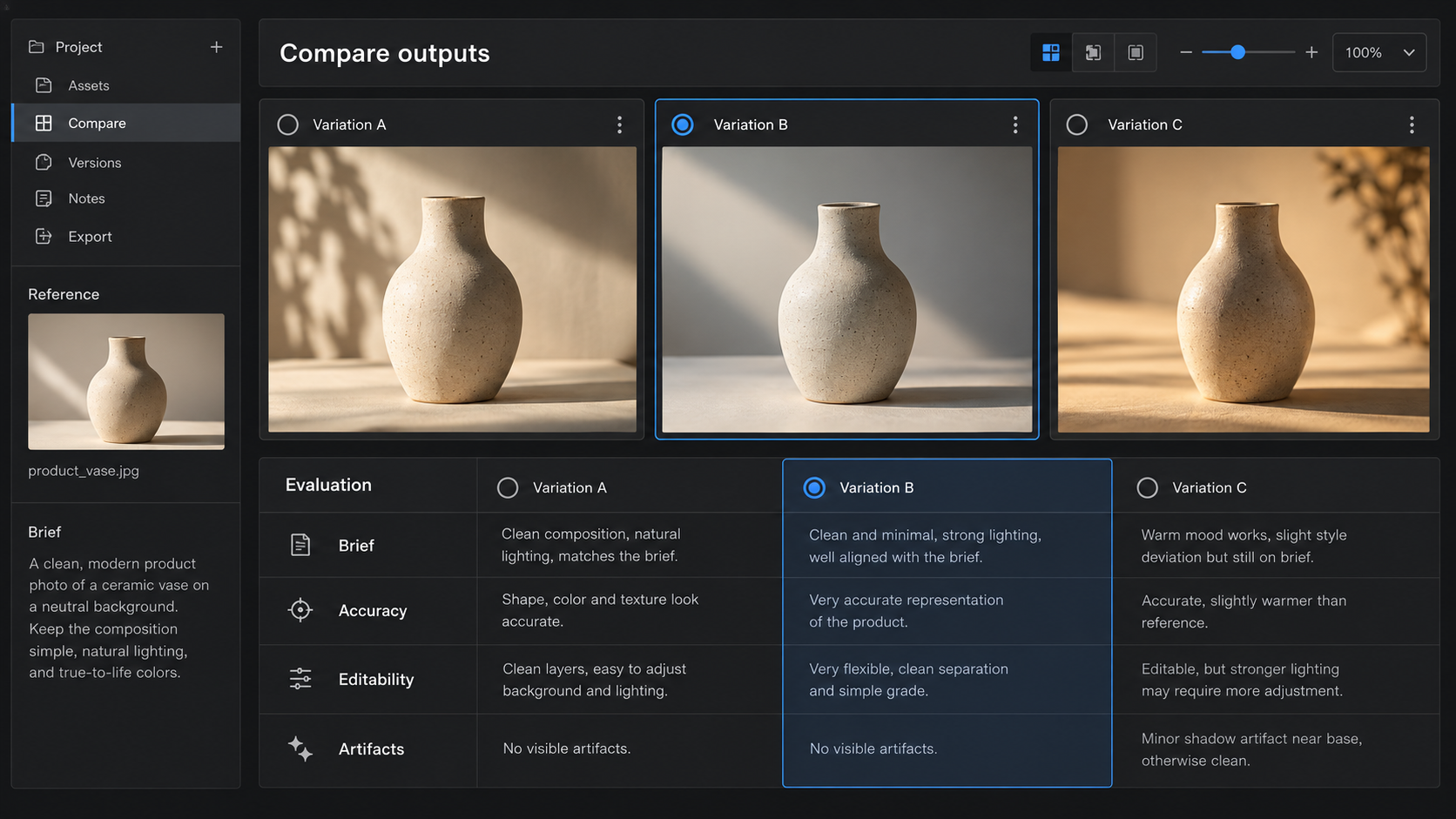
AI-generated conceptual illustration; not a product screenshot, measured result, or factual diagram.
The most attractive AI output is not always the one you can use. An illustration may look polished but omit the required object. A headline may sound confident while changing the offer. A layout may match the brief visually but arrive as a flattened image when the next person needs editable text.
A rubric makes those differences discussable. It does not turn creative judgment into objective truth, and it does not establish a universal ranking of models. Its job is narrower: help a team choose among a defined set of outputs for a defined production task, with the reasons preserved.
The example below is fictional. A small studio needs three illustrations for a repair-workshop campaign: a lamp, a chair, and a bicycle. Each must leave space for a headline, use the same limited palette, and remain usable in a portrait crop. All scores are invented to demonstrate the method, not results from testing any product.
Define the decision before the score
Write the decision in one sentence: choose an illustration workflow for this campaign’s first draft, subject to human correction and final review. That is different from choosing a long-term vendor or certifying images for publication. The narrower decision tells you which evidence you need and which conclusions would overreach.
Keep the original brief beside the rubric. For this campaign, the brief specifies the three objects, a cream background, blue linework, a single orange accent, and empty space above the object. It also states that lettering will be added later in the design file. These are observable constraints; “make it delightful” can remain a discussion prompt but cannot be the only acceptance criterion.
Identify the person who will use the result next. If a designer must recolor parts independently, editability matters. If the output is only a moodboard candidate, that same requirement may be unnecessary. A rubric should reflect the actual handoff rather than every desirable property you can imagine.
Put disqualifiers outside the weighted average
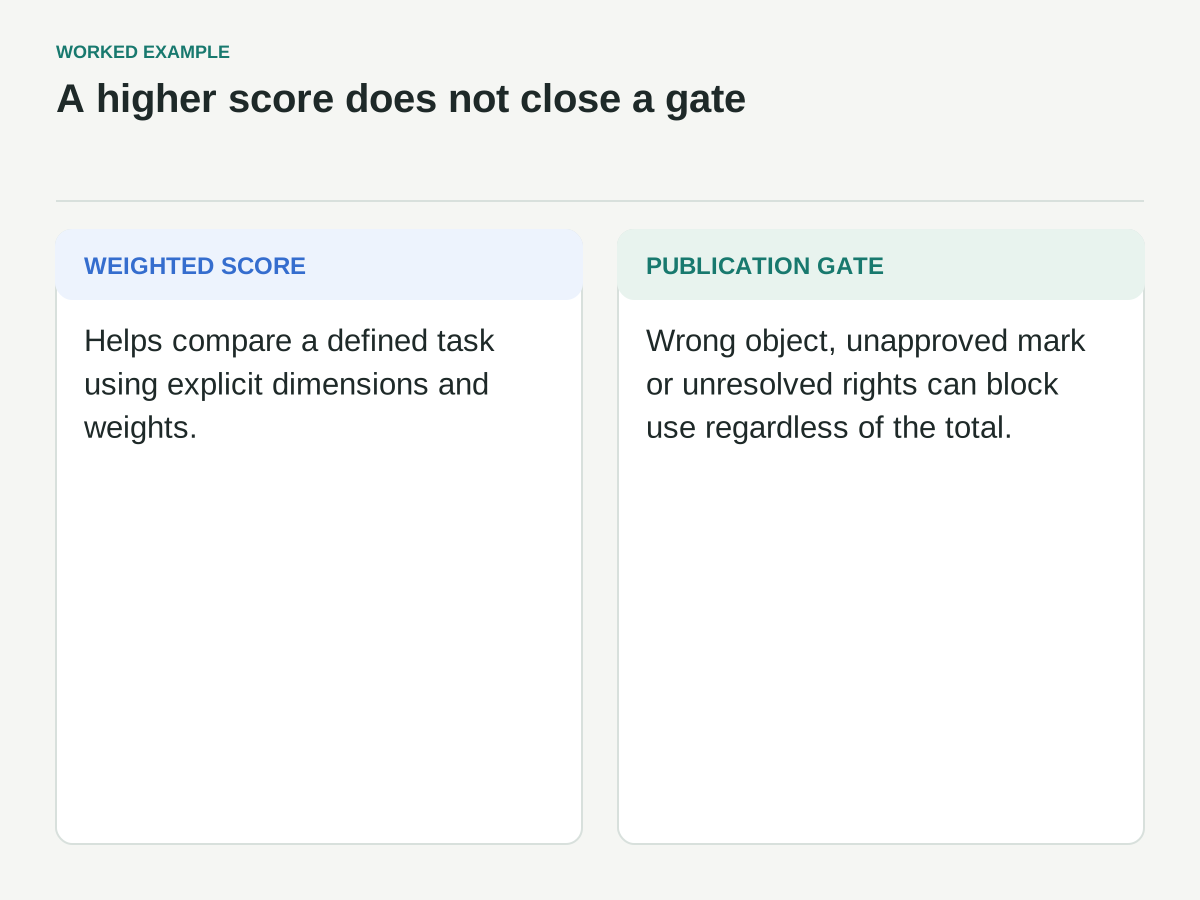
Some failures should block use regardless of other strengths. For the fictional workshop, the image must depict the requested object, contain no unapproved brand marks, and have a rights review before publication. A high score for composition cannot compensate for the wrong object or unresolved permission.
Record these as gates with pass, fail, or unresolved status. Unresolved is useful: it prevents a reviewer from treating missing evidence as a pass. A gate may apply to the individual output, the workflow, or the final use. Keep those scopes visible so that rejecting one image does not imply a tool is unusable for every purpose.
The NIST AI Risk Management Framework provides voluntary guidance for incorporating trustworthiness into AI development, use, and evaluation. This article’s small creative rubric is an operational example, not an implementation or certification of that framework. The relevant lesson is to make the intended use and consequential limitations explicit.
Use four dimensions with behavioral anchors
Start with brief adherence, factual or semantic accuracy, editability, and visible artifacts. Use a short scale, such as zero through three, and describe what each level means. More numerical precision is not necessarily more useful when the underlying judgment remains approximate.
For brief adherence, three means every stated visual constraint is satisfied; two means one minor correction; one means a substantial redesign; zero means the central requirement is missing. For semantic accuracy, inspect the object and its function: a chair needs a coherent seat and supporting structure, not merely a chair-like silhouette.
For editability, define the actual operation. Three might mean a designer can change the orange accent without rebuilding the object using the required deliverable format. Two might require a manageable selection or mask. One might require substantial redraw. Zero means the available output cannot support the needed revision. Those anchors are campaign-specific, not statements about what an image format guarantees.
For artifacts, identify the defects that matter at delivery size: broken contours, duplicated parts, incoherent joins, or unintended marks. Do not penalize a deliberately rough line style simply because it is not smooth. The anchor should distinguish intended treatment from a mistake that harms recognition or use.
Choose weights without hiding priorities
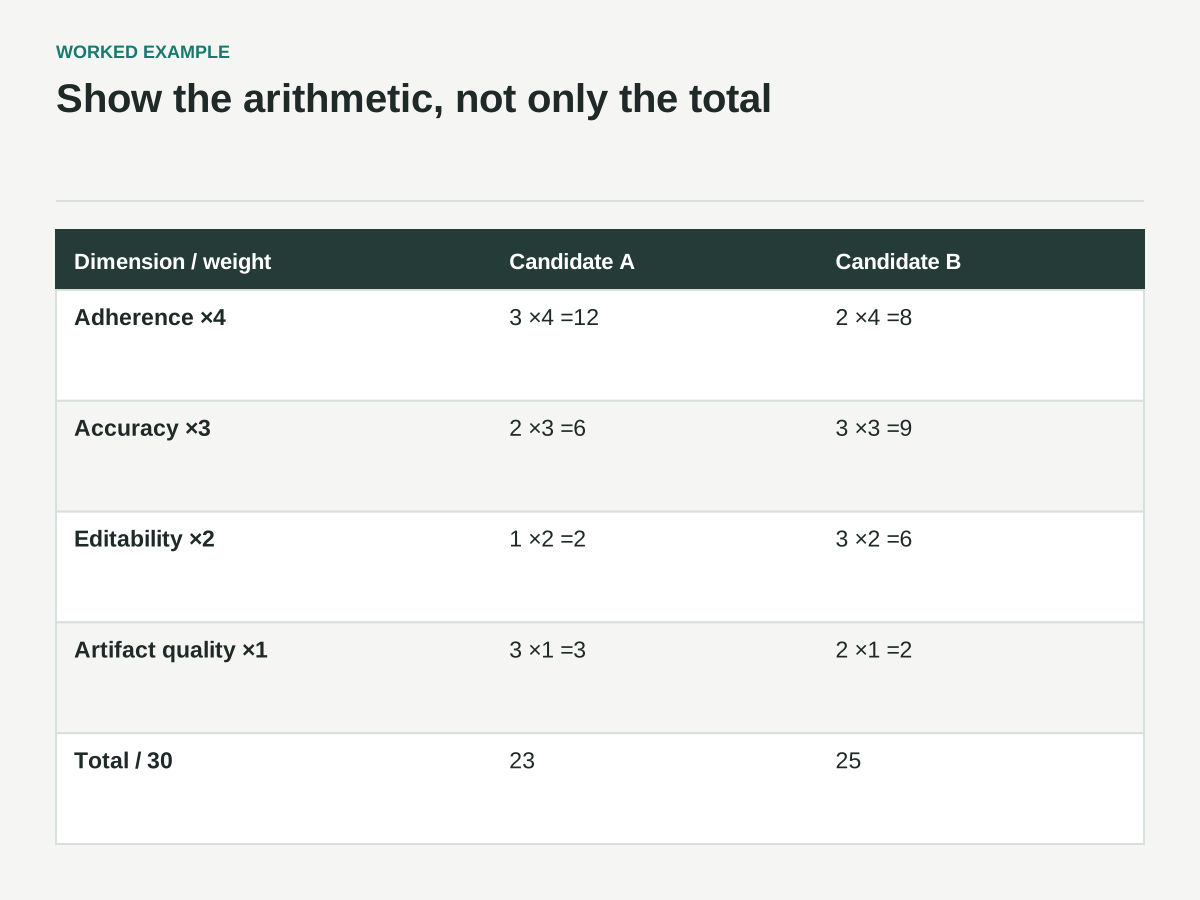
For this example, assign brief adherence a weight of four, accuracy three, editability two, and artifacts one. With scores from zero to three, the maximum weighted total is thirty. The choice reflects a campaign where matching a tightly constrained series matters more than superficial polish.
Write down why those weights were selected before looking at the candidates. Otherwise it is easy to adjust the math until a favored image wins. If the client’s priority changes, revise the rubric openly and rescore the relevant outputs; do not silently compare totals generated by different rules.
Keep the raw dimension scores alongside the total. Two images can both score twenty-four while having very different weaknesses. A total is a sorting aid. It should not erase the difference between a palette mismatch that takes a small edit and an inaccurate bicycle frame that requires a redraw.
Build a small, fixed comparison set
Use the same three object briefs for every workflow being compared. Preserve prompt text, input references, available settings, output dimensions, and the date. Record when tools require different instructions or do not support a requested control; apparent symmetry should not conceal real limitations.
Decide in advance how many outputs each workflow gets. Comparing one ordinary image from one system with the best of fifty from another is a selection process, not a fair single-output comparison. It can still answer a production question if generation and selection effort are counted, but label it honestly.
Separate the examples used to tune your instructions from a small fresh set used to check the final workflow. Google’s dataset guidance explains why repeatedly optimizing against a test set weakens claims about unseen examples. Here the practical analogy is modest: do not treat a prompt perfected on the lamp as proof that the same process works on every other object.
Review without unnecessary identity cues
Label candidates A, B, and C rather than displaying vendor names prominently. Use the same viewing size, background, and crop. If one candidate is shown enlarged against a dramatic background and another is a small thumbnail, presentation is influencing the judgment before the rubric begins.
Review each dimension independently before choosing an overall favorite. For a small team, two reviewers can score separately and then discuss disagreements. Do not average away a disagreement about a hard requirement. Ask what each reviewer observed, whether the anchor is clear, and whether the candidate actually meets it.
Blind labels cannot remove every bias. Reviewers may recognize a style or remember generating an output. Record that limitation if it matters. The goal is to reduce avoidable cues and create a repeatable process, not to claim laboratory-level blinding for a quick studio exercise.
Work the fictional numbers
Imagine candidate A receives adherence three, accuracy two, editability one, and artifacts three. Its weighted total is twenty-three: twelve plus six plus two plus three. Candidate B receives two, three, three, and two, totaling twenty-five. Candidate B ranks higher under this rubric despite looking less polished at first glance.
The useful discussion is about the defects. A has an attractive line treatment but a malformed lamp hinge and difficult recoloring. B needs its composition shifted upward and a small contour repaired, while the object structure and editable handoff are suitable. If the repair of B is within the agreed production budget, it may be the more practical choice.
Now imagine B also contains an unapproved logo. Its weighted score remains twenty-five, but the gate is unresolved or failed until that issue is addressed. Do not change the score to hide the gate. The separate record explains why a high-ranking output is still not ready for use.
Keep the score calculation visible
These invented scores compare two lamp candidates only. Chair and bicycle candidates have not been scored in this worked example. Higher scores always mean better suitability, including fewer harmful artifacts.
| Dimension and weight | Candidate A | Candidate B |
|---|---|---|
| Brief adherence × 4 | 3 × 4 = 12 | 2 × 4 = 8 |
| Semantic accuracy × 3 | 2 × 3 = 6 | 3 × 3 = 9 |
| Editability × 2 | 1 × 2 = 2 | 3 × 2 = 6 |
| Artifact quality × 1 | 3 × 1 = 3 | 2 × 1 = 2 |
| Total, maximum 30 | 23 | 25 |
| Publication gates | Rights review unresolved | Rights review unresolved; unapproved logo in the later hypothetical variant |
Define artifact quality as 3 for no harmful visible defects at delivery size, 2 for minor local corrections, 1 for major corrections, and 0 for an unusable result. The score does not close a rights or content gate. Repeat the comparison on the chair and bicycle before choosing a workflow for the whole series.
Measure correction work separately
A reviewer’s estimate that a fix looks easy is not the same as a measured correction time. If time affects the decision, perform the specified edit and record the actual duration, including export and verification. Keep estimates clearly labeled until that work happens.
Define when timing starts and stops. Does it include waiting for generation? Does it include selecting the best result? Does it include rebuilding text in another application? Different answers are legitimate for different decisions, but inconsistent timing makes a comparison misleading.
Also record failed attempts. A workflow that occasionally produces a beautiful first result may still require extensive cleanup across a series. For a small sample, describe that variability without inventing an average that implies more evidence than you have. A simple per-output log often communicates the limitation better than a dashboard.
Turn the result into a bounded decision
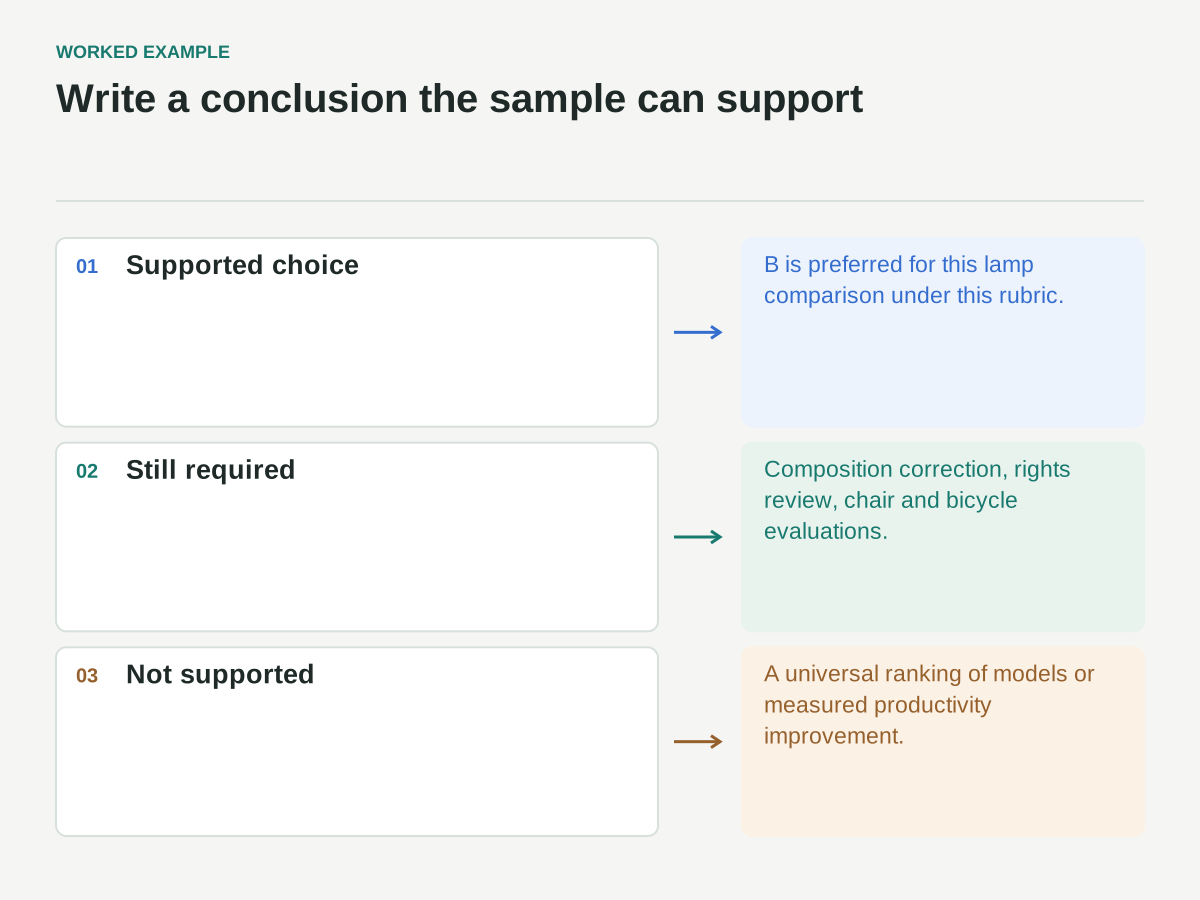
The final note should name the task, sample, rubric version, selected workflow, unresolved gates, and next check. A useful conclusion is: candidate B is preferred for this lamp comparison because its structure and editing handoff fit the brief; composition corrections and rights review remain required, and the chair and bicycle still need their own evaluations.
An unsupported conclusion is: this system is the best AI image model. Your examples do not establish performance across other styles, languages, subjects, settings, or future versions. Keep the evaluation attached to the production problem it actually examined.
Save the rejected candidates and concise reasons while retention and permissions allow. They are useful when someone asks why a visually impressive option was not chosen. Do not preserve unnecessary sensitive inputs merely for the sake of a complete archive.
Rubric checklist
Before comparing outputs, confirm that the decision is explicit, the inputs are fixed, the gates are separate from scores, and each score has an observable anchor. Confirm that weights were chosen before selection and that presentation conditions are comparable.
Before adopting the result, inspect disagreements, verify correction work where it matters, and write down the sample’s limits. Repeat the relevant checks when the brief, tool, settings, or delivery requirements change. The most useful rubric is one that helps a collaborator understand the choice and reproduce the reasoning without pretending the numbers settle every creative question.